
Why AI Automation Projects Get Stuck at the Pilot Stage...
Categories
Tags
- : Technical Support Outsourcing India
- application maintenance and support services India
- hire technical support experts from India
- IT helpdesk outsourcing India
- IT infrastructure support India
- IT management support services
- IT support and maintenance services India
- managed IT support services India
- software enhancement and support services India
- tech support companies in India
- technology support solutions

The IT Support Gap That Grows With the India Team
A US SaaS company with a 65-person engineering team in Bengaluru has been routing IT issues to their San Francisco helpdesk for three years. Average ticket resolution time: 19 hours. The primary cause is not capability. It is time zones. By the time the San Francisco team opens, the Bengaluru engineer who raised the ticket at 9 AM IST has already lost half a working day waiting.
A UK fintech whose India GCC grew from 18 to 95 people in 24 months had one IT person who handled everything from device setup to network troubleshooting. When he resigned, there was no knowledge base, no asset register, no vendor contact list, and no one to provision the four new hires starting the following Monday.
These are not edge cases. They are the standard trajectory for foreign companies whose India teams outgrow their informal IT support arrangements. Technical support outsourcing India is the structured solution: professional IT support sourced locally, operating within SLAs, and managed at a cost that a dedicated India hire or an onshore helpdesk extension cannot match.
This guide covers what technical support outsourcing in India actually includes, what it costs by support tier and model type, how to hire the right people or partner, and what SLA standards to insist on before signing anything.
What Technical Support Outsourcing in India Actually Covers
Technical support outsourcing in India covers the full IT support lifecycle for an organisation’s India-based users: first-line helpdesk (L1), infrastructure and application support (L2/L3), endpoint and device management, NOC monitoring, and on-site troubleshooting. It is distinct from software development outsourcing, IT staff augmentation, and general managed services.
Technical support outsourcing is not:
- Software development or product engineering (building new systems)
- IT staff augmentation (placing individual IT engineers into a client team)
- General managed services for cloud infrastructure or DevOps
- One-time IT setup or office infrastructure installation
Technical support outsourcing is the ongoing operational function that keeps an organisation’s IT environment running for its users. It covers five core scope areas:
Helpdesk operations: Ticket intake, triage, first-line resolution, user communication, and escalation management. This is the primary L1 function and is typically the highest-volume, lowest-complexity part of the support scope.
Endpoint management: Device provisioning, patch management, antivirus and endpoint security, hardware asset tracking, and device retirement. For India teams of 30 to 200 people, this alone justifies outsourcing.
Network and connectivity support: ISP management, VPN troubleshooting, Wi-Fi access point management, and connectivity incident response. Particularly relevant for India offices where ISP reliability varies and dual-provider management is standard practice.
Application support: Troubleshooting and minor fixes for business applications, ERP systems, productivity suites, and internal tools. Distinct from software development but overlapping with application maintenance services.
On-site support: Physical presence for hardware replacement, cabling, device swap, and issues that cannot be resolved remotely. This is where India-based providers with actual offices in Bengaluru or Gurugram have a structural advantage over remote-only support arrangements.
For companies evaluating the full scope of what professional IT support in India should include, the best IT support services in India guide covers the complete service model and evaluation criteria.
What Are the Most Popular IT Helpdesk Outsourcing Options and Typical Pricing in India
The three most popular IT helpdesk outsourcing models in India are the managed services provider model (shared support pool, $12 to $40 per user per month depending on tier and engagement size), the dedicated team model (exclusively assigned engineers, $40 to $70 per user per month for full-stack L1 to L3), and the hybrid model (dedicated lead with shared pool backup, $22 to $50 per user per month). Per-ticket pricing ranges from $5 to $12 for L1 at mid-market scale and $20 to $50 for L3.
Managed Services Provider Model
The managed services provider (MSP) model means engaging a vendor who owns the team, the tooling, and the SLA accountability. The client pays a monthly fee per user or per ticket and receives IT support against a defined scope and SLA. The vendor’s team typically serves multiple client organisations simultaneously from a shared support pool.
This model suits companies that want zero operational ownership of the IT support function, have a clearly defined support scope, and do not need exclusive resource availability at all times.
Typical pricing: $12 to $22 per user per month for L1-only coverage at mid-market scale (20 to 150 users). $22 to $40 per user per month for L1 and L2 combined. Full-stack L1/L2/L3 from $40 to $70 per user per month. The lower end of any published market range (around $8 to $10 per user for L1) reflects high-volume enterprise engagements of 500 or more users with large Indian IT service firms and is not accessible to companies in the 20 to 150 user range.
Dedicated Team Model
The dedicated team model means the client has an exclusively assigned group of IT support engineers who work only on their environment. This can be structured through a managed services provider who fields a ring-fenced team, or through a staffing or EOR arrangement where the client directly employs or manages India-based IT support engineers.
This model suits companies above 50 users, companies with complex or sensitive IT environments, and companies whose IT Director wants direct management visibility into the support team.
Typical pricing: $40 to $70 per user per month for a full-stack dedicated team at mid-market scale. A dedicated team of 3 to 5 engineers for a 50 to 100 user India office typically runs $6,000 to $15,000 per month fully loaded, depending on city, seniority mix, and whether the provider includes tooling in the fee.
Hybrid Model
The hybrid model combines a dedicated engagement manager or senior support engineer (who owns the client relationship and the knowledge base) with a shared support pool handling ticket volume. This preserves institutional knowledge while managing cost.
Typical pricing: $22 to $50 per user per month depending on the dedicated-to-shared ratio and tier coverage.
L1, L2, and L3 IT Support Tiers Explained: What Each Covers in an India Outsourcing Context
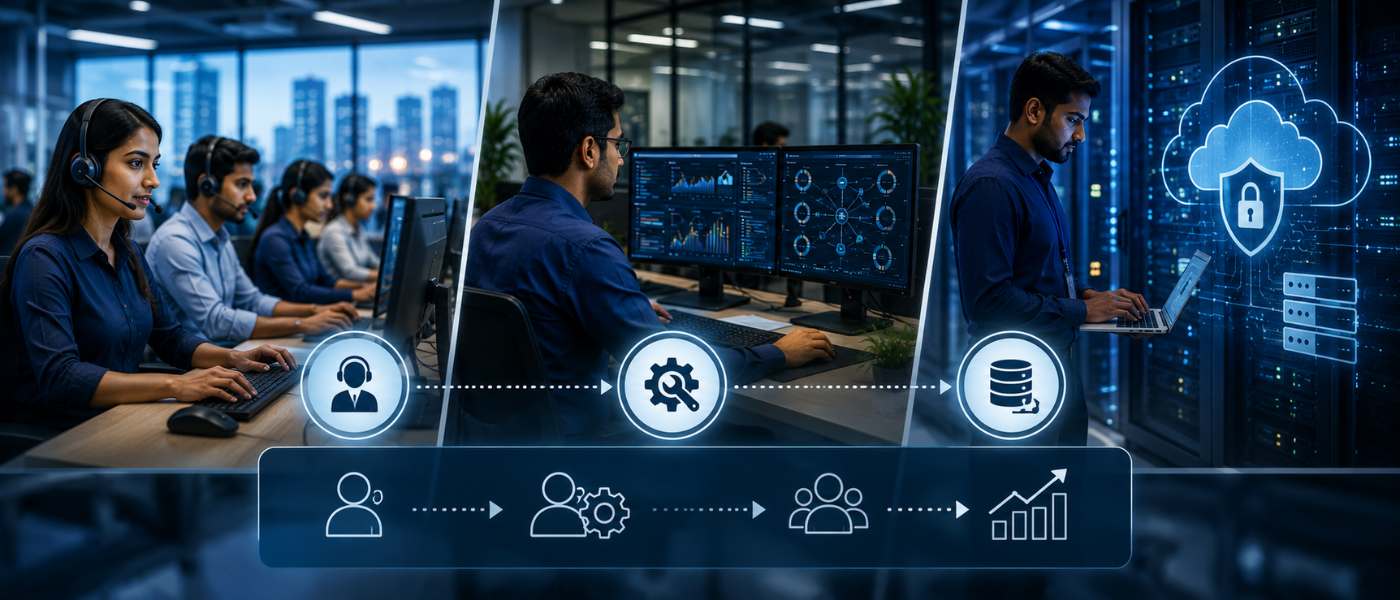
L1 IT support covers first-line helpdesk and basic user issues. L2 covers network, application, and infrastructure troubleshooting requiring technical expertise. L3 covers server management, security incidents, cloud infrastructure, and code-level application support. The ITIL 4 framework defines these tiers by incident complexity and the escalation path between them.
L1: First-Line Helpdesk Support
Scope: Password resets, account unlocks, basic connectivity troubleshooting, device setup guidance, software installation queries, user onboarding support, printer and peripheral issues, ticket logging and triage, and initial triage for all incoming requests.
What L1 does not cover: Network infrastructure issues, application-level errors, server problems, VPN configuration, security incidents.
Staffing ratio: Typically 1 L1 engineer per 50 to 80 users for an India office with standard complexity.
SLA benchmark: First response within 15 minutes, mean time to resolution under 4 hours for standard incidents.
Appropriate for: Every India office regardless of size. L1 is the baseline support tier and is always present.
L2: Infrastructure and Application Support
Scope: Network troubleshooting (LAN, WAN, Wi-Fi), VPN setup and connectivity issues, software installation and configuration, escalated hardware diagnosis, application-level support (ERP, CRM, productivity suites), patch management oversight, antivirus management, and escalations from L1 that require hands-on technical resolution.
What L2 does not cover: Server infrastructure management, security incident response, cloud environment troubleshooting, code-level application issues.
Staffing ratio: Typically 1 L2 engineer per 100 to 150 users, often combined with L1 coverage in a blended role for smaller teams.
SLA benchmark: First response within 1 hour, mean time to resolution under 8 hours.
Appropriate for: India offices above 30 users, particularly those with network infrastructure or multi-application environments.
L3: Infrastructure and Specialist Support
Scope: Server management (on-premise and cloud), security incident response, cloud environment troubleshooting (AWS, Azure, GCP), application maintenance at a code or configuration level, database performance issues, infrastructure architecture changes, and complex escalations from L2 that require specialist intervention.
What L3 does not cover: New software development, major infrastructure projects, or strategic IT planning (these fall outside support scope into professional services).
Staffing ratio: Typically 1 L3 engineer per 200 to 300 users, or shared across multiple client environments in a managed services model.
SLA benchmark: First response within 4 hours, mean time to resolution under 24 hours. P1 critical incidents should carry a shorter MTTR commitment of 4 to 8 hours.
Appropriate for: India GCCs and ODCs above 75 users, companies with on-premise server infrastructure, and any organisation where IT downtime has direct revenue or delivery impact.
Technical Support Outsourcing India Pricing: Real Numbers by Tier, Model, and City
Technical support outsourcing in India costs $12 to $22 per user per month for L1-only managed services at mid-market scale, $22 to $40 for L1/L2 combined, and $40 to $70 for full-stack L1/L2/L3. A dedicated team of 3 to 5 engineers for a 50 to 100 user office typically runs $6,000 to $15,000 per month. Bengaluru and Hyderabad run 5 to 10 percent above NCR for equivalent senior roles.
Important pricing context: All per-user ranges below reflect mid-market engagements of 20 to 150 users, which is the typical profile for a foreign company’s India GCC or ODC. Published market ranges from vendor directories often cite lower floors ($8 to $10 per user for L1) that apply only to enterprise-volume engagements of 500 or more users with large Indian IT service firms. Companies in the 20 to 150 user range should plan against the mid to upper portion of the ranges below.
Pricing Comparison Table
Support Model | Per-User/Month Range | Per-Ticket Range | Min. Size | SLA Standard | Best Suited For |
Shared pool (L1 only) | $12–$22 | $5–$12 | 20 users | First response 15 min | Small India offices, basic helpdesk |
Shared pool (L1+L2) | $22–$40 | $10–$22 | 30 users | First response 15–60 min | 30–80 user offices, mixed needs |
Dedicated team (L1+L2) | $30–$50 | $12–$28 | 40 users | First response 15 min | 50–150 users, complex environment |
Dedicated team (full-stack L1–L3) | $40–$70 | $22–$50+ | 50 users | First response 15 min/P1 4hr | GCCs, ODCs, 75+ users |
Hybrid (dedicated lead + shared pool) | $22–$50 | $10–$30 | 30 users | First response 30 min | 50–150 users, cost-conscious |
Per-ticket only (L1) | N/A | $5–$12 | No minimum | Best-effort or SLA variable | Low-volume, episodic support |
City-Level Cost Variation
Bengaluru and Hyderabad: India’s primary IT support hubs with the deepest talent pools for certified IT support engineers. NASSCOM data shows Bengaluru and Hyderabad as the top two cities for IT-BPM delivery by both headcount and export revenue. Pricing runs 5 to 10 percent higher than NCR equivalents for senior L2 and L3 roles due to competitive compensation benchmarks, driven in part by GCC expansion pulling talent from the managed services market.
NCR (Gurugram, Noida, Delhi): Strong talent availability, particularly for L1 and L2 helpdesk. Lower commercial real estate costs than Bengaluru, which translates into marginally lower overheads for managed services providers. Salary benchmarks for equivalent L2 and L3 roles run 10 to 15 percent below Bengaluru, making NCR the better cost option for companies whose support scope does not require Bengaluru’s deep specialist talent.
Pune: Competitive for L1 and L2 coverage with lower salary benchmarks than Bengaluru and growing infrastructure support talent. Best for companies whose primary India presence is already in Pune.
Hidden Costs to Plan For
Onboarding and knowledge transfer: A managed services provider needs 4 to 8 weeks to build an environment knowledge base. During this period, resolution times run longer than the contracted SLA. Some providers charge a one-time onboarding fee of $1,500 to $5,000. Others absorb it. Confirm which applies before signing.
ITSM tooling: If the provider uses their own platform (ServiceNow, Freshservice, Jira Service Management), the licence cost is typically included. If you require integration with your existing ITSM tool, confirm whether the integration is in scope or billed separately.
DPDPA 2023 compliance setup: India’s Digital Personal Data Protection Act creates data handling obligations for IT support teams processing employee personal data through helpdesk systems. Providers who have not addressed DPDPA compliance in their data processing agreements may require additional contractual and legal review time before the engagement can go live. Budget for this in your project timeline.
Hardware procurement overhead: On-site support in India often involves the provider coordinating hardware procurement. Mark-up on hardware (laptops, peripherals, networking equipment) is standard practice and should be disclosed and capped in the contract.
Not sure which pricing model applies to your India team size and support scope? iValuePlus will scope your specific requirements and provide a pricing estimate within five business days.
How to Hire Technical Support Experts from India
Hiring technical support experts from India follows three models: engaging a managed services provider (vendor owns the team and SLA), building a dedicated staffed team through an India EOR or staffing partner (you manage the team directly), or a hybrid arrangement combining both. The right model depends on your user count, IT environment complexity, and how much management oversight you want to retain.
Model 1: Managed Services Provider Engagement
The client engages a vendor who provides IT support as a service. The vendor recruits, trains, manages, and retains the support team. The client pays a monthly fee and holds the vendor to the SLA. The client does not manage individual engineers.
Best for: Companies above 20 users who want zero internal IT management overhead for the India support function. Also appropriate for first-time India offices where the client has no existing IT management presence in the country.
Hiring timeline: 2 to 4 weeks from contract signature to live support. Onboarding and knowledge base build runs a further 4 to 8 weeks before SLA performance stabilises at contracted levels.
What the vendor owns: Team recruitment, compensation, training, tooling, compliance, and escalation management.
What the client owns: Scope definition, SLA governance, and escalation approval for major incidents.
Model 2: Dedicated Staffed Team
The client hires India-based IT support engineers directly through an India EOR partner or staffing firm. The engineers are effectively the client’s own team in India, managed by the client’s IT Director or a designated India-side team lead.
Best for: Companies above 50 users with an existing IT manager who can supervise the India team. Also appropriate for companies with sensitive IT environments where direct control over team composition matters.
Hiring timeline: 4 to 8 weeks to source, screen, and onboard the first hire. A team of 3 to 5 engineers typically takes 8 to 12 weeks to fully assemble.
Typical team composition for 50 to 100 users:
- 1 IT Support Team Lead (L2/L3 capable, manages the India team day-to-day)
- 2 L1/L2 Support Engineers
- 1 L2 Network Support Engineer (if network infrastructure is in scope)
India market salaries for IT support roles (2026 benchmarks, Bengaluru/Hyderabad):
Role | Annual Salary Range (INR) | Notes |
L1 Helpdesk Engineer | INR 4–6.5 lakh | NCR runs approximately 10–15% lower |
L2 Network Support Engineer | INR 7–12 lakh | Wide range reflects stack specialisation |
L3 Infrastructure Engineer | INR 12–20 lakh | Higher end for cloud/security specialists |
IT Support Team Lead | INR 14–22 lakh | ITIL-certified leads command upper range |
Note: Bengaluru and Hyderabad benchmarks. NCR (Gurugram/Noida) runs 10 to 15 percent lower for equivalent roles. Niche stack specialists (AWS architects, Salesforce administrators, SAP basis) sit above the L3 range at INR 20 to 30 lakh and above.
What to look for in direct IT support hires:
- ITIL Foundation certification (minimum for team lead, desirable for L2 and above)
- Specific stack experience matching the client’s environment (Windows or macOS, Office 365, cloud platform)
- English communication standard appropriate for direct interaction with onshore IT management
- Shift flexibility for time zone coverage requirements
From direct experience scoping IT support teams for foreign companies in Bengaluru and Gurugram: the most consistent failure mode in the dedicated staffed team model is hiring individual engineers before hiring the team lead. Without a senior India-based lead who owns the knowledge base and the vendor relationships, individual L1 and L2 engineers operate without institutional context, and every escalation routes back to the onshore IT Director who was trying to reduce their management load in the first place. The team lead is the first hire, not the last.
For companies building a dedicated India IT support team from scratch, the India operations setup checklist for global companies covers the operational and compliance prerequisites that must be in place before the first hire joins.
Model 3: Hybrid Engagement
A managed services provider supplies L1 and L2 ticket volume coverage from a shared pool. The client’s own senior engineer (hired directly or through staffing) handles L3 escalations and owns the client relationship with the MSP.
Best for: Companies between 50 and 150 users who need breadth of coverage (L1 volume handled efficiently) combined with depth of technical knowledge (L3 owned internally). Provides cost efficiency against a fully dedicated team while avoiding complete dependency on a single-vendor MSP for all tiers.
Hiring timeline: MSP engagement sets up in 2 to 4 weeks. Internal L3 hire takes 6 to 10 weeks. Full model operational in 10 to 14 weeks.
SLA Benchmarks for Technical Support Outsourcing in India
Standard SLA benchmarks for IT support outsourcing in India are: L1 first response within 15 minutes and MTTR under 4 hours; L2 first response within 1 hour and MTTR under 8 hours; L3 first response within 4 hours and MTTR under 24 hours. First call resolution rate should be 70 to 80 percent minimum for L1. Any SLA without a penalty clause for breach is a target, not a commitment.
The HDI Technical Support Practices and Salary Report benchmarks FCR rates between 70 and 75 percent as the industry standard for well-run L1 helpdesks. Providers claiming 90 percent FCR without demonstrating how they measure it (per ticket raised, per unique incident, or per user session) are using a definition that inflates the metric. Ask for the measurement methodology before accepting any FCR claim.
SLA Benchmark Reference Table
Support Tier | First Response | FCR Benchmark | MTTR Benchmark | Availability | Penalty Trigger |
L1 | 15 minutes | 70–80% | 4 hours | 99.5% during agreed hours | Breach on more than 5% of monthly tickets |
L2 | 1 hour | 65–75% | 8 hours | 99.5% during agreed hours | Breach on more than 3% of monthly tickets |
L3 / P1 Critical | 4 hours (P1: 1 hour) | N/A (escalated) | 24 hours (P1: 4–8 hours) | 99.9% for critical systems | Any P1 breach beyond MTTR |
Network uptime | N/A | N/A | Per incident | 99.5% monthly minimum | Any breach below threshold |
What Happens When SLAs Are Missed
A well-structured SLA agreement includes a credit mechanism, typically 5 to 15 percent of the monthly fee for each defined tier of breach, applied as a credit against the following month’s invoice. The credit percentage should scale with severity: a single minor breach triggers a small credit, a pattern of breaches triggers a larger credit and an escalation review.
The escalation path when SLAs are consistently missed should be defined in the contract: who within the vendor organisation is notified at what breach threshold, what the remediation plan process looks like, and what the client’s exit rights are if performance does not recover within a defined review period.
Red Flags in SLA Proposals
Aspirational targets with no penalty clause: An SLA without a financial or credit consequence for breach is a target, not a commitment. Insist on a penalty structure before signing any engagement.
SLAs that apply only during business hours with no after-hours definition: If your India team works shifts or your global users need coverage outside IST business hours (9 AM to 6 PM), confirm explicitly whether the SLA applies around the clock or only during standard hours. Many standard proposals default to business hours only without disclosing it prominently.
Resolution time measured from “engineer assignment” rather than “ticket raised”: This is the most common SLA definition issue in vendor proposals. A 4-hour MTTR measured from engineer assignment rather than ticket creation can hide 2 to 3 hours of queue time before the clock starts. Insist on MTTR measured from the moment the ticket is raised in the ITSM system.
No escalation path definition: Every SLA should define what happens when an incident exceeds the MTTR threshold: who is notified, what the secondary response process is, and at what point the client’s own team is engaged for a P1 or P2 incident.

Application Maintenance and Support Services in India: Scope and Pricing
Application maintenance and support services in India cover bug fixing, performance monitoring, patch application, minor enhancements, database maintenance, and API integration support for existing applications. Pricing runs $15 to $25 per hour for L1/L2 application support and $25 to $40 per hour for code-level L3 support, with niche stack specialists (Salesforce, SAP, proprietary platforms) reaching $45 to $60 per hour. Fixed monthly retainers are available for defined incident volumes.
Application maintenance and support is the function that keeps existing software running reliably after development is complete. For foreign companies with India teams using bespoke internal applications, ERP customisations, or proprietary business tools, this is a distinct outsourcing requirement from general helpdesk support.
What application maintenance and support covers:
- Bug identification and resolution across production environments
- Performance monitoring (response time, error rate, availability) with alert configuration
- Patch application for third-party components, libraries, and frameworks
- Minor enhancements that do not require full development cycles (configuration changes, report modifications, UI adjustments within existing architecture)
- Database maintenance: index optimisation, backup verification, query performance tuning
- API integration support: monitoring and fixing integration points between systems
- Release management for minor updates and hotfixes
What it does not cover:
- New feature development (this is a software development engagement, not maintenance)
- Major architecture changes or platform migrations
- Regulatory compliance changes requiring design work
Pricing structure for 2026:
Hourly model: $15 to $25 per hour for L1/L2 application support (monitoring, minor fixes, configuration). $25 to $40 per hour for L3 application support (code-level fixes, database administration, complex integrations). Niche stack specialists including Salesforce developers, SAP basis administrators, and proprietary platform experts run $45 to $60 per hour for India-based resources billed to international clients. Minimum monthly retainer typically 20 to 40 hours.
Fixed-scope monthly retainer: A defined number of incidents per priority level handled per month. Typical structure: 5 P1 incidents, 15 P2 incidents, 30 P3 incidents and minor enhancements per month at a fixed monthly fee agreed at engagement start.
Application maintenance SLA benchmarks:
- P1 critical bug (system down or data loss risk): response within 1 hour, fix or workaround within 4 hours
- P2 major bug (significant functionality impaired): response within 4 hours, fix within 24 hours
- P3 minor bug or minor enhancement: response within 8 hours, resolution within 5 business days
For companies evaluating whether their current IT arrangements are creating application performance bottlenecks, the how to identify IT bottlenecks in your organization guide provides a structured diagnostic framework.
How to Choose a Technical Support Outsourcing Company in India
Evaluate technical support outsourcing companies in India across six criteria: ITIL framework compliance and team lead certification, penalty-backed SLA structure with MTTR measured from ticket raised, DPDPA 2023-compliant data processing agreements, on-site support capability in your India office city, open-book pricing for dedicated team models, and verified reference clients at comparable user count and sector complexity.
Evaluation Framework
Criterion 1: ITIL compliance and team certifications.
The ITIL 4 framework defines incident management, service request fulfilment, and change management standards. A provider whose team lead is not ITIL Foundation certified is operating without a documented process framework. Request team certifications at proposal stage, not after shortlisting.
Criterion 2: Penalty-backed SLA structure.
A credible provider will agree to service credits, typically 5 to 15 percent of the monthly fee, for defined breach thresholds. An SLA without a financial consequence for breach is a marketing document.
Criterion 3: DPDPA 2023 data processing compliance.
Under India’s Digital Personal Data Protection Act 2023, IT support teams processing employee personal data through helpdesk systems are data processors with defined obligations. The vendor must provide a Data Processing Agreement (DPA) specifying how personal data is handled, retained, and protected. Providers who cannot produce a DPA or are unfamiliar with DPDPA obligations present a compliance risk.
Criterion 4: On-site support capability in your city.
Remote-only IT support cannot handle hardware replacements, physical network issues, or on-site security incidents. Confirm the provider has staff physically present in your India office city, not just remote support delivered from another location.
Criterion 5: Open-book cost structure for dedicated team models.
In a dedicated team model, the client should receive a monthly cost statement showing each engineer’s salary cost and the provider’s management margin as separate disclosed line items. Resistance to open-book pricing in a dedicated model is a signal that the margin structure would not survive client scrutiny.
Criterion 6: Reference clients at comparable scale.
Request two to three reference clients with India team sizes within 50 percent of your own user count, in a comparable sector or IT complexity profile. Ask those references specifically about SLA performance in months 3 to 6 of the engagement, not the initial honeymoon period.
Questions to Ask Before Signing
- How is MTTR measured: from ticket raised or from engineer assignment?
- What is the penalty structure for SLA breach and how are service credits applied?
- Who owns the knowledge base if we terminate the engagement?
- How are DPDPA 2023 data handling obligations addressed in your standard contract?
- What is your on-site response capability in our India office city and what is the response time for a physical visit?
- Can you provide open-book cost breakdown for a dedicated team engagement?
Red Flags
A shared pool model with no minimum resource guarantee, no ITIL-certified team lead, and a contract where the knowledge base belongs to the vendor rather than the client are disqualifying conditions for any professional outsourcing engagement. Additionally, any provider that cannot answer the DPDPA question with a prepared DPA should not be handling employee personal data through their helpdesk systems.
iValuePlus Technical Support Services in India
iValuePlus provides technical support outsourcing for foreign companies in India from on-ground offices in Gurugram, covering L1/L2/L3 helpdesk, endpoint management, ISP and network management, DPDPA 2023-compliant data handling, and hardware procurement coordination for offices of 15 to 200 or more users.
The iValuePlus IT support model addresses the India-specific operational challenges that generic managed services providers often do not cover as standard.
Hardware procurement and asset management: Coordinating laptop and peripheral procurement in Indian cities, managing the asset register, and handling device retirement and data wipe under a documented procedure. Hardware sourcing lead times in India vary by location and vendor, and managing this without an on-ground presence creates delays that affect new hire onboarding timelines directly.
ISP escalation management: India ISP service quality varies by city, building, and provider. Effective ISP management requires direct relationships with enterprise ISP account teams, documented escalation contacts, and incident logs that support SLA compensation claims. iValuePlus manages this as part of standard IT support scope for clients in
DPDPA 2023-compliant data handling: All IT support ticket data containing personal information is handled under a documented data processing framework aligned with DPDPA 2023 obligations. Clients receive a Data Processing Agreement as part of the standard engagement contract.
Endpoint security management for foreign company compliance requirements: Many US and UK parent companies require India offices to meet specific endpoint security standards, including CrowdStrike deployment, Intune enrolment, and BitLocker enforcement. iValuePlus manages endpoint security configuration and compliance reporting as part of the L2 and L3 support scope.
The iValuePlus model is designed for IT Directors and COOs managing India offices from the US, UK, or Australia who need on-ground IT support with direct accountability, not a generic shared-pool arrangement where no single engineer owns their environment.
For an overview of the complete IT support services model, including scope, coverage, and engagement options, the service page covers the full delivery structure.
Common Mistakes When Outsourcing Technical Support to India
The most consequential mistakes are choosing a provider based on price per ticket without verifying the SLA penalty structure, signing a contract where the knowledge base belongs to the vendor, not specifying on-site versus remote support scope, and failing to address DPDPA 2023 data handling obligations before the engagement goes live.
Mistake 1: Prioritising lowest per-ticket price without evaluating SLA depth.
A $5 per ticket rate is attractive until the first month of performance data shows 35 percent of tickets breaching MTTR with no penalty consequence. Price and SLA standard must be evaluated together, not separately.
Mistake 2: Not specifying knowledge base ownership in the contract.
The knowledge base built during an IT support engagement (environment documentation, known issue resolutions, vendor contacts, asset register) is the most valuable operational asset the provider creates. If the contract does not assign this to the client, it defaults to the vendor, and transition to a new provider starts from scratch.
Mistake 3: Leaving on-site versus remote scope undefined.
IT support in a proposal can mean remote-only support. If your India office needs physical attendance for hardware issues, this must be explicitly scoped and priced. Assuming it is included and discovering it is not happens at the worst possible moment.
Mistake 4: Not running a knowledge transfer period before going live.
Deploying a managed services provider without a structured 4 to 8 week knowledge transfer period produces low first-call resolution rates and frustrated users for the first quarter. Build the knowledge transfer period into the project timeline and the contract before signing.
Mistake 5: Ignoring shift coverage requirements.
If your India team works outside standard IST business hours, or if your US or UK-based team needs to raise tickets during their morning, confirm exactly what hours the SLA applies to and whether a shift premium applies to after-hours coverage.
Mistake 6: Underestimating the DPDPA compliance requirement.
In 2026, DPDPA enforcement is active. An IT support provider processing employee personal data through a helpdesk system without a compliant DPA is a liability for the client company, not the provider. Do not treat this as a legal technicality to resolve later.

IT Support Outsourcing Evaluation Checklist
Before Shortlisting
- Defined the India user count and expected monthly ticket volume
- Identified which support tiers are needed: L1 only, L1/L2, or full-stack L1/L2/L3
- Determined whether on-site support in the India office city is required
- Confirmed the preferred model: managed services, dedicated team, or hybrid
- Established the budget range using the pricing table in this guide as the reference
During Proposal Review
- Confirmed the provider has ITIL Foundation certified team leadership
- Verified that the SLA includes a penalty clause for breach with defined credit percentages
- Confirmed MTTR is measured from ticket raised, not from engineer assignment
- Requested the Data Processing Agreement for DPDPA 2023 compliance review
- Confirmed knowledge base ownership at contract end
In Vendor Evaluation Meetings
- Asked for references from clients with comparable India team size (within 50 percent of your user count)
- Requested open-book cost breakdown for dedicated team models
- Confirmed on-site support capability and physical presence in the India office city
- Asked about the knowledge transfer timeline before SLA performance clock starts
- Confirmed shift coverage and after-hours SLA applicability
In Contract Review
- Knowledge base ownership assigned to client
- SLA penalty clause confirmed with credit percentage and trigger threshold
- DPDPA 2023 Data Processing Agreement in place
- On-site versus remote scope explicitly defined
- Hardware procurement mark-up disclosed and capped
- Notice period and transition support obligations defined
Conclusion
Technical support outsourcing India is not a cost-cutting exercise. For US, UK, and Australian companies managing India teams of 20 to 200 people, it is the operational infrastructure that prevents developer downtime, ensures new hire onboarding runs on time, and keeps the India IT environment secure and compliant without requiring onshore IT leadership to manage it across time zones.
The pricing ranges in this guide ($12 to $70 per user per month depending on tier, model, and engagement size), the salary benchmarks for dedicated team builds (INR 4 to 22 lakh per annum depending on seniority), and the SLA benchmarks (15-minute first response for L1, 70 to 80 percent FCR as the minimum standard) give buyers the reference points to evaluate vendor proposals without being anchored to the first number a sales team presents.
The hiring framework, managed services for zero internal overhead, dedicated staffed team for direct control, and hybrid for cost-efficiency with depth, gives buyers the structural choice before they brief any vendor.
FAQ
What are the most popular IT helpdesk outsourcing options and typical pricing in India?
The three most popular IT helpdesk outsourcing options in India are the managed services provider model ($12 to $40 per user per month depending on tier and engagement size), the dedicated team model ($40 to $70 per user per month for full-stack L1 to L3), and the hybrid model ($22 to $50 per user per month). Per-ticket pricing ranges from $5 to $12 for L1 at mid-market scale and $20 to $50 for L3. Lower per-user rates published in vendor directories (around $8 to $10 for L1) apply to enterprise-volume engagements of 500 or more users and are not accessible to companies in the 20 to 150 user range.
What is the difference between L1, L2, and L3 IT support?
L1 covers first-line helpdesk tasks including password resets, basic connectivity issues, and user onboarding support. L2 covers network troubleshooting, software configuration, and escalated hardware issues. L3 covers server management, security incident response, cloud environment troubleshooting, and code-level application support. As defined in the ITIL 4 framework, each tier escalates incidents the previous tier cannot resolve within its defined scope.
How much does technical support outsourcing in India cost?
Technical support outsourcing in India costs $12 to $22 per user per month for L1-only managed services at mid-market scale, $22 to $40 for L1/L2 combined, and $40 to $70 for full-stack L1/L2/L3. A dedicated team of 3 to 5 engineers for a 50 to 100 user India office typically runs $6,000 to $15,000 per month. Bengaluru and Hyderabad run 5 to 10 percent higher than NCR for equivalent senior roles due to competitive talent benchmarks driven by GCC expansion in both cities.
How do you hire technical support experts from India?
Hire technical support experts from India through three routes: a managed services provider engagement (vendor owns the team, fastest to deploy in 2 to 4 weeks), a dedicated staffed team through an India EOR or staffing partner (you manage directly, 8 to 12 weeks to assemble), or a hybrid arrangement. For a dedicated team, hire the team lead first. Look for ITIL Foundation certification, specific stack experience, and English communication standards appropriate for interaction with onshore IT management.
What SLAs should I expect from IT support outsourcing in India?
Standard SLA benchmarks are: L1 first response within 15 minutes with MTTR under 4 hours; L2 first response within 1 hour with MTTR under 8 hours; L3 first response within 4 hours with MTTR under 24 hours. First call resolution rate should be 70 to 80 percent minimum for L1, per HDI industry benchmarks. Any SLA proposal without a financial penalty clause for breach is a target, not an enforceable commitment. Insist on MTTR measured from ticket raised, not from engineer assignment.
What does application maintenance and support services in India include?
Application maintenance and support services in India cover bug fixing, performance monitoring, patch application, minor enhancements, database maintenance, and API integration support for existing applications. Pricing runs $15 to $25 per hour for L1/L2 application support, $25 to $40 for code-level L3 support, and $45 to $60 for niche stack specialists including Salesforce, SAP, and proprietary platform experts. A fixed monthly retainer for defined incident volumes is the most common pricing structure for ongoing engagements.
How does offshore IT helpdesk outsourcing work for foreign companies?
Foreign companies engage an India-based IT support provider or build a dedicated India support team through a staffing or EOR partner. The provider handles ticket intake, triage, resolution, and escalation for India-based users. Most tickets are resolved remotely, with on-site capability for hardware and physical infrastructure issues. India’s time zone provides a follow-the-sun advantage for US, UK, and Australian companies: India support teams handle tickets raised during Western business hours and resolve them before the client team starts the next day.
What are the red flags when choosing a technical support outsourcing company in India?
Key red flags include: SLA proposals with no financial penalty for breach; MTTR measured from engineer assignment rather than ticket raised; shared pool pricing with no minimum resource guarantee; no ITIL-certified team lead; knowledge base ownership assigned to the vendor rather than the client; and no Data Processing Agreement for DPDPA 2023 compliance. In 2026, any provider that cannot produce a DPDPA-compliant DPA should not be handling employee personal data through their helpdesk systems.
How do managed IT support services in India differ from IT staff augmentation?
Managed IT support services mean the vendor owns the team, the SLA, the tooling, and the operational accountability. The client pays a monthly fee and holds the vendor to performance standards. IT staff augmentation means the client hires India-based IT support engineers through a staffing or EOR partner and manages them directly as part of the internal IT team. Managed services suit companies that want zero operational ownership of the support function. Staff augmentation suits companies with an existing IT manager who can supervise an India-based team directly.
Recent Post
Staff Augmentation vs Full-Time Hiring: A Strategic Comparison for 2026
Compare staff augmentation vs full-time hiring across cost, speed, flexibility,...
Step-by-Step Guide to Setting Up Accounting Services in India in 2026
Learn how to start accounting services in India in 2026:...

iValuePlus Services
iValuePlus is a one-stop solution to address all your needs to access, build and grow your business in the Indian market which is cost-effective & has a huge talent pool. Established in 2019 as a ‘Business Solution provider', our team has delivered successful growth projects in the international market.
Our services include setting up ODC (offshore development center), Staff Augmentation, Talent Acquisition, Digital Marketing, in the IT/ITES domain.