

Explore Offshore vs in-house teams and compare cost, control, talent...
Categories
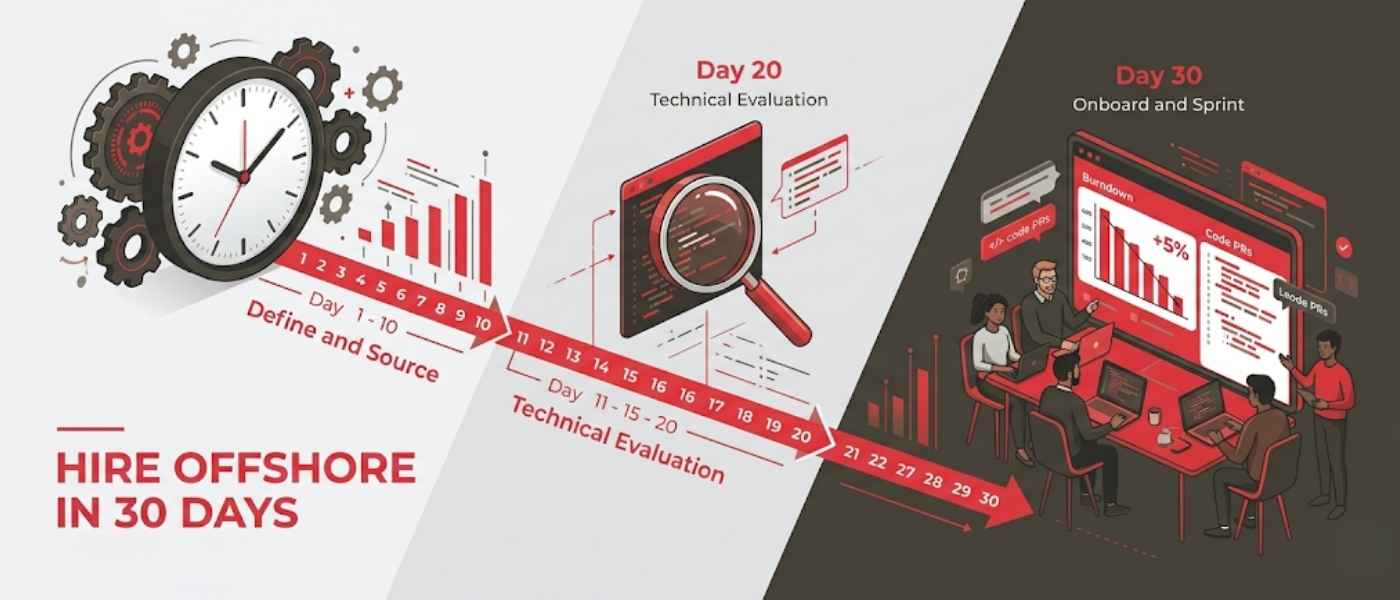
How to Hire an Offshore Development Team in 30 Days
Building a development team locally can take several months, especially when businesses need specialized technical talent quickly.
Hiring delays, rising engineering salaries, and long recruitment cycles are forcing companies to rethink how they scale technical teams. Offshore development models now allow businesses to build fully operational engineering teams faster while maintaining flexibility, delivery speed, and cost efficiency.
The good news is this: with the right hiring framework, businesses can hire and onboard an offshore development team within 30 days.
This guide provides a practical, execution focused roadmap for engineering leaders, startup founders, and enterprises looking to scale software development operations quickly through offshore hiring.
You’ll learn:
- How to reduce hiring bottlenecks
- Which offshore hiring model works best
- How to evaluate offshore vendors
- How to run a structured technical screening process
- How to onboard offshore engineers effectively
- How to achieve sprint alignment within the first month
This is not a generic outsourcing guide. It is a decision stage playbook built for businesses that need engineering capacity fast without compromising on quality
Why Offshore Hiring Usually Takes Too Long
Most offshore hiring delays happen before candidate evaluation even begins.
Businesses often contact multiple vendors without clearly defining:
- Team structure
- Technical requirements
- Hiring timelines
- Delivery expectations
- Remote collaboration models
As a result:
- Vendors send irrelevant profiles
- Technical assessments become inconsistent
- Decision-making slows down
- Product roadmaps continue slipping
The fastest offshore hiring teams follow a structured process before vendor outreach.
What You Must Define Before Contacting Vendors
Before starting your offshore hiring process, define:
Role Requirements
- Backend developers
- Frontend developers
- Full-stack engineers
- DevOps specialists
- QA automation engineers
Technical Stack
Examples:
- Node.js
- React
- Python
- Java Spring Boot
- AWS
- Kubernetes
Seniority Requirements
Decide whether you need:
- Junior developers
- Mid-level engineers
- Senior engineers
- Technical leads
Engagement Model
Choose between:
- Staff augmentation
- Dedicated offshore team
- Project outsourcing
Time Zone Expectations
Determine:
- Full overlap
- Partial overlap
- Async-first collaboration
This preparation dramatically reduces hiring delays and improves vendor alignment.
Understanding the Hiring Models: Which One Gets You to Day 30?
Choosing the right engagement model directly impacts onboarding speed, operational flexibility, and management overhead.
Staff Augmentation
Developers work directly within your internal team structure while the offshore partner handles HR, payroll, and administration.
Best For
- Fast scaling
- Agile sprint support
- Extending engineering bandwidth
Benefits
- Faster onboarding
- Better sprint alignment
- Greater operational control
This model is commonly used by startups and SaaS companies that need rapid development expansion.
Companies evaluating flexible scaling models can explore Offshore Development Team for Startups to understand how startup-focused offshore hiring works.
Dedicated Offshore Development Team
A dedicated offshore pod typically includes:
- Developers
- QA engineers
- Tech leads
- Delivery managers
The team works exclusively on your product while the vendor manages operational support.
Best For
- Long-term product development
- Continuous delivery pipelines
- Scaling multiple engineering functions
Project-Based Outsourcing
The vendor delivers a defined scope independently.
Limitation
This model usually requires lengthy discovery and planning phases, making it unsuitable for businesses trying to build engineering capacity quickly.
Typical Hiring Delays Businesses Face
Most companies underestimate how much time traditional hiring consumes.
Here are the most common delays businesses face when building engineering teams locally:
Notice Periods
Experienced developers often have 30 to 90-day notice periods before joining a new company.
This alone can delay product delivery timelines significantly.
Sourcing Bottlenecks
Finding engineers with niche technical expertise is increasingly difficult in competitive hiring markets.
Recruiters often struggle to source qualified candidates quickly.
Interview Delays
Internal interview coordination slows hiring because engineering managers already operate under heavy sprint workloads.
Multiple interview rounds further extend hiring timelines.
Onboarding Gaps
Many businesses lack structured onboarding workflows, which delays productivity even after hiring is complete.
Without proper onboarding:
- Engineers struggle to understand systems
- Sprint alignment takes longer
- Collaboration efficiency drops
This is why businesses increasingly adopt offshore hiring strategies with pre vetted engineering talent and established onboarding workflows.
The 30-Day Offshore Hiring Framework
This framework assumes you’ve completed the pre-work (role definition, model selection) before Day 1.
Week 1 (Days 1–5): Define and Source
Day 1–2: Write your technical requirements document (TRD)
This is a 1–2 page document, not a job description. It should cover:
- Stack requirements (language, frameworks, infrastructure tools)
- Seniority level and expected outputs (what does “senior” mean to your team?)
- Code quality expectations (test coverage, PR review standards, documentation)
- Communication requirements (async vs. sync, written English proficiency level)
- Access and security constraints (do engineers need to pass background checks? Sign NDAs on Day 1?)
Treat this document as your hiring filter. Every vendor should receive it in your first email.
Day 3–4: Identify and contact 5–7 vendors
Don’t contact 20 vendors. You’ll drown in follow-up. Identify 5–7 credible vendors using the following channels:
- Clutch — filter by service focus (custom software development, staff augmentation), region, and review count (target >25 verified reviews)
- LinkedIn — search for “offshore software development” + region; check company size, client testimonials
- Referrals from your network — if a trusted CTO in your network has used a vendor, that’s worth two Clutch reviews
- Domain-specific communities — Slack groups like CTO Craft, Rands Leadership, or Software Engineering Daily often have active referral threads
Send each vendor your TRD and ask for: team profiles, 2 client references, and a proposed engagement structure (not a proposal — just a structure).
Day 5: Filter to a shortlist of 3
Based on vendor responses, cut the list to 3. Criteria for cutting:
- Vendor didn’t read your TRD and sent a generic deck
- No verifiable references from companies similar to yours in size or industry
- Engineers presented don’t match your stated stack
- Suspiciously low rates without explanation (under-market rates often mean high turnover, junior talent presented as senior, or bait-and-switch after signing)
Week 2 (Days 6–14): Technical Evaluation
This is the phase most companies rush — and where most offshore hiring failures originate.
Day 6–8: Async technical assessment
Do not skip this. A well-designed async assessment filters out 40–60% of candidates who passed the resume screen.
Send each candidate (or 2–3 candidates per vendor) a structured async task:
- For backend engineers: a real-world problem your team encountered — not a LeetCode puzzle. Ask them to write a short solution, document their approach, and flag what they’d do differently with more time.
- For frontend engineers: a UI component challenge relevant to your stack, evaluated on readability, performance awareness, and edge case handling.
- For full-stack/tech leads: an architecture brief. Give them a feature your team is building and ask them to propose a high-level technical design with trade-off notes.
Target 2–3 hours of effort per assessment. Compensate senior candidates for their time if asking for >2 hours.
Day 9–11: Live technical interviews
Run a 60-minute session for candidates who passed the async filter. Structure it as:
- 15 min: Background and current project context (not a verbal resume review — ask about decisions made, constraints, mistakes)
- 25 min: Technical discussion (architecture question, debugging exercise, or code review of something they wrote)
- 20 min: Process and collaboration questions (how do they handle disagreement with a product manager? How do they raise a technical debt issue?)
Have two people from your team in this interview — your engineering lead and ideally one senior engineer. The second voice catches things one interviewer misses.
Day 12–14: Reference checks
Call (don’t email) two references per final candidate. Ask:
- What was their strongest technical contribution on your project?
- How did they communicate blockers or escalate issues?
- Would you hire them again without hesitation? (Pause and wait for the answer — silence is data.)
- What would they need to succeed in a new team context?
What should you check before hiring an offshore software team?
Before hiring an offshore software team, verify: (1) technical skills via an async assessment relevant to your stack, not a generic coding test; (2) communication quality in written and spoken English across at least two interactions; (3) references from clients in similar industries or with similar team structures; (4) the vendor’s staff retention rate — high churn means your engineers will rotate out; (5) the vendor’s contract terms around IP ownership, confidentiality, and engineer replacement timelines.
Week 3 (Days 15–21): Select, Contract, and Pre-Onboard
Day 15–16: Make your selection
With evaluation data in hand, select your vendor and the specific engineers. Don’t let the vendor substitute candidates at this stage without restarting the technical evaluation — this is a common point of bait-and-switch.
Day 17–19: Contract negotiation
Your offshore agreement should include:
- IP ownership
- NDA clauses
- Security compliance
- Replacement SLAs
- Rate protection
- Termination terms
Businesses comparing hiring models often benefit from understanding the cost differences between local and offshore teams. This guide on In-House vs Outsourced Development Cost Comparison provides useful decision stage insights.
Day 20–21: Pre-onboarding setup
Before the engineers’ official start date:
- Provision all access (GitHub, Jira/Linear, Slack, staging environments)
- Set up a short async “team context” document: current architecture overview, coding standards, sprint cadence, definition of done
- Schedule introductory calls with your tech lead and each new engineer
- Assign a single point of contact on your side (ideally your engineering lead, not a project manager)
Week 4 (Days 22–30): Structured Onboarding Sprint
Day 22–24: Orientation and codebase familiarization
New offshore engineers should not be thrown into a sprint backlog on Day 1. Run a structured 3-day orientation:
- Codebase walkthrough (recorded is fine, but have a live Q&A session)
- Architecture overview with your tech lead
- Code style and review standards walkthrough
- First small task: fix a known low-priority bug or write a unit test for an existing function — this gives them a safe, low-stakes way to commit code and get feedback on their process
Day 25–27: First sprint involvement (shadowed)
Include new engineers in a sprint planning session, but pair them with an internal engineer for their first two or three tickets. The pairing serves two purposes: knowledge transfer and quality assurance.
Day 28–30: Solo contribution and feedback loop
By Day 28, your offshore engineers should be picking up unassisted tickets and submitting PRs for review. On Day 30, run a brief retrospective: what’s working, what’s not, what process adjustments are needed.
This closes the 30-day loop. You now have a functional offshore team integrated into your development workflow.
Offshore Development Team vs. In-House Hiring: A Decision Framework
| Factor | Offshore Team | In-House Hiring |
|---|---|---|
| Hiring Speed | 3 to 6 weeks | 3 to 6 months |
| Cost Structure | Lower operational cost | Higher full-time overhead |
| Scalability | Flexible expansion | Slower scaling |
| Access to Global Talent | High | Limited locally |
| Onboarding Speed | Faster with vendor support | Internal dependency |
| Operational Flexibility | High | Moderate |
The most effective businesses combine:
- In house product ownership
- Offshore development scalability
This hybrid approach improves delivery continuity while controlling operational costs.

How to Choose the Right Country for Your Offshore Development Team
Geography matters more than most hiring guides admit. Here’s what to actually evaluate:
Eastern Europe (Poland, Romania, Ukraine, Czech Republic, Bulgaria)
Strengths: CS-heavy education systems, strong algorithmic fundamentals, European business culture alignment, good English proficiency, large pool of .NET, Java, Python, and React engineers.
Timezone: UTC+1 to UTC+3 (good overlap with US EST 3–4 hours of business day)
Consideration: Post-2022 geopolitical context means some clients prefer routing through Polish or Romanian vendors for engineers previously based in Ukraine, which adds a layer of vendor complexity.
South Asia (India, Pakistan, Bangladesh)
Strengths: Largest offshore developer pool globally; strong in enterprise software (Java, SAP, Salesforce), cloud, and data engineering; competitive pricing.
Timezone: UTC+5 to UTC+6 (challenging overlap with US; requires async-first workflow or extended-hour coverage)
Consideration: Quality varies dramatically across vendors. Tier 1 engineering talent in India is world-class; commodity outsourcing firms often present junior talent as senior. Vetting is non-negotiable.
Southeast Asia (Vietnam, Philippines, Indonesia)
Strengths: Fast-growing engineering ecosystems; Philippines has native English-speaking engineers and cultural alignment with US business norms; Vietnam has strong mobile and React Native talent.
Timezone: UTC+7 to UTC+8 (requires async workflow for US companies)
Consideration: Smaller talent pool for very niche skills; strong for frontend, mobile, and QA roles.
Latin America (Colombia, Mexico, Argentina, Brazil)
Strengths: US timezone overlap (key differentiator); growing full-stack and cloud talent pool; cultural alignment with US companies; nearshore pricing.
Timezone: UTC-3 to UTC-6 (near-full overlap with US business hours)
Consideration: More expensive than Asia-based teams; talent pool smaller for very specialized skills; political and currency instability in some markets affects vendor reliability.
Managing Your Offshore Development Team After Day 30
Hiring is the beginning. The companies that get lasting value from offshore teams are the ones that treat management as a practice, not a reaction to problems.
Communication Infrastructure
- Async-first, sync-when-needed: Not every question requires a meeting. Establish a norm where Slack/Teams messages are the default, with daily standup async video updates using tools like Loom or Standuply.
- Weekly syncs: A 45-minute engineering sync between your tech lead and the offshore tech lead. Not a status report — a technical discussion.
- Monthly retrospectives: What’s working? What’s creating friction? Process alignment degrades slowly; a monthly retro catches it early.
Code Quality and Velocity
- All code goes through PR review — by your engineers, not just the offshore team’s internal review. This is the single most important quality control mechanism.
- Track velocity, not just hours: If you’re paying for 8 hours/day but getting 3 story points per sprint per engineer, the problem is either scope creep, under-specification, or skill mismatch. Measure to know which.
- Run quarterly technical reviews: Ask your tech lead to present the offshore team’s contribution to overall code health: test coverage trends, bug introduction rate, architectural decisions made.
Retention
Engineer turnover is the biggest operational risk in offshore teams. Mitigate it by:
- Building a direct relationship with individual engineers, not just the vendor account manager
- Including offshore engineers in product context discussions — they should understand why they’re building a feature, not just what
- Recognizing strong contributors in team-wide communications
- Negotiating engineer-specific retention clauses with your vendor (if an engineer leaves before 6 months, a replacement is provided at no cost)
Offshore Software Development Checklist for CTOs
Use this checklist before signing any offshore team engagement:
Requirements phase:
- Technical requirements document written and reviewed internally
- Engagement model selected (staff augmentation vs. dedicated team)
- Seniority mix and team structure defined
- Timezone overlap requirements confirmed
- Budget range and duration decided
Vendor evaluation:
- Shortlist of 3–5 vendors with verified reviews and references
- Vendor has placed engineers in your tech stack before
- Vendor has disclosed actual staff retention rate (>80% is acceptable)
- You received individual engineer profiles, not team decks
Technical assessment:
- Async technical assessment completed and scored
- Live technical interview conducted with your engineering team
- Reference calls completed (at least 2 per candidate)
- Communication quality assessed across multiple async interactions
Contracting:
- IP ownership clause is explicit and comprehensive
- Individual NDAs signed by engineers
- Rate transparency and 12-month lock confirmed
- Engineer replacement SLA defined (14–21 days)
- Termination notice period is reasonable (30–60 days)
Onboarding:
- Access provisioned before Day 1
- Team context document shared 5 days before start
- 3-day structured orientation planned
- Pairing assignments for first sprint confirmed
- Day 30 retrospective scheduled
Common Mistakes When Hiring an Offshore Development Team
Mistake 1: Hiring on rate alone The difference between a $35/hr and $55/hr offshore developer is rarely a budget question — it’s a quality and retention question. Low-rate engineers often have higher turnover, require more management, and produce code that creates technical debt. The math almost always favors investing in the right rate.
Mistake 2: Skipping the async assessment Portfolio reviews tell you what a team did. An async assessment tells you how an individual engineer thinks. These are different data points. Skipping the assessment is how teams end up with engineers who look senior on paper and perform mid-level in practice.
Mistake 3: Treating offshore engineers as external vendors Engineers who feel like external contractors — given specs, asked for output, excluded from context — underperform. Engineers who are included in product discussions, have their technical opinions sought, and understand the product mission overperform. This is true onshore and offshore.
Mistake 4: Ignoring documentation Offshore teams operate in different timezones. Documentation is not bureaucracy — it is communication infrastructure. Teams with strong internal documentation (architecture decisions, API contracts, deployment runbooks) onboard offshore engineers 3x faster than teams that rely on tribal knowledge.
Mistake 5: Not defining “done” If your team and your offshore engineers don’t have the same definition of done — including code review, testing, documentation, and deployment steps — you will have misaligned expectations on every sprint. Define it in writing before the first ticket is assigned.
How iValuePlus Helps You Build an Offshore Development Team
At iValuePlus, we specialize in staff augmentation and dedicated offshore team solutions for growth-stage and enterprise technology companies. Our hiring process is built to compress your time-to-team without compressing your standards.
Here’s what we do differently:
- Pre-vetted talent pool: Engineers on our platform have cleared a 4-stage technical assessment before they’re ever presented to a client. You’re not running the first filter — we are.
- 72-hour candidate presentation: After receiving your technical requirements document, we present a shortlisted profile in 72 hours, not 2 weeks.
- Direct interview access: You interview the engineers you hire. No opaque team assignment.
- Flexible engagement models: Staff augmentation for team extension, dedicated pods for product teams, and hybrid models for companies scaling across multiple workstreams.
- IP and compliance infrastructure: Standard contracts include IP assignment, individual NDAs, and data security compliance.
- 30-day replacement guarantee: If an engineer doesn’t work out within the first 30 days, we replace them at no additional cost.
We’ve helped engineering teams across SaaS, fintech, healthcare technology, and e-commerce build offshore software development teams that deliver — not just exist.
FAQ
How long does it actually take to hire an offshore development team?
With a defined requirements document and a pre-vetted vendor, you can have a signed contract and onboarded engineers in 21–30 days. Without preparation, the same process takes 60–90 days. The 30-day timeline is achievable but requires doing the requirements work before vendor outreach.
What is the best country to hire offshore developers for a software product?
For US companies prioritizing real-time collaboration, Latin America (Colombia, Mexico, Argentina) offers the best timezone overlap. For cost-quality balance with some async tolerance, Eastern Europe (Poland, Romania, Bulgaria) is consistently strong. For large-scale staffing at lowest cost, India remains the largest market but requires rigorous vetting.
How do you ensure code quality with an offshore development team?
Code quality is maintained through process, not geography. Require all code to go through PR reviews by your internal engineers. Establish clear coding standards and a definition of done before the first sprint. Run async code assessments during hiring. Review velocity and bug introduction rate quarterly.
What is the difference between staff augmentation and a dedicated offshore team?
Staff augmentation embeds individual engineers into your existing team under your management. A dedicated team is a semi-autonomous pod with its own internal structure, typically managed partly by the vendor’s delivery manager. Staff augmentation gives you more direct control; a dedicated team gives you less management overhead.
How do you manage an offshore development team across timezones?
Establish a daily async standup (video update via Loom or text via Slack), a weekly live sync with your tech lead, and a monthly retrospective. Use written documentation as your primary communication layer. Define response time expectations for each channel. Avoid making live collaboration mandatory for async work.
What should an offshore development team contract include?
At minimum: explicit IP ownership clause, individual NDAs, engineer replacement SLA (14–21 days), fixed rates for 12 months, 30–60 day termination notice, and data security / acceptable use policy sign-off by individual engineers.
Is offshore development right for short-term projects?
Staff augmentation works well for projects as short as 3 months. Dedicated teams are better suited to 6+ month engagements due to onboarding overhead. For true short-term work (under 2 months), freelance platforms may be more efficient than going through a staffing vendor.
Recent Post
A Smart Guide to Scale Your Business Faster: BOT Model in India
Learn how the BOT Model in India helps businesses scale...
Hire Remote Offshore Developers in India: Cost, Process, and Best Practices
Hire remote offshore developers in India the smart way. Get...

iValuePlus Services
iValuePlus is a one-stop solution to address all your needs to access, build and grow your business in the Indian market which is cost-effective & has a huge talent pool. Established in 2019 as a ‘Business Solution provider', our team has delivered successful growth projects in the international market.
Our services include setting up ODC (offshore development center), Staff Augmentation, Talent Acquisition, Digital Marketing, in the IT/ITES domain.