
Why AI Automation Projects Get Stuck at the Pilot Stage...
AI Engineers and Data Scientists: The New Frontier of IT Staff Augmentation in 2026
A US fintech company had three weeks left before its AI powered credit scoring model was due to enter production testing. The senior ML engineer who built the model’s core logic accepted a competing offer at a larger platform company. Nobody else on the team understood the feature engineering decisions well enough to take the model past the finish line, and the board had already been told the launch date would hold.
This is not a rare situation. It is the default situation for companies running active AI initiatives in 2026. Permanent hiring for a senior AI or ML role currently takes three to six months in competitive markets, and most AI projects do not have three to six months of slack built into them. This is exactly the scenario in which companies choose to hire AI engineers and data scientists on contract instead of waiting for a permanent hire to clear the pipeline.
This guide is written for CTOs, founders, and product leaders who are past the “what is AI staffing” stage and need to make an operational decision this quarter. It covers what a contract AI engagement actually looks like, which roles get hired for which problems, what it costs by role and geography, how fast a contract professional can start contributing, and what separates a genuine AI staffing specialist from a generalist IT firm that added “AI” to its service list.
The State of AI Talent in 2026 and Why Permanent Hiring Is Failing
Permanent AI hiring is failing because senior AI talent supply has not kept pace with demand. AI and ML job postings rose sharply through 2025, average time to fill AI roles now runs close to three months, and most of the deepest technical talent is concentrated inside a small number of large technology companies and AI labs.
The scarcity is not evenly spread. AI, ML, and data science job postings totaled 49,200 in 2025, an increase of 163 percent from the prior year, and AI and ML roles now take an average of 89 days to fill, the longest of any technology category. That is close to three months before a candidate even starts, and it assumes the search produces a qualified candidate at all.
Global demand for AI talent now exceeds supply by a ratio of roughly 3.2 to 1, with well over a million open AI related positions against a much smaller pool of qualified candidates. The number of workers in occupations where AI fluency is explicitly required has grown roughly sevenfold in just two years, moving from about a million professionals in 2023 to around seven million in 2025. Demand is not slowing down to meet supply. Second TalentGloat
The roles where this gap is most acute are specific: machine learning engineers with production deployment experience, generative AI application developers, data scientists with hands on LLM fine tuning exposure, MLOps engineers, and AI product engineers who can integrate model APIs into existing software. These are not entry level gaps. They are senior and mid senior gaps, which is exactly where permanent hiring cycles run longest.
Given this, contract augmentation is not a workaround for companies that could not hire permanently if they tried harder. It is a structural response to a structural market condition. The talent exists, but it is not sitting in an applicant pool waiting for a six month interview process. It is already employed, often on a project basis, through specialist staffing partners.
What Contracting an AI Engineer or Data Scientist Actually Looks Like
A contract AI engineer or data scientist typically joins an existing product or data team as an embedded resource, working inside the client’s tools, sprint cadence, and reporting lines, scoped to a defined deliverable such as model development, fine tuning, pipeline build, or GenAI integration, with IP terms set in advance.
This is meaningfully different from hiring a freelancer off a marketplace. A staff augmentation engagement places a professional who reports into the client’s team structure, attends the client’s standups, and is managed day to day by the client’s engineering or data leadership. The staffing partner handles employment, payroll, compliance, and continuity. The client retains full technical direction.
Engagement scope for AI roles tends to fall into a few recognizable categories: building or extending a model from a defined dataset, fine tuning an existing foundation model on proprietary data, building a RAG pipeline or evaluation framework for a GenAI feature, standing up an MLOps pipeline for model deployment and monitoring, or delivering exploratory data science work to validate a hypothesis before a build decision is made.
IP ownership needs to be addressed explicitly, and this is a point many companies underestimate until it becomes a problem. Model weights, fine tuned checkpoints, training data pipelines, evaluation datasets, and any custom prompt templates need clear contractual ownership terms before the engagement starts, not after. A software development IP clause written for application code does not automatically cover a fine tuned model checkpoint or a proprietary evaluation dataset.
Engagement length varies by project type. A short term AI project, such as building and validating a specific model or shipping a GenAI feature, typically runs eight to sixteen weeks. Sustained augmentation, where a contract professional is embedded across a longer product roadmap, commonly runs six to eighteen months on a rolling basis with periodic review points.
Companies exploring this model for the first time often start by reviewing our staff augmentation services to understand how the employment and engagement structure works before scoping a specific AI role.
How to Hire AI Engineers and Data Scientists on Contract in 5 Steps
Hiring AI engineers and data scientists on contract involves five steps: define the exact role and project phase, select a staffing partner with AI specific vetting, review a shortlist within one to two weeks, run technical and cultural fit interviews, then onboard with pre-provisioned access so the contractor can contribute inside the first sprint.
- Define the role and project phase precisely. Decide whether the project needs a data scientist doing exploratory analysis, an ML engineer building a model, an MLOps engineer productionizing an existing model, or a GenAI developer integrating an LLM. The wrong role definition is the single biggest cause of a failed engagement.
- Select a staffing partner with genuine AI vetting depth. Confirm the partner can technically differentiate between the AI disciplines and has a screening process built for each one, not a generic developer assessment repurposed for AI roles.
- Review a realistic shortlist. Expect five to ten business days for most ML engineer and data scientist roles, and ten to fifteen days for highly specialized GenAI or MLOps roles. A shortlist that arrives in 24 hours for a senior specialist role is a red flag, not a strength.
- Run structured interviews focused on the project phase. Test for the specific skill the phase requires: model architecture reasoning for an ML engineer, prompt orchestration and evaluation methodology for a GenAI developer, deployment and monitoring experience for MLOps.
- Onboard with access ready on day one. Provision repository access, data access under the correct governance controls, and tooling before the contractor’s start date, so the first week is spent contributing rather than waiting on IT tickets.
AI Roles Most Commonly Hired on Contract in 2026
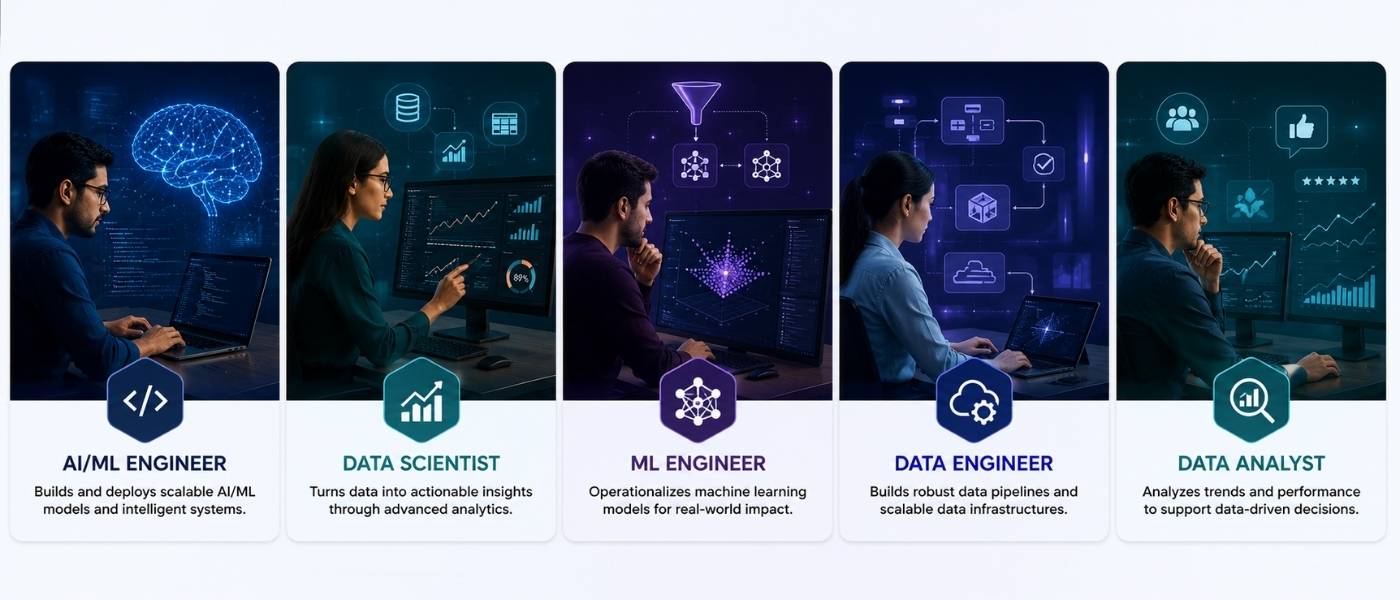
The AI and data science roles most commonly hired on contract in 2026 are machine learning engineers, generative AI developers and LLM engineers, data scientists, MLOps engineers, and AI product engineers, each mapped to a distinct phase of the AI project lifecycle rather than used interchangeably.
Machine Learning Engineers
Machine learning engineers build and train models from defined datasets, handle feature engineering at scale, and take a model from prototype to a state where it can be handed to production infrastructure. They are typically engaged for model development sprints, retraining existing models on new data, or improving model accuracy against a defined metric.
Contract duration for this role commonly runs twelve to twenty weeks per engagement. Tech stack expectations usually include Python, PyTorch or TensorFlow, and experience with pipeline tooling such as MLflow or Kubeflow. This is currently the largest single category of contract AI hiring because most companies already have data infrastructure and need the modeling layer built on top of it.
Generative AI Developers and LLM Engineers
Generative AI developers are distinct from general ML engineers. Their work centers on working with pretrained foundation models rather than training models from scratch, and the skill set is closer to applied systems engineering than classical machine learning.
Typical engagement scope includes building retrieval-augmented generation pipelines, fine-tuning smaller open-source models on proprietary data, prompt engineering at production scale, and building evaluation frameworks that measure hallucination rate and output quality. Common tools include LangChain, LlamaIndex, the OpenAI or Anthropic APIs, and Hugging Face libraries. This is currently the fastest growing contract category and also the hardest to source well, because the discipline is young and genuine production experience is rarer than resumes suggest.
Data Scientists
A data scientist engagement is distinct from an ML engineering engagement in both output and process. Data scientists are typically contracted for exploratory data analysis, feature engineering research, model selection studies, statistical validation, and translating findings into a business recommendation rather than production code.
Data scientists usually sit earlier in the AI product lifecycle, validating whether a modeling approach is viable before an ML engineer is brought in to build it at production scale. Briefing for a data scientist when the project actually needs someone to build and ship a production model is one of the most common and costly mismatches in this hiring category.
MLOps Engineers
MLOps is the most underserved discipline in the contract AI market, and it is also the one companies most often skip until they pay for it later. An MLOps contract engagement typically covers model deployment infrastructure, monitoring for model drift, automated retraining pipelines, CI/CD specifically for ML workflows, and model registry management.
Companies that ship a model without MLOps capability tend to discover the gap at the worst possible time, when a model degrades in production and nobody has a monitoring pipeline that would have caught it earlier. Because this specialism is scarce, shortlist timelines for MLOps roles run longer than for ML engineers or data scientists.
AI Product Engineers
AI product engineers are a newer and increasingly requested category. They sit at the intersection of software engineering and AI integration, building AI powered features using API based model access rather than training models from scratch. This role is most in demand at SaaS and product companies adding GenAI capability to an existing product rather than building an AI product from zero.
Companies scaling a team without the traditional multi-month hiring delay often use this role as the first contract hire, since it delivers a visible product feature quickly while a longer-term AI roadmap is scoped. Our guide on how startups can scale teams faster without traditional hiring delays covers the broader mechanics of this approach.
Full-Time vs Contract vs AI Outsourcing: Which Model Fits Your Stage
Full time hiring suits long term core AI capability where institutional continuity matters most. Contract augmentation suits defined project phases needing speed and flexibility with in-house IP control. AI outsourcing suits companies that want an outcome delivered without managing the delivery team directly.
| Criterion | Permanent Hire | Contract Augmentation | AI Outsourcing |
|---|---|---|---|
| Time to first contribution | 3 to 6 months | 2 to 3 weeks | 3 to 6 weeks |
| Cost structure | Salary, benefits, equity, recruiter fees | Monthly contract rate, no benefits overhead | Project or retainer fee, often bundled |
| IP and model ownership | Fully in-house by default | Contractually defined, client controlled | Requires explicit negotiation, higher risk |
| Flexibility to scale or exit | Low, severance and notice exposure | High, scale up or down per sprint | Moderate, bound by contract terms |
| Depth of integration with internal team | Highest | High, embedded in daily workflow | Lower, vendor operates semi independently |
| Best suited AI project type | Core long term AI capability building | Defined phase: build, fine tune, integrate, productionize | Well specified project with clear outcome definition |
| Risk profile | Hiring risk, salary inflation, attrition | Lower commitment risk, IP clarity needed upfront | Vendor dependency, less internal visibility |
| Management overhead | High, full HR and performance cycle | Moderate, managed like an internal team member | Low day to day, higher oversight at milestones |
Most companies do not choose one model exclusively. A common pattern is to use contract augmentation to build and stabilize the first version of an AI capability, then convert the highest performing contract role to permanent once the roadmap and budget justify it.

What to Look for in a Provider When You Want to Hire AI Engineers and Data Scientists on Contract
A credible AI staffing provider demonstrates AI-specific technical vetting, can clearly differentiate between AI disciplines, gives realistic shortlist timelines, addresses model and data IP explicitly in contracts, understands the AI project lifecycle, and employs its AI professionals under structures that reduce attrition risk mid-engagement.
Depth of AI-Specific Vetting
A generic developer screening process does not surface whether someone can reason about model architecture, has real training pipeline experience, or understands evaluation methodology. For GenAI roles specifically, the screening needs to test LLM orchestration and prompt engineering proficiency, not general coding ability. Ask a provider to walk you through exactly what their technical assessment covers for the specific role you need.
Role Differentiation Capability
Ask the provider directly whether they can explain, in their own words, the difference between a data scientist, an ML engineer, an MLOps engineer, and a GenAI developer for your specific project. If the answer is vague or the roles are described as roughly interchangeable, the provider is a generalist IT staffing firm operating under an AI label, not an AI specialist.
Speed of Shortlist Delivery for Specialist AI Roles
Realistic shortlist timelines run five to ten business days for ML engineers and data scientists, and ten to fifteen days for highly specialized GenAI or MLOps roles. Providers promising a 24 hour shortlist for a senior LLM engineer role are either misrepresenting their process or pulling from a shallow, unvetted pool that will not hold up under technical interview.
IP and Model Ownership Clarity
For AI engagements, standard software IP language is not sufficient. The contract needs to name ownership terms for trained model weights, fine tuned checkpoints, training data pipelines, evaluation datasets, inference code, and proprietary prompt templates specifically. If a provider has never raised this as a distinct topic, they have not scoped an AI engagement seriously before.
Understanding of AI Project Lifecycle
A discovery phase data science engagement, a model build, an MLOps productionization phase, and a GenAI integration sprint are four different projects requiring four different profiles. A provider who does not ask which phase your project is in will likely place the wrong person for the work at hand.
Employment Model and Continuity
AI contract professionals with deep, embedded model knowledge are frequently approached with competing offers mid engagement. A provider that employs its AI talent on fixed term contracts with competitive, structured compensation reduces this attrition risk considerably compared with a gig marketplace model, where the individual has no structural commitment to your project’s continuity.
For companies evaluating remote delivery models more broadly, hiring remote developers through staff augmentation covers the operational mechanics that also apply to remote AI engagements.
In placing AI and data science professionals into active product teams, the most common failure point I have seen is not technical skill, it is a briefing gap. A company asks for “a data scientist” when what they actually need is an MLOps engineer to stabilize a model already in production. Get the phase and the discipline right at the briefing stage, and the rest of the engagement tends to run itself.
Cost of Hiring AI Engineers and Data Scientists on Contract
Contract AI engineer and data scientist rates vary by seniority, specialism, and geography. India based augmentation typically runs at 35 to 55 percent of equivalent US or UK monthly cost, with GenAI and MLOps specialists commanding the highest premiums within that range due to scarcity.
Contract AI Engineer and Data Scientist Monthly Rates: India-Based Augmentation vs US and UK Equivalent
| Role | India-Based Monthly Rate (USD) | US Equivalent Monthly Cost (USD) | UK Equivalent Monthly Cost (USD) | Approx. Saving vs US Hire |
|---|---|---|---|---|
| Junior Data Scientist (0-3 yrs) | 2,200 – 3,200 | 6,500 – 8,500 | 5,800 – 7,500 | 55-65% |
| Mid-level Data Scientist (3-6 yrs) | 3,500 – 5,000 | 9,500 – 12,500 | 8,500 – 11,000 | 55-60% |
| Senior ML Engineer (5-8 yrs) | 5,500 – 7,800 | 14,000 – 18,000 | 12,500 – 16,000 | 55-60% |
| GenAI Developer / LLM Engineer | 6,500 – 9,500 | 16,000 – 21,000 | 14,000 – 18,500 | 50-55% |
| MLOps Engineer | 6,000 – 8,500 | 15,000 – 19,500 | 13,000 – 17,000 | 50-55% |
| AI Product Engineer | 4,500 – 6,500 | 12,000 – 15,500 | 10,500 – 13,500 | 55-60% |
These ranges assume a full time equivalent monthly engagement at market competitive rates for genuinely vetted, senior capable talent, not entry level or unverified resources. Rates rise for candidates with narrow, high demand specialisms such as production LLM fine tuning experience or multi cloud MLOps deployment history.
Total cost of ownership matters more than the headline rate. A permanent US hire typically carries recruiter fees of 15 to 25 percent of first year salary, onboarding costs, salary inflation risk in a market where AI compensation is rising quickly, and severance exposure if the hire does not work out. Contract augmentation removes most of that overhead, since the staffing partner carries the employment relationship.
Ready to compare your specific hiring timeline?
A permanent AI hire typically takes three to six months to land. Contract augmentation can have a vetted specialist contributing inside two to three weeks. Talk to us about the fastest realistic path for your project
How Fast Can You Have a Contract AI Engineer Working on Your Project?
From first brief to first meaningful sprint contribution typically takes two to three weeks for ML engineers and data scientists, and three to four weeks for GenAI or MLOps specialists, broken across sourcing, shortlisting, interviews, contracting, and access provisioning.
The timeline breaks into five phases. Brief and sourcing typically takes two to four days once the role and project phase are clearly defined. Shortlisting and interviews run five to ten business days for ML engineers and data scientists, extending to ten to fifteen days for GenAI and MLOps specialists given the smaller qualified pool.
Selection and contracting usually completes within two to three days once a candidate is chosen, assuming the client has pre-agreed contract terms rather than negotiating IP and rate structure from scratch mid process. Access provisioning, meaning repository, data, and tooling access, is the phase most commonly underestimated and can silently cost a client one to two weeks if IT and security approvals are not initiated in parallel with interviews.
First sprint contribution typically happens within the contractor’s first five working days once access is in place. Companies can compress the overall timeline meaningfully by writing a precise brief that names the project phase, scheduling interviews within 48 hours of shortlist delivery, and pre-provisioning access ahead of the contractor’s start date rather than after it.
Common Mistakes Companies Make When Contracting AI Talent
The most costly mistakes are briefing for the wrong role, failing to specify the project phase, treating GenAI integration as identical to ML model development, leaving model IP undefined, choosing a cheaper generalist provider, skipping success metrics, and losing engagement time to slow access provisioning.
- Briefing for a data scientist when the project needs an ML engineer. This produces excellent exploratory analysis and no production model, wasting weeks of runway on the wrong deliverable.
- Not specifying the project phase in the brief. A brief that does not state whether the project is in discovery, build, or production leads providers to guess, and the guess is often wrong.
- Assuming GenAI integration is the same as ML model development. These require different skill sets entirely, and placing a classical ML engineer on a RAG pipeline build typically stalls the sprint.
- Not addressing IP ownership for model weights before the engagement starts. Retrofitting an IP clause after a fine tuned checkpoint already exists creates avoidable commercial risk and negotiation friction.
- Choosing a generalist IT staffing firm because the rate was lower. The placed resource frequently lacks depth in the specific AI discipline, and the cost saving is erased by rework and delay.
- Not defining success metrics before the engagement starts. Without an objective basis, the 30-day performance review becomes subjective and the engagement risks stalling without a clear signal of why.
- Delaying access provisioning. Losing the first two weeks of a contracted engagement to setup administration is one of the most common and entirely avoidable sources of wasted budget.

Contract AI Talent Evaluation Checklist
- Project phase is named explicitly: discovery, build, productionization, or integration
- Exact role discipline is specified, not a general “AI engineer” label
- Provider can explain their AI specific technical vetting process
- Shortlist timeline quoted matches realistic industry ranges for the role
- IP terms for model weights, checkpoints, and training data are defined in writing
- Success metrics and a 30-day review framework are agreed before start
- Access provisioning plan is initiated before the contractor’s start date
- Provider’s employment model reduces mid engagement attrition risk
Where a Contract Model Is Not the Right Fit
Contract AI augmentation is not the right answer everywhere. Projects requiring deep institutional and domain knowledge from day one, highly regulated environments with strict data residency requirements, and engagements where continuity into the next project phase is business critical often justify a permanent hire or a hybrid approach instead. A credible advisor should tell you this rather than push a contract model onto every conversation.
India remains the primary sourcing base for US, UK, and Australian companies pursuing this model, and the reasons are structural rather than promotional. India ranks first among OECD and G20 countries in AI skill penetration and talent concentration, with tech talent in the country roughly three times more likely to report AI skills than in other markets. India’s AI talent pool is projected to grow from roughly 600,000 to 650,000 professionals toward more than 1.25 million by 2027, a 15 percent compound annual growth rate. That depth is concentrated heavily in Bengaluru and Hyderabad, where the ML engineering, data science, and MLOps talent pools are deepest.
iValuePlus operates as a structured AI talent augmentation partner with formal employment infrastructure and AI specific vetting, not a freelance marketplace. That distinction matters most in the discipline differentiation and continuity areas covered above, where a generalist or gig based approach tends to break down.
FAQ
How do I hire AI engineers on a contract basis?
Define the exact AI discipline and project phase, work with a staffing partner that runs AI specific technical vetting, review a shortlist within five to ten business days, interview for the specific skill your phase requires, and provision access before the start date. Most engagements begin contributing within two to three weeks of the initial brief.
Where can I find data scientists for short-term projects?
Specialist AI staffing partners with dedicated data science vetting pipelines are the most reliable source for short term engagements, since freelance marketplaces rarely verify depth in feature engineering, statistical methods, or business translation. Look for a provider that can show a shortlist within about a week and explain how they differentiate data scientists from ML engineers.
How much does it cost to hire a contract AI engineer?
Costs vary by role and geography, with India based senior ML engineers typically running 5,500 to 7,800 USD per month against 14,000 to 18,000 USD for a US equivalent hire. GenAI and MLOps specialists command higher rates in every geography due to talent scarcity.
What is the difference between hiring AI engineers full time versus on contract?
Full time hiring suits long term core AI capability but typically takes three to six months and carries salary, benefits, and severance exposure. Contract hiring delivers a vetted specialist within two to three weeks, scoped to a defined project phase, with lower long term commitment and clearly defined IP terms.
How do I find data scientists with generative AI experience?
Ask potential providers directly whether their vetting process tests LLM fine tuning, prompt engineering at scale, and RAG pipeline experience specifically, since this is a distinct skill set from classical data science. A provider unable to describe this distinction is unlikely to have genuinely GenAI experienced candidates in their pool.
How long does it take to onboard a contract AI engineer?
From brief to first meaningful sprint contribution typically takes two to three weeks for ML engineers and data scientists, and three to four weeks for GenAI or MLOps specialists. The biggest controllable variable is how quickly the client provisions repository, data, and tooling access.
Is it better to outsource AI talent or hire in-house?
It depends on project maturity and control needs. In-house hiring suits long term core capability where institutional continuity is critical. Contract augmentation suits defined project phases needing speed with in-house IP control. Full outsourcing suits well specified projects with a clear outcome where day to day management overhead needs to stay low.
What is the best way to scale an AI team quickly in 2026?
Combine a precise, phase specific brief with a staffing partner that has genuine AI discipline differentiation and pre-provisioned access for new starters. Companies that compress their timeline most successfully treat access provisioning as a parallel workstream to interviewing, not a step that starts after selection.
What roles are most commonly hired on contract for AI projects?
Machine learning engineers, generative AI developers and LLM engineers, data scientists, MLOps engineers, and AI product engineers are the five most commonly contracted roles, each mapped to a distinct phase of the AI project lifecycle rather than treated as interchangeable.
Recent Post
Staff Augmentation vs Full-Time Hiring: A Strategic Comparison for 2026
Compare staff augmentation vs full-time hiring across cost, speed, flexibility,...
Step-by-Step Guide to Setting Up Accounting Services in India in 2026
Learn how to start accounting services in India in 2026:...

iValuePlus Services
iValuePlus is a one-stop solution to address all your needs to access, build and grow your business in the Indian market which is cost-effective & has a huge talent pool. Established in 2019 as a ‘Business Solution provider', our team has delivered successful growth projects in the international market.
Our services include setting up ODC (offshore development center), Staff Augmentation, Talent Acquisition, Digital Marketing, in the IT/ITES domain.