
What Makes an AI-Led GCC Different from a Traditional Global...

What Makes an AI-Led GCC Different from a Traditional Global Capability Centre?
An AI-led Global Capability Centre (GCC) differs from a traditional GCC in how it uses artificial intelligence, data, automation and intelligent agents to run enterprise work and deliver business outcomes. A traditional GCC relies on skilled teams, established processes and enterprise applications. An AI-led GCC builds AI into those same activities, so workflows, decisions and services improve at the operating-model level. Using a few AI tools is not enough: the shift needs new thinking on workflows, technology, workforce capabilities and governance.
Both models support global operations, innovation and growth. For organisations planning a Global Capability Centre in India, understanding the difference helps leaders judge technology investments, hiring needs and the long-term direction of their global operating model.
What Is a Traditional Global Capability Centre?
A traditional GCC is an offshore or nearshore unit that an organisation sets up to run specialised functions for its global business. It works as an extension of the parent company, with dedicated teams, systems, processes and management structures.
Traditional GCCs typically cover:
- Information Technology: software development, application maintenance, infrastructure management and technical support.
- Human Resources: recruitment, onboarding, payroll administration and workforce management.
- Finance: accounting, financial reporting, accounts payable and receivable, and compliance support.
- Operations: business process management, customer support, reporting and administrative services.
- Data and Analytics: business intelligence, data management and performance analysis.
The model depends on skilled professionals working through established workflows and enterprise applications. A finance team, for instance, uses an ERP system to process invoices, reconcile accounts and prepare reports, while employees manage the workflow, resolve exceptions and coordinate approvals.
Many traditional GCCs also do advanced engineering, research and innovation work. What defines them is their delivery approach and organisational structure, not a lack of advanced technology.
What Is an AI-Led Global Capability Centre?
An AI-led GCC is a Global Capability Centre that builds artificial intelligence, intelligent automation, data engineering and AI agents into its core operating model. AI becomes part of how the centre manages workflows, supports decisions, delivers services and develops enterprise capabilities, rather than sitting as a separate technology project.
Its capabilities can include:
- AI-powered workflow automation
- Intelligent agents that perform defined tasks across connected systems
- Predictive analytics and data-driven insights
- Generative AI for knowledge management and document processing
- AI-assisted software development and quality assurance
- Automated reporting and operational monitoring
- Integrated data platforms for enterprise-wide visibility
Take a finance team receiving hundreds of invoices a week. In an AI-led model, an intelligent workflow extracts the invoice data, classifies the documents, matches them against purchase orders and flags discrepancies. Exceptions go to the right finance professional, and connected systems update after authorised approval. People keep ownership of financial controls and complex decisions, while technology handles more of the repeatable processing.
An AI-led GCC is not the same as an autonomous one. Its AI systems work within defined permissions, business rules and human oversight.
Traditional GCC vs AI-Led GCC: What Are the Key Differences?
The main difference is how each model combines people, technology, data and automation to deliver enterprise services.
Comparison area | Traditional GCC | AI-led GCC |
Operating model | People-led processes supported by enterprise technology | Human and AI collaboration across integrated workflows |
Technology | Enterprise applications, cloud systems and business software | AI platforms, cloud infrastructure, data platforms and integrated applications |
Workflow execution | Employees manage most process activities | AI automates defined activities and coordinates workflow stages |
Decision-making | Reports, analysis and professional judgement | Predictive insights, AI-assisted analysis and human judgement |
Data utilisation | Reporting, business intelligence and historical analysis | Integrated data, predictive analytics and AI-supported insights |
Workforce | Functional specialists, engineers and operational teams | Functional specialists, AI engineers, data professionals and AI governance roles |
Service delivery | Teams deliver services through defined processes | Intelligent workflows combine automated execution and human intervention |
Governance | Enterprise IT, operational and regulatory controls | Enterprise controls extended to AI access, outputs, actions and monitoring |
Business contribution | Operational efficiency, specialised delivery and enterprise support | Efficiency, intelligent automation, innovation and business transformation |
These are two points on an evolving path, not two separate species. A traditional GCC can add AI capabilities step by step and grow into an AI-led model as its needs and maturity develop.
How Does AI Change the GCC Operating Model?
AI changes the GCC operating model by shifting work from manual coordination towards intelligent workflow management, automation and data-supported operations.
In a conventional structure, functions often run through separate teams and applications, and employees pass information and approvals between departments. An AI-led model connects those steps through integrated systems and automated workflows. Employee onboarding shows the difference.
Traditional approach
- HR receives the new employee’s details.
- An HR professional enters them into the HRMS.
- IT receives a separate request for system access.
- Finance receives payroll information.
- Employees coordinate across departments to complete onboarding.
AI-led approach
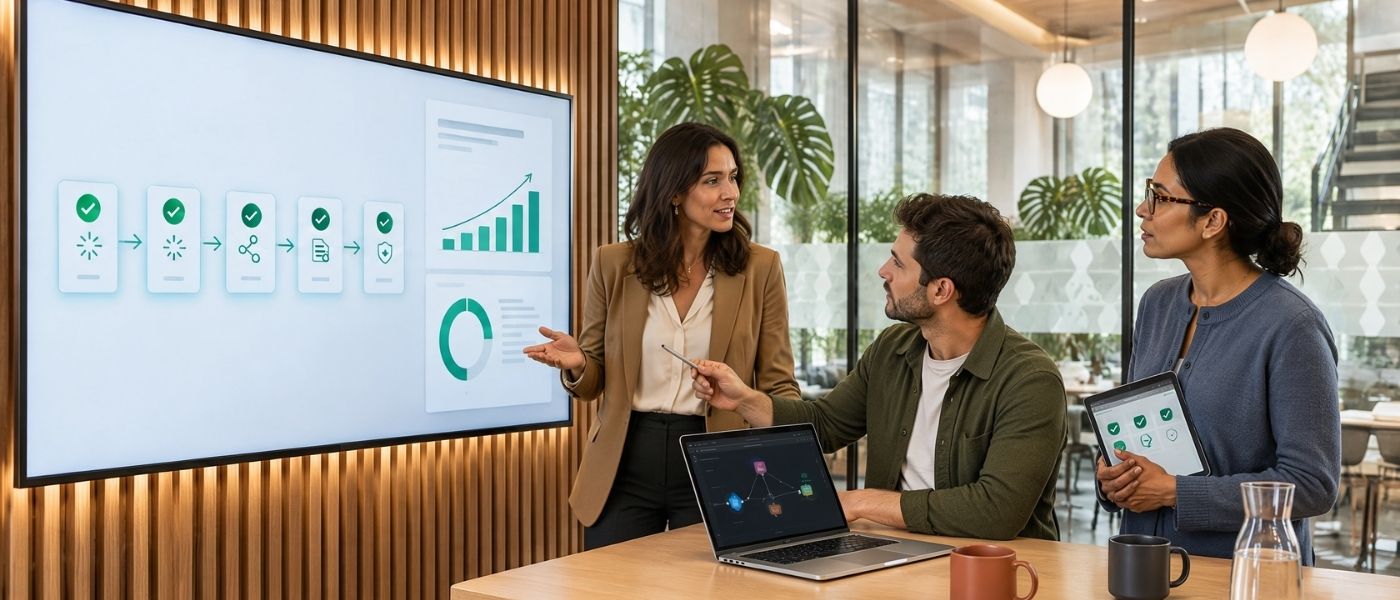
- The onboarding workflow receives authorised employee information.
- AI extracts and validates the relevant details.
- The workflow starts predefined HR, IT and administrative tasks.
- An intelligent agent tracks progress and sends updates.
- HR reviews exceptions and approves anything that needs human judgement.
This gives GCCs better coordination across departments, consistent information across systems, faster completion of repeatable work, clearer visibility of process status and more time for specialised responsibilities. The results still depend on process design, data availability, system integration and the reliability of the AI solution.
From individual task automation to connected workflows
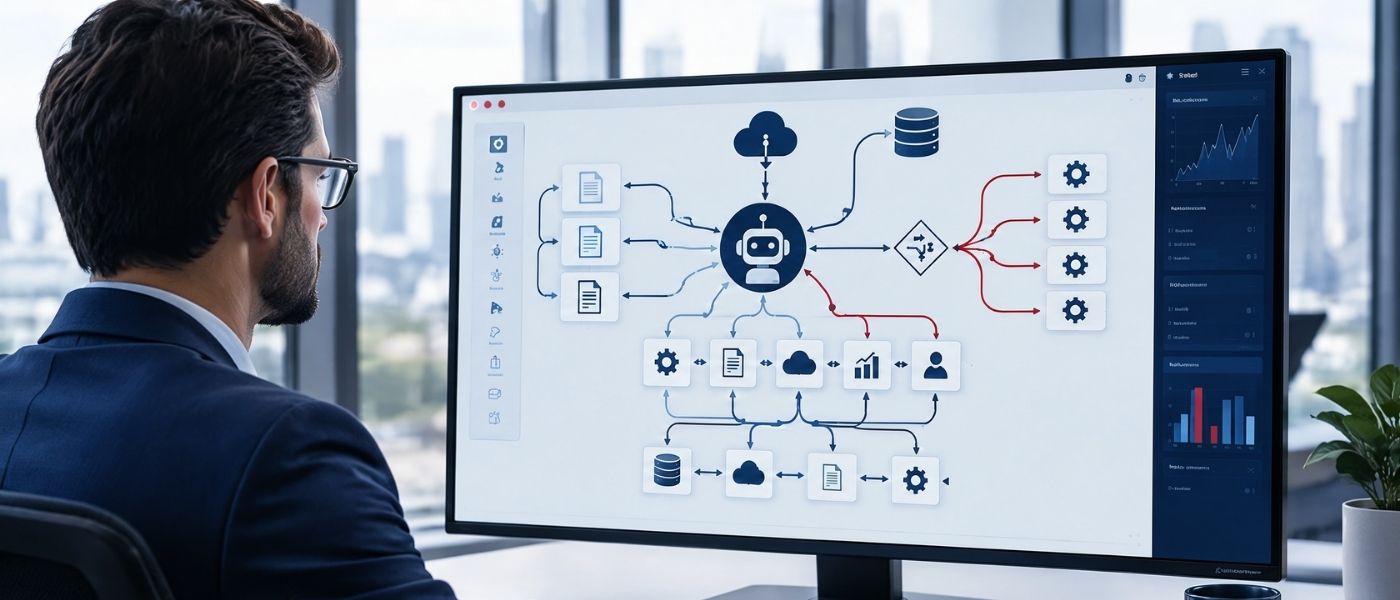
Traditional automation usually handles single activities, such as generating a report or sending a notification. AI-led GCCs connect several activities into one workflow using AI agents, APIs and orchestration platforms. An IT support workflow, for example, can classify an incoming ticket, retrieve relevant knowledge, recommend a fix, route the request and update the ticketing system, with an employee reviewing or approving actions as policy requires.
What Is the Role of AI Agents and Intelligent Automation in GCCs?
AI agents and intelligent automation help GCCs coordinate multi-step activities, work with enterprise applications and complete defined tasks within authorised boundaries.
It helps to separate four related capabilities:
- Traditional automation (RPA and scripts): follows predefined rules, such as moving data between systems or generating scheduled reports.
- Intelligent automation: combines rule-based automation with AI, such as reading documents, classifying requests and making routine decisions, so automated processes can handle less structured work.
- Generative AI: processes and generates content, summarises documents and supports information retrieval.
- AI agents: use AI reasoning and authorised tools to pursue a defined goal across several workflow stages.
A generative AI assistant can summarise a financial report. An AI agent can go further: retrieve the report, extract the relevant figures, compare them with approved records and prepare an exception summary for finance review. That matters in a GCC because enterprise operations are chains of connected activities, not isolated tasks.
AI agents can support IT service management, employee query handling, invoice and document review, knowledge retrieval, software testing and operational reporting. Businesses exploring this can also read iValuePlus’s article on how AI agents move businesses from tasks to outcomes.
The right level of automation varies by process. Work involving financial commitments, employee decisions, sensitive data or regulatory duties needs clearly defined approval steps.
How Are AI-Led GCCs Transforming Different Business Functions?
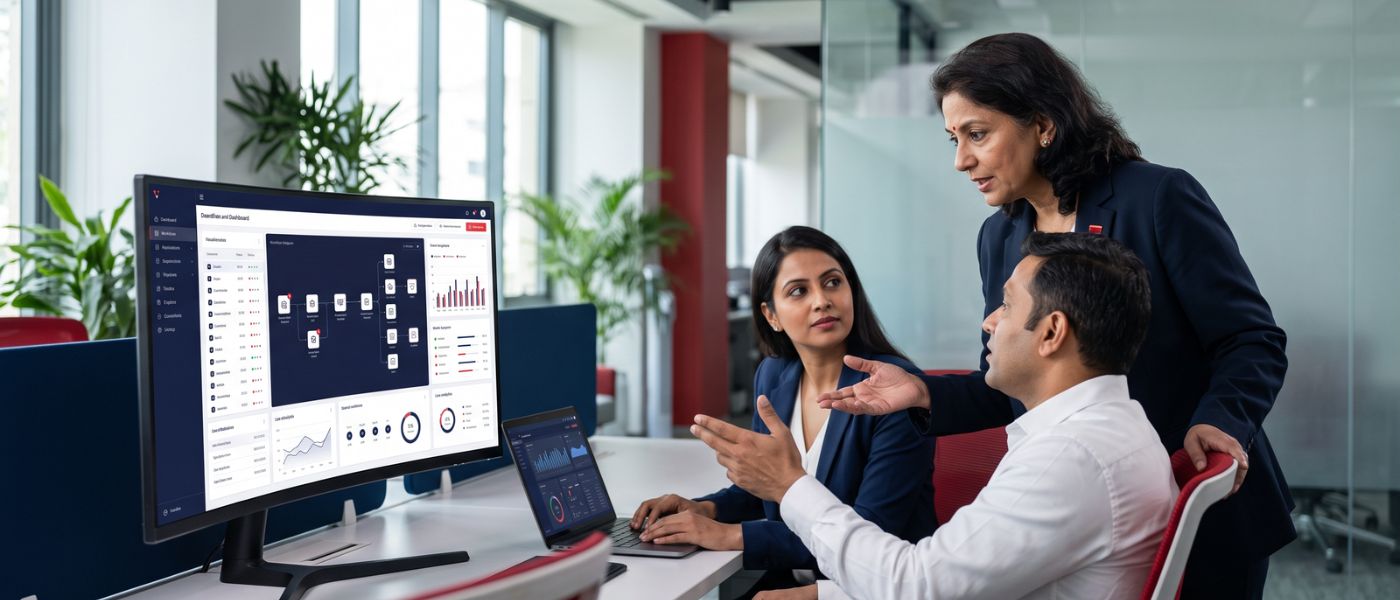
AI-led GCCs can bring intelligent automation to IT, HR, finance and operations, with each function applying AI to its own requirements.
Information Technology
AI supports software development, infrastructure management, monitoring and quality assurance. Examples include AI-assisted code generation and documentation, automated test-case creation, intelligent incident routing, predictive infrastructure monitoring and knowledge retrieval for support teams. A software team can use AI to draft test cases from application requirements, while QA professionals validate coverage and handle complex scenarios.
Human Resources
AI supports employee services across the employee lifecycle: query handling through AI assistants, resume information extraction, onboarding coordination and policy retrieval. An HR agent can answer routine questions from approved company policies, while sensitive employee matters go to HR professionals.
Finance
Finance teams can use AI for document processing, reconciliation support and analysis. Beyond invoice matching, AI can help with month-end close checklists, vendor onboarding document checks, transaction anomaly detection and compliance document review. An authorised finance professional reviews flagged items and approves the action.
Operations
AI improves coordination across processes, reporting and service delivery through workflow allocation, request classification, performance monitoring, document processing and demand forecasting. An operations team can use AI to categorise incoming service requests and route each one to the right department.
Across all four functions, the aim is the same: combine human expertise with intelligent technology to improve service delivery and operational visibility.
How Do Technology and Data Requirements Differ?
An AI-led GCC needs a technology environment that supports connected applications, reliable data access, AI deployment and continuous monitoring.
Traditional GCCs already use cloud infrastructure, ERP and HRMS platforms, databases and BI tools, and these stay important. An AI-led environment adds several layers:
Technology area | Role in an AI-led GCC |
Cloud infrastructure | Supports scalable computing, storage and AI workloads |
Data engineering | Collects, cleans, structures and connects enterprise information |
Enterprise integration | Connects AI solutions with ERP, CRM, HRMS and other systems |
AI and machine learning | Supports predictive analysis, classification and intelligent applications |
Large language models | Enables natural language processing and generative AI applications |
RAG systems | Connects AI responses with approved enterprise knowledge sources |
Workflow orchestration | Coordinates tasks across people, agents and business applications |
AI monitoring | Tracks performance, usage, accuracy and operational behaviour |
Security infrastructure | Manages identity, permissions, encryption and access controls |
Data quality matters most. AI systems need relevant, accurate and appropriately accessible information to give useful results. An HR agent needs approved employee policies, and a finance agent needs controlled access to the right financial records. Before expanding AI across functions, organisations should review system compatibility, data ownership, integration architecture and information security.
How Does the Workforce Change in an AI-Led GCC?
An AI-led GCC raises the importance of AI literacy, data skills, engineering expertise and the ability to manage intelligent workflows.
Traditional GCC roles across IT, HR, finance, operations and project management remain essential. AI adds new responsibilities and specialist needs:
Traditional capabilities | Emerging AI-led capabilities |
Software development | AI engineering and agent development |
Manual quality testing | AI-assisted testing and automation |
Business reporting | Data analytics and predictive insights |
Process administration | Intelligent workflow management |
IT support | AI-assisted service management |
Functional management | AI governance and process transformation |
Not every employee needs to become an AI engineer. Finance professionals need to understand how AI-supported workflows operate, HR teams need to review AI-generated information and handle exceptions, and IT professionals may need deeper knowledge of AI integration, cloud architecture and security. GCCs also need specialists in data engineering, machine learning, AI development, cybersecurity and quality assurance.
EY’s GCC Pulse Survey (November 2025) points to this shift. It reported that 71% of surveyed GCCs had reskilling initiatives, 63% prioritised AI and machine learning skills and 54% prioritised data engineering and business intelligence. The survey covered more than 65 GCC leaders across India and other international hubs.
The practical focus is on developing existing employees, hiring specialist talent and building teams that work well with AI-enabled systems.
How Do Governance and Human Oversight Work in an AI-Led GCC?
AI governance keeps intelligent systems within organisational policies, security requirements and defined business responsibilities.
Once AI is part of enterprise workflows, governance has to go beyond conventional IT access control. The key areas are:
- Data privacy: define which business and employee data AI systems can access. For India-based operations, this includes alignment with the Digital Personal Data Protection Act, 2023, especially for HR and customer data.
- Access permissions: give each agent permissions that match its responsibilities.
- Human oversight: decide which activities need employee review or approval.
- Output validation: test the accuracy and reliability of AI-generated information.
- Auditability: keep records of relevant AI interactions and authorised actions.
- Security: protect applications, databases and AI infrastructure.
- Performance monitoring: track system behaviour, usage, cost and output quality.
The NIST AI Risk Management Framework is a useful reference. It organises AI risk work into four functions, Govern, Map, Measure and Manage, supporting continuous assessment and management of AI risks.
For GCC leaders, governance belongs in the operating model from day one. It keeps accountability clear while AI capabilities grow across functions.

What Are the Common Challenges, and How Do GCCs Handle Them?
Most AI-led GCC journeys meet a few predictable hurdles, and each has a practical answer.
- Data silos: consolidate and clean data on a shared platform before scaling AI.
- Integration complexity: start with workflows that connect to a limited number of systems, then expand.
- Change management: involve process owners early and invest in reskilling so teams see AI as support, not replacement.
- Cost and value tracking: set measurable outcomes, such as processing time or accuracy, before each rollout.
Tackling these early lets GCCs build AI capabilities on a stable foundation.
How Can Businesses Evaluate Their Readiness for an AI-Led GCC?
Businesses can assess readiness by reviewing their processes, data infrastructure, workforce skills, technology environment and governance arrangements. A phased approach shows where AI can create practical value.
- Review existing GCC operations. Map the functions the centre manages and how work moves between teams. Note repetitive tasks, approval chains and system dependencies.
- Identify suitable AI opportunities. Choose workflows with measurable outcomes, such as document processing, employee queries, software testing, reconciliation and IT service management.
- Assess data and technology. Review data quality, applications, APIs, cloud infrastructure and security, and list the integrations the chosen workflows need.
- Evaluate workforce capabilities. Compare current skills with the AI engineering, data, automation and governance expertise required. Consider reskilling, specialist hiring and external support.
- Set governance and performance measures. Define AI permissions, approval points, security controls and accountability. Track indicators such as processing time, accuracy, productivity and cost per completed activity.
- Expand based on results. Start with suitable workflows, evaluate performance and extend successful ones to other functions.
Every organisation’s path differs. Some GCCs add AI to selected departments, while others build AI into their operating model from the start.
How Are AI-Led GCCs Shaping the Future of Enterprise Strategy?
AI-led GCCs are moving global capability centres from specialised service delivery towards enterprise intelligence, technology innovation and GCC transformation.
EY’s GCC Pulse Survey 2025 reported that 58% of surveyed GCCs were investing in agentic AI, with another 29% planning to invest within a year, and that 83% were investing in generative AI. These are 2025 survey findings, and they show how central AI has become to GCC strategy.
The broader direction includes:
- Greater innovation ownership: GCC teams contribute to technology development and enterprise transformation.
- Connected functions: AI-powered GCC operations and integrated data support coordination across departments.
- Outcome-oriented delivery: performance is measured on business results alongside service volumes.
- Advanced capabilities: GCCs build expertise in AI, analytics, cloud engineering and intelligent automation.
- Global decision-making: experienced teams contribute to enterprise planning and process improvement.
AI-driven business operations will develop at a different pace in each organisation. Traditional GCC structures will keep serving important enterprise needs, while AI-led capabilities are introduced according to priorities and maturity. The most effective path builds on existing GCC strengths while adding the skills needed for intelligent, connected operations.
How iValuePlus Helps
iValuePlus supports organisations establishing and expanding GCCs in India through its Global Capability Centre services, covering talent acquisition, operating models, operational launch, governance and business expansion.
For AI capabilities, its AI Automation and Intelligent Agent Services cover intelligent agent development, RAG systems, workflow automation, system integrations and governed AI implementation. Through Staff Augmentation, businesses can add specialist technology talent quickly, and the Build-Operate-Transfer model helps establish and run an India capability before transferring it to the client.
Together, these services help organisations build technology teams, automate relevant processes and grow their operations in line with enterprise requirements.
Conclusion
The difference between a traditional GCC and an AI-led GCC lies in how technology, people, data and processes work together. Traditional GCCs deliver specialised enterprise capabilities through dedicated teams and established structures. AI-led GCCs build on that foundation with intelligent automation, AI agents, data platforms and AI-supported decision-making.
For organisations planning the next phase of their GCC, the opportunity is to find where AI can strengthen existing capabilities and open up new responsibilities. A structured approach to technology, workforce, integration and governance builds an operating model that fits long-term goals.
Planning to establish or expand your GCC in India? Contact us to discuss your business and technology requirements.
FAQs
What is an AI-led GCC?
It is a Global Capability Centre that makes AI, intelligent automation, data capabilities and AI agents part of how it runs, improving service delivery, decision-making and enterprise capabilities.
What is the difference between an AI-led GCC and a traditional GCC?
A traditional GCC delivers specialised services through dedicated teams and established processes. An AI-led GCC pairs human expertise with AI-powered workflows, intelligent agents and integrated data, making operations more connected and automated.
Can a traditional GCC become an AI-led GCC?
Yes. It can start with selected use cases and add employee training, technology integration, better data infrastructure and governance. The transition can happen function by function.
What role do AI agents play in GCC operations?
AI agents carry out defined multi-step activities across connected enterprise applications, supporting document processing, IT service management, HR queries, financial workflows and operational coordination within authorised permissions.
Which business functions benefit from AI-led GCCs?
IT, HR, finance and operations all benefit. Common uses include software testing, employee query handling, document classification, vendor and compliance checks, reporting and workflow coordination.
What skills are required to build an AI-led GCC?
Typically AI and machine learning engineers, data engineers, software developers, cloud specialists, cybersecurity professionals, QA engineers and functional experts with AI literacy.
Is an AI-led GCC suitable for every organisation?
Not necessarily. Suitability depends on business priorities, operational maturity, data environment and technology needs. Businesses can begin with a few AI use cases and expand as requirements grow.
Recent Post
How Can Businesses Identify and Prevent Errors in AI Agent Workflows?
How Can Businesses Identify and Prevent Errors in AI Agent...
Cloud-First vs On-Premises IT Infrastructure: What Should Growing Companies Consider?
Cloud-First vs On-Premises IT Infrastructure: What Should Growing Companies Consider?...

iValuePlus Services
iValuePlus is a one-stop solution to address all your needs to access, build and grow your business in the Indian market which is cost-effective & has a huge talent pool. Established in 2019 as a ‘Business Solution provider', our team has delivered successful growth projects in the international market.
Our services include setting up ODC (offshore development center), Staff Augmentation, Talent Acquisition, Digital Marketing, in the IT/ITES domain.