

Why AI Automation Projects Get Stuck at the Pilot Stage...
Categories
Tags
- demand for digital marketing in Dubai
- digital marketing agency in Dubai
- digital marketing for small businesses in Dubai
- digital marketing in Dubai
- digital marketing plan Dubai
- digital marketing strategies in Dubai
- digital marketing strategy Dubai
- digital marketing strategy in Dubai
- Dubai marketing strategy
- marketing for small businesses in Dubai
- marketing strategy in Dubai
- online marketing strategy Dubai
- SME marketing strategy Dubai

Digital Marketing Strategy in Dubai: A 90-Day Plan for SMEs and Growing Businesses
A B2B consultancy in Business Bay has been running Google Ads for four months. A healthcare clinic in Jumeirah posts on Instagram daily. A real estate firm in Dubai Marina refreshed its website in January. All three businesses are spending on digital marketing. None of them can tell which activity is generating revenue, which is burning budget, or what to do differently next month.
The problem in each case is not a lack of channels. It is a lack of a digital marketing strategy in Dubai that connects the channels, sets measurable goals, and tells the business what to do in what order. This article provides exactly that: a practical 90-day plan covering channel selection, budget allocation, SEO, paid advertising, Arabic content, local SEO, conversion tracking, CRM setup, and the decision between building in-house versus outsourcing execution.
If your Dubai business needs leads and not just activity, this guide is the starting point.
Why Dubai Businesses Need a Clear Digital Marketing Strategy
A digital marketing strategy in Dubai is not optional for businesses that depend on inbound leads. Disconnected tactics — an ad here, a post there, a website update when time allows — produce fragmented data, inconsistent lead quality, and no clear learning about what is actually working. A strategy connects every channel to a measurable goal, sets a sequence for what to build first, and creates the foundation that makes paid spend more effective over time.
Dubai’s digital ad spend has surpassed $1.2 billion, and the digital ad spend market in the UAE is expected to grow by 15.2 percent annually, reaching $2.64 billion in 2026. This level of investment from the market means competition for attention and search placement is real and increasing. Businesses entering paid channels without a strategy compete against companies that have been optimizing their campaigns for years.
The other cost of running without a strategy is misallocated budget. SMEs that spend on Meta Ads before fixing their landing pages, or that invest in SEO before installing conversion tracking, collect traffic data they cannot act on. Strategy determines sequence. Sequence determines whether the money spent in month one produces useful information or disappears.
What Makes Digital Marketing in Dubai Different?
Digital marketing in Dubai operates across a genuinely multicultural market with distinct search behavior, high mobile dependency, and a strong preference for conversational lead channels. These differences require planning choices that a generic digital marketing approach does not account for.
Internet penetration in the UAE stands at approximately 99 percent of the population, with 11.1 million people online. There were 11.3 million active social media user identities in the UAE at the start of 2025, equivalent to 100 percent of the population. Every customer segment a Dubai SME targets is reachable digitally. The question is which platform, which language, and which message reaches them at the right point in their decision journey.
Arabic and English search behavior differ meaningfully. Emirati nationals, Gulf Arab professionals, and Arabic-speaking expatriates increasingly search and transact in Arabic. A business whose only digital presence is in English misses a portion of its addressable market. Equally, most of Dubai’s South Asian and Western expatriate population searches primarily in English. A multilingual marketing UAE strategy that addresses both search behaviors is not optional for businesses with broad customer profiles.
WhatsApp is the default lead communication channel across all demographic groups in Dubai. Most service businesses close a significant share of their leads through WhatsApp conversations rather than email or form submissions. A digital marketing strategy that generates website traffic without a functional WhatsApp lead capture and follow-up system loses leads at the point of highest intent.
Paid media competition is also more intense in specific Dubai sectors than in most other markets. Real estate, healthcare, education, legal, and financial services carry high Google Ads cost-per-click levels. Entering these sectors without a clear keyword strategy, well-optimized landing pages, and negative keyword management means budget absorbs quickly without generating useful data.

The 90-Day Digital Marketing Strategy for SMEs in Dubai
A 90-day digital marketing strategy for SMEs in Dubai gives businesses enough time to build a proper foundation, activate the right channels, measure early performance, and optimize before committing to full-scale budget. Starting with 90 days forces prioritization. It prevents the common mistake of trying to run SEO, Google Ads, Meta Ads, LinkedIn, content marketing, and social media simultaneously with limited resources and no clear sequencing.
Timeframe | Primary goal | Key actions | Expected outcome |
Days 1 to 30 | Audit, research, foundation | Website and tracking audit, keyword research, competitor analysis, persona mapping, CRM and analytics setup | Clean data foundation, strategy clarity, channel priorities confirmed |
Days 31 to 60 | Channel activation and lead generation | SEO improvements, paid ads launched, content published, landing pages optimized, lead capture and follow-up workflows active | First leads tracked by source, initial cost per lead data available |
Days 61 to 90 | Optimization and scaling | Campaigns refined, retargeting launched, underperforming channels paused, winning channels scaled | Reduced cost per lead, improved conversion rate, foundation for next quarter |
Days 1 to 30: Audit, Research, and Foundation Setup
The first 30 days are not about generating leads. They are about ensuring that when leads arrive, the business can track them, attribute them to the right source, and follow up effectively. Skipping this phase and going straight into paid advertising is the most common and expensive mistake Dubai SMEs make.
In many digital strategy audits, the most consistent finding is not a shortage of channels. It is that the business is paying for traffic before it has fixed the landing page, the lead capture process, and the follow-up system. Every dirham spent on paid ads before conversion tracking is installed is data that is permanently lost.
Foundation setup checklist:
Website speed and mobile performance reviewed
All service pages audited for clarity, keyword alignment, and CTA visibility
WhatsApp Business or click-to-chat button installed and tested on key pages
Google Analytics 4 configured with conversion goals defined
Google Search Console verified and initial search performance reviewed
Google Ads conversion tracking installed and tested
Meta Pixel installed and verified
LinkedIn Insight Tag installed if business is B2B
CRM or lead tracking sheet set up with source fields defined
Google Business Profile reviewed and fully updated
Competitor research completed across three to five primary competitors
Keyword research completed for service terms, location terms, commercial intent terms, and question terms
Customer persona mapped with primary decision criteria and communication preferences
Arabic content need assessed against audience profile
WhatsApp inquiry flow reviewed and response time assessed
Landing pages reviewed against conversion rate benchmarks
Local SEO for Dubai small businesses starts here too. A Google Business Profile that is incomplete, missing service descriptions, or lacking recent reviews will underperform in local search and Google Maps regardless of how well the main website performs.
Days 31 to 60: SEO, Content, Paid Ads, and Lead Generation
With tracking, landing pages, and CRM in place, days 31 to 60 activate the primary channels. The priority at this stage is generating enough lead data to understand which channels produce qualified demand for the specific business and audience.
SEO work in this phase:
Service pages published or improved around commercial-intent keywords
Location-specific landing pages created for Dubai areas and service categories
FAQ sections added to service pages structured around buyer questions
Internal linking between service pages improved
Technical SEO fixes from the audit implemented
Google Business Profile updated with new photos, service listings, and a review generation campaign started
Paid advertising in this phase:
Google Search Ads launched targeting high-intent keywords with dedicated landing pages per campaign
Meta Ads testing begun with a small budget to identify which audience segments respond
LinkedIn Ads activated for B2B businesses targeting specific job titles and company sizes
Negative keywords added to Google Ads campaigns before significant spend begins
Retargeting audiences built from website visitors and campaign engagements, even if retargeting campaigns are not yet launched
Content in this phase:
Two to four buyer-intent content pieces published targeting question-based keywords
Arabic or bilingual landing pages created for audience segments where Arabic search volume is material
Lead magnet or consultation CTA added to highest-traffic pages
Email or WhatsApp follow-up sequence drafted for incoming leads
For a broader view of current digital marketing services in Dubai and which channels are gaining ground in 2025 and 2026, iValuePlus covers the trend context alongside this execution framework.
Days 61 to 90: Optimization, Retargeting, and Scaling
By day 60, a business with clean tracking has enough data to make allocation decisions based on evidence rather than assumption. The third phase is about improving what is running, pausing what is not, and scaling the channels producing qualified leads at an acceptable cost.
Optimization priorities:
Google Ads search terms report reviewed and irrelevant terms added to negative keyword list
Cost per lead compared across channels, not just cost per click
Landing page conversion rates reviewed and underperforming pages improved
Retargeting campaigns launched for visitors who reached the contact page without converting
Organic keyword movement checked in Google Search Console
Lead quality reviewed with the sales team, not just lead volume
High-performing ad groups scaled with additional budget
WhatsApp response time and follow-up sequence reviewed against lead-to-meeting conversion rate
Monthly reporting structure created with agreed metrics: leads by source, cost per lead, organic traffic, keyword rankings, and conversion rate
Performance marketing in Dubai rewards patience more than most markets because the combination of high mobile usage, WhatsApp-driven sales conversations, and multilingual search behavior means the first 30 to 60 days of data often looks incomplete before patterns emerge. The businesses that optimize based on 90 days of data consistently outperform those that change campaigns after two weeks.
Best Digital Marketing Channels for Dubai SMEs
The right digital marketing channels for businesses in Dubai depend on the business type, sales cycle length, and audience profile. No single channel works for every Dubai SME at the same budget level.
Channel | Best for | Timeline to impact | Recommended for | Key risk if managed poorly |
SEO | Organic visibility and long-term leads | 3 to 6 months | All business types | Slow results if technical issues are not fixed first |
Google Ads | High-intent lead generation | 2 to 4 weeks | Service businesses, clinics, legal, real estate | Budget absorbed quickly without negative keywords and good landing pages |
Meta Ads | Awareness, retargeting, eCommerce | 2 to 6 weeks | B2C, eCommerce, events, local services | Low-quality leads if audience targeting is too broad |
LinkedIn Ads | B2B lead generation | 4 to 8 weeks | B2B services, SaaS, consulting, GCC firms | High cost per click if audience is too narrow or creative is generic |
Content marketing | Authority building and organic reach | 3 to 6 months | All business types | Produces traffic without leads if content does not connect to service offers |
Arabic content | Arabic-speaking audience reach | 3 to 6 months | Healthcare, real estate, education, retail | Generic translation without localization fails to build trust |
Local SEO | Map visibility and local search leads | 4 to 8 weeks | Clinics, retail, hospitality, professional services | Inconsistent NAP or missing reviews limits map ranking |
WhatsApp marketing | Lead follow-up and nurturing | Immediate | All business types | Slow response time destroys lead quality even when lead volume is good |
Email marketing | Lead nurturing and retention | Immediate for existing contacts | B2B, subscription services, eCommerce | Low open rates if list quality is poor or content is generic |
Influencer or creator marketing | Brand awareness in specific niches | 4 to 12 weeks | Hospitality, fashion, F and B, consumer brands | Difficult to measure ROI without clear conversion tracking |
Local SEO Strategy for Dubai Small Businesses
A local SEO strategy for Dubai small businesses produces qualified leads from people who are searching for a specific service in a specific area, which is the highest-intent traffic available in organic search. Local SEO does not require a large budget, but it does require consistent effort across several connected activities.
The foundation is a fully optimized and actively maintained Google Business Profile. This means complete service descriptions, accurate business hours, regularly updated photos, and an active review generation process that produces genuine, recent reviews from real customers. Businesses with 20 or more detailed Google reviews consistently outperform businesses with five or fewer in local map pack visibility.
Location-specific landing pages are the second major lever. A physiotherapy clinic serving patients in Jumeirah, Downtown, and Business Bay needs a separate page optimized for each area’s search terms, not a single generic “physiotherapy Dubai” page. Each location page should address the specific audience, include local landmarks or references, and have a clear CTA connected to a WhatsApp or booking flow.
NAP consistency, meaning the same business name, address, and phone number appearing identically across the Google Business Profile, website, and local directory listings, remains a ranking signal that many Dubai SMEs overlook.
Arabic Content Strategy for UAE Businesses
An Arabic content strategy for UAE businesses is necessary when a meaningful proportion of the target audience searches, browses, and makes decisions in Arabic. This is not a universal requirement for every Dubai business, but for specific sectors and audience profiles, ignoring Arabic digital presence means ceding ground that competitors with Arabic content will occupy.
Healthcare clinics serving Emirati patients, real estate businesses targeting Gulf Arab buyers, education companies reaching Emirati families, and retail brands with significant Arab consumer bases all face material commercial consequences from English-only digital marketing. The Arabic-speaking portion of their audience searches using different keywords, uses different platforms for research, and responds to different trust signals.
Arabic SEO requires more than translating English pages. Search volume for Arabic keywords is distinct from English equivalents. The keyword “عيادة أسنان في دبي” (dental clinic in Dubai) has different competition dynamics, different search intent, and different seasonal patterns than “dental clinic Dubai.” Treating Arabic content as a translation exercise produces pages that are technically Arabic but commercially ineffective.
For bilingual businesses, the practical starting point is identifying the two or three service pages where Arabic search volume is highest, creating genuinely localized Arabic versions of those pages, and launching a small Arabic Google Ads campaign to test demand before committing to a full Arabic content operation.
How Much Should SMEs Spend on Digital Marketing in Dubai?
SMEs in Dubai should allocate between 8 and 20 percent of annual revenue on digital marketing depending on growth stage, competitive intensity, and lead dependency. There is no universal number, but the table below provides practical planning tiers based on business stage and marketing objectives.
Business stage | Monthly budget range | Best use of budget | Recommended channels | What not to expect |
Early-stage SME | AED 3,000 to AED 8,000 | Foundation setup, tracking, basic Google Ads, one content piece per month | Local SEO, Google Ads, WhatsApp lead flow | Significant organic traffic or brand awareness at this budget |
Growth-stage SME | AED 8,000 to AED 20,000 | SEO, Google Ads, Meta Ads testing, content, landing pages | SEO, Google Ads, Meta Ads, WhatsApp, content | Immediate returns on SEO investment or low cost per lead in competitive sectors |
Competitive local business | AED 20,000 to AED 50,000 | Full channel mix, Arabic content, retargeting, CRM integration | All primary channels, Arabic SEO, retargeting | Shortcuts on landing page quality or tracking at this spend level |
B2B lead generation business | AED 10,000 to AED 30,000 | Google Ads, LinkedIn Ads, content, CRM, lead nurturing | LinkedIn, Google Ads, content, email nurturing | Fast results from LinkedIn without strong ad creative and landing pages |
eCommerce business | AED 15,000 to AED 40,000 | Meta Ads, Google Shopping, retargeting, email and WhatsApp retention | Meta, Google Shopping, email, WhatsApp | Strong returns without product photography, landing page quality, and retention sequences |
For Dubai SMEs, paid advertising accounts for 35 to 40 percent of monthly digital marketing budgets. SEO and conversion rate optimization account for 15 to 20 percent. CRM and email marketing account for 5 to 10 percent of SME digital marketing budgets in Dubai. These ratios reflect where businesses are allocating spend, not necessarily where returns are strongest.
Digital Marketing for Small Businesses in Dubai: What to Prioritize First
Digital marketing for small businesses in Dubai produces the best return when activities are sequenced correctly. The most common sequencing mistake is scaling traffic before the conversion infrastructure is ready, which produces data that cannot be acted on and leads that cannot be followed up effectively.
The correct sequence is: fix tracking before running ads; fix landing pages before scaling ad spend; publish service pages before expecting organic search leads; set up WhatsApp and CRM workflows before generating leads that arrive without a follow-up system; and measure lead quality alongside lead volume before deciding which channels to scale.
SMEs with limited budget should start with local SEO and Google Ads for high-intent keywords, because both channels reach buyers who are already looking for the specific service. Social media should initially support brand visibility and trust rather than replace paid search as the primary lead generation channel. WhatsApp should be integrated into every lead capture touchpoint before budget is committed to any paid channel.

Common Mistakes Dubai Businesses Make With Digital Marketing
Most digital marketing failures in Dubai are not failures of the channel. They are failures of sequencing and measurement.
Running paid ads without landing pages is the most expensive mistake. Sending Google Ads traffic to a homepage, or to a page with no clear CTA and no conversion tracking, produces click spend with no data about what happened after the click.
Ignoring conversion tracking means every allocation decision for the next campaign is based on assumptions rather than evidence. A business that cannot answer “where did this lead come from” has no basis for deciding where to spend more.
Treating Arabic content as simple English translation produces content that is technically readable but culturally generic. UAE Arabic-speaking audiences respond to content that reflects their specific context, concerns, and vocabulary. Translation without localization produces pages that appear in Arabic search results but do not convert.
Measuring social media performance by follower count and engagement rate rather than by leads generated keeps marketing activity looking productive while the actual lead pipeline stagnates. Followers do not pay invoices.
Changing campaigns after two or three weeks produces data that is too early to interpret. Most paid media campaigns in Dubai reach meaningful data thresholds at four to six weeks when managed with appropriate daily budgets.
Choosing the cheapest digital marketing agency without understanding their process, measurement framework, or previous results means optimizing for spend rather than performance. The cost of a poor agency relationship is not just the agency fee, but also the wasted ad budget managed without proper oversight.
In-House Marketing Team vs Outsourcing in Dubai
Deciding between an in-house marketing team and outsourcing digital marketing execution is one of the most consequential decisions a Dubai SME makes as it scales. The right answer depends on the business’s revenue stage, the complexity of its channel mix, and the availability of qualified marketing talent at a sustainable salary level.
An in-house team makes sense when the business has consistent, high-volume marketing activity that requires deep institutional knowledge of the brand, product, and sales process. It makes sense when the team can afford a full-time senior marketer alongside a content creator and a paid media specialist, which typically requires a marketing budget that justifies three to four full-time salaries plus tools and advertising spend.
Outsourcing makes sense when the business needs SEO, paid ads, content, landing page optimization, and reporting managed as an integrated system but cannot yet justify the headcount cost of building that capability internally. It also makes sense when the business needs to move quickly, does not have the time to hire and onboard a team, or needs specialist capability in Arabic content, technical SEO, or conversion rate optimization that is difficult to hire as a generalist in-house.
A hybrid model works well for growing businesses: an in-house marketing manager who owns strategy, brand, and sales alignment, working with an outsourced execution team that handles channel management, creative production, and analytics. This structure provides strategic continuity with operational flexibility.
For businesses exploring cost-effective outsourced execution, why startups outsource digital marketing to India is also relevant context for Dubai SMEs evaluating their options.
When Should You Hire a Digital Marketing Agency in Dubai?
A digital marketing agency in Dubai adds the most value when the business needs strategy, execution, tracking, and optimization managed as a connected system but does not have the in-house skills, time, or headcount to do this across multiple channels simultaneously.
The signs that an agency relationship is necessary:
Paid ads are spending but not converting, and the internal team cannot identify why
SEO traffic is flat or declining and no one has audited the technical foundation
Website leads are arriving but lead quality is consistently poor and no one knows which channel is responsible
Social media has visibility but no connection to the sales pipeline
The founding team is personally managing marketing campaigns between client delivery and operations
The business is entering Dubai for the first time and needs local market expertise alongside execution capability
Marketing reporting shows activity metrics (clicks, impressions, followers) but not commercial metrics (leads, cost per lead, pipeline contribution)
A business is not ready to work with an agency when the core offer is not clearly defined, when there is no sales process to handle the leads that marketing generates, or when there is no decision-maker available to review performance and provide strategic direction. Agencies cannot create demand for a product or service that the market has not responded to. They can amplify what works, but they require a functional foundation to work with.
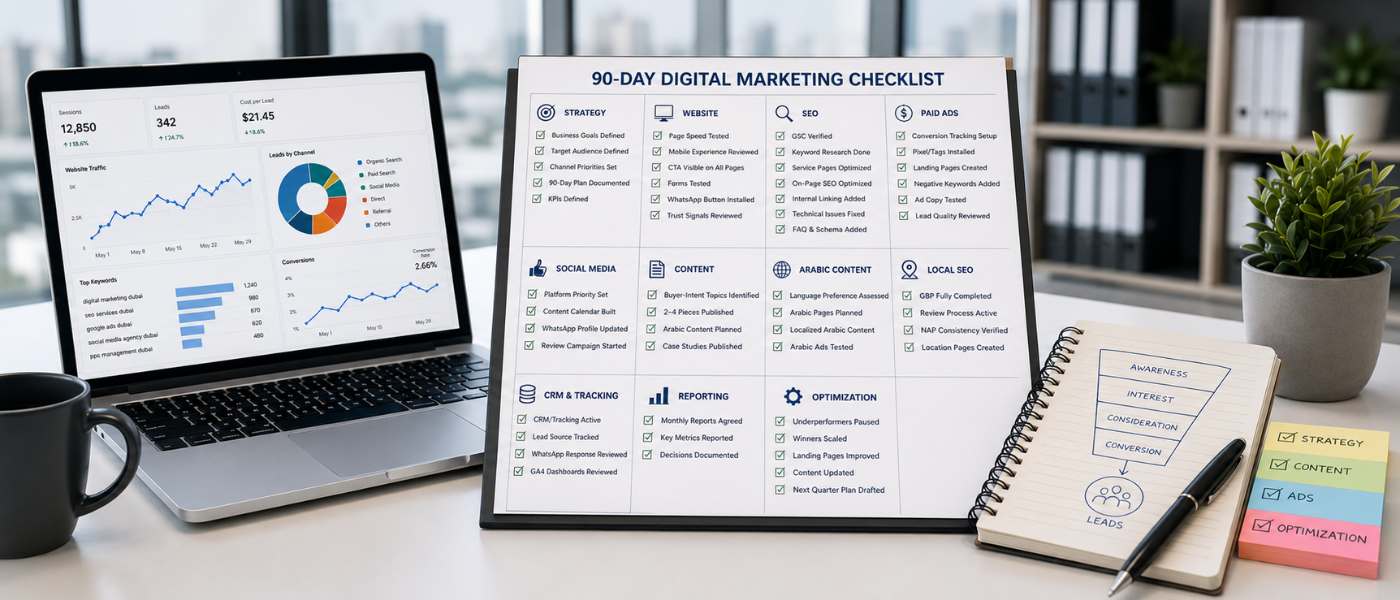
90-Day Digital Marketing Checklist for Dubai SMEs
Strategy
Business goals and target audience defined with specific criteria
Channel priorities ranked against audience behavior and budget
90-day plan documented with owners and timelines
KPIs defined: leads, cost per lead, organic traffic, keyword rankings, conversion rate
Website
Page speed tested on mobile and desktop
Mobile experience reviewed across all service pages
CTA visible on every page without scrolling
Forms tested for submission and confirmation
WhatsApp click-to-chat button installed and click-tracked
Trust signals reviewed: reviews, case studies, credentials, location
SEO
Google Search Console verified
Keyword research completed for service and location terms
Service pages reviewed for keyword alignment
Title tags, meta descriptions, and H1 tags optimized
Internal linking between service pages added
Technical issues from GSC flagged and fixed
FAQ sections added to key service pages with schema markup
Paid Ads
Google Ads conversion tracking installed and verified
Meta Pixel installed and verified
LinkedIn Insight Tag installed if B2B
Dedicated landing pages created per campaign
Negative keyword list built before launch
Ad copy variants tested from day one
Lead quality reviewed alongside lead volume weekly
Social Media
Platform priority set based on audience profile
Content calendar built for 30-day periods
WhatsApp Business profile updated and linked from all social bios
Review generation campaign started on Google and relevant platforms
Content
Buyer-intent content topics identified from keyword research
Two to four pieces published in first 60 days
Arabic content need assessed and Arabic pages planned if relevant
Case studies or outcome-based content drafted and published
Arabic and Multilingual Content
Target audience language preference assessed
Highest-value service pages prioritized for Arabic versions
Arabic pages built with localized copy, not translated English
Arabic ad copy tested alongside English in relevant campaigns
Local SEO
Google Business Profile fully completed with service descriptions, hours, and photos
Review generation process active and monitored
NAP consistency verified across website, GBP, and directory listings
Location-specific service pages created for primary Dubai areas served
CRM and Tracking
CRM or lead tracking sheet active with source fields defined
Lead source tracked for every inquiry
WhatsApp follow-up response time reviewed and documented
GA4 dashboards reviewed weekly with defined metrics
Reporting
Monthly report structure agreed with decision-maker
Metrics reported: leads by source, cost per lead, organic traffic, keyword movement, conversion rate, and WhatsApp response rate
Campaign decisions documented with rationale
Optimization
Underperforming keywords and audiences paused at 30-day review
Winning campaigns scaled at 60-day review
Landing pages improved based on conversion data
Content updated based on search performance data
Next quarter plan drafted at 90-day review
Conclusion
A digital marketing strategy in Dubai that produces measurable leads is built on a foundation of clean tracking, well-structured landing pages, a defined channel mix matched to the audience, and a 90-day commitment to testing and optimizing before scaling. The businesses that see consistent return from digital marketing in Dubai are not always the ones with the largest budgets. They are the ones that built the foundation correctly, chose their channels deliberately, and measured performance at the right level of detail.
The 90-day framework in this article covers what to fix before spending, which channels to activate in what order, how to allocate budget by business stage, when Arabic content and local SEO matter, and how to assess whether in-house execution or outsourced support is the right model for where the business is now.
Dubai’s digital marketing environment is competitive, but it rewards businesses that combine local market knowledge with disciplined execution. SEO, paid ads, WhatsApp lead flows, Arabic content, and CRM integration are not separate activities. They are connected parts of one system. The strategy is what connects them.
If your business needs a clearer 90-day digital marketing plan, iValuePlus can help assess your current marketing setup, identify the right channels for your sector and audience, and build an execution roadmap with defined activities, budgets, and success metrics. Start the conversation on the digital marketing services.
FAQ
What is the best digital marketing strategy in Dubai for SMEs?
The best digital marketing strategy for SMEs in Dubai combines local SEO, Google Search Ads for high-intent keywords, Meta Ads for awareness and retargeting, WhatsApp lead follow-up, and clean conversion tracking to measure every channel’s contribution. The right channel mix depends on the industry, target audience, and sales cycle length. Start with foundation setup and tracking before activating paid spend.
How do you create a digital marketing strategy in Dubai?
Create a digital marketing strategy in Dubai by auditing your website, tracking, and lead sources first, then identifying which two or three channels best match your audience’s search and purchasing behavior. Build a 90-day plan covering foundation setup in days 1 to 30, channel activation in days 31 to 60, and optimization in days 61 to 90. Confirm tracking is working before committing to ad spend.
What should a 90-day digital marketing plan for Dubai businesses include?
A 90-day digital marketing plan for Dubai businesses should include a full audit and tracking setup in the first 30 days, SEO improvements, paid media testing, landing page optimization, and lead capture workflows in days 31 to 60, and campaign optimization, retargeting, and scaling decisions based on real data in days 61 to 90. Each phase requires clean measurement to make the next phase effective.
How much should SMEs spend on digital marketing in Dubai?
Dubai SMEs at the growth stage should allocate between AED 8,000 and AED 20,000 per month on digital marketing, with 35 to 40 percent going to paid advertising and 15 to 20 percent to SEO and content. Early-stage businesses can start with AED 3,000 to AED 8,000 focused on local SEO, Google Ads for high-intent terms, and WhatsApp lead flow setup. Budget allocation should follow performance data, not assumptions.
Which digital marketing channels work best for Dubai businesses?
Google Search Ads and local SEO work best for service businesses targeting high-intent buyers. Meta Ads are effective for B2C, eCommerce, and brand awareness. LinkedIn is the strongest B2B lead generation channel. WhatsApp is essential for lead follow-up across all sectors. Arabic content and local SEO pages are critical for businesses serving Emirati and Arab expatriate audiences. The right mix depends on business type and audience profile.
Is SEO or paid advertising better for Dubai SMEs?
SEO and paid advertising serve different timelines and work best when used together. Paid advertising generates leads within two to four weeks but stops when budget stops. SEO builds compounding organic visibility over three to six months. Most Dubai SMEs should run Google Ads for immediate lead generation while building SEO infrastructure in parallel, then reduce paid dependency as organic rankings improve.
Why is Arabic content important for UAE businesses?
Arabic content is important for UAE businesses targeting Emirati nationals, Gulf Arab professionals, and Arabic-speaking expatriates who search and make decisions primarily in Arabic. Healthcare clinics, real estate businesses, education companies, and retail brands with significant Arab customer bases see material commercial benefit from Arabic SEO and localized Arabic landing pages. Arabic content requires genuine localization, not just translation, to build trust and convert effectively.
How can Dubai businesses generate better leads online?
Dubai businesses generate better leads online by combining high-intent Google Ads with dedicated landing pages, local SEO targeting service and location keywords, WhatsApp click-to-chat on all key pages, active Google Business Profile review generation, and retargeting for visitors who did not convert on first visit. Lead quality improves when conversion tracking connects every lead to its source, enabling budget to follow performance.
Should Dubai SMEs hire a digital marketing agency or build an in-house team?
Dubai SMEs should outsource digital marketing when they need SEO, paid ads, content, and analytics managed as an integrated system but cannot justify the cost of hiring a full team internally. An in-house team makes sense at the stage where marketing volume and brand complexity justify dedicated headcount. A hybrid model with an in-house marketing manager and outsourced channel execution works well for growth-stage businesses.
How long does digital marketing take to show results in Dubai?
Google Ads can generate leads within two to four weeks with correct setup. Local SEO and Google Business Profile improvements typically show map ranking changes within four to eight weeks. Content SEO and organic search rankings improve meaningfully within three to six months with consistent effort. Social media visibility builds over weeks, but its contribution to lead generation depends on retargeting and a connected CTA strategy.
What are the most common digital marketing mistakes Dubai businesses make?
The most common mistakes are running paid ads before conversion tracking is working, sending traffic to the homepage instead of a dedicated landing page, measuring social media performance by follower count instead of leads, treating Arabic content as direct translation rather than localization, changing campaigns after two weeks before enough data exists, and choosing agencies on price rather than process. Each mistake either wastes budget or produces data that cannot be acted on.
What is the difference between digital marketing strategy and digital marketing trends in Dubai?
Digital marketing strategy in Dubai is the execution plan: which channels to use, how to allocate budget, what to build in the first 90 days, and how to measure results. Digital marketing trends in Dubai describe what is changing in the market, including AI, short-form video, Arabic search growth, and performance marketing. Strategy tells you what to do. Trends inform how to adapt that strategy to what is working now.
Recent Post
Staff Augmentation vs Full-Time Hiring: A Strategic Comparison for 2026
Compare staff augmentation vs full-time hiring across cost, speed, flexibility,...
Step-by-Step Guide to Setting Up Accounting Services in India in 2026
Learn how to start accounting services in India in 2026:...

iValuePlus Services
iValuePlus is a one-stop solution to address all your needs to access, build and grow your business in the Indian market which is cost-effective & has a huge talent pool. Established in 2019 as a ‘Business Solution provider', our team has delivered successful growth projects in the international market.
Our services include setting up ODC (offshore development center), Staff Augmentation, Talent Acquisition, Digital Marketing, in the IT/ITES domain.