

An effective offshore operating model connects financial control, people management...
Categories

Why Your Deployment Cycle Is Slow and How DevOps Solutions Fix It
In today’s fast-moving digital landscape, speed is everything. Businesses that release products and updates faster gain a competitive edge, while those stuck in slow deployment cycles risk falling behind.
Yet, many organizations continue to struggle with delayed releases, missed deadlines, and inefficient workflows.
A slow deployment cycle doesn’t just impact IT—it affects business growth, customer satisfaction, and revenue.
The root cause? Outdated processes, lack of automation, and poor collaboration.
The solution? DevOps solutions.
What Is a Deployment Cycle?
A deployment cycle is the complete sequence of steps that moves code from a developer’s machine into live production — covering development, testing, integration, deployment, and monitoring. In high-performing teams, this process is largely automated and completes in minutes. In organizations still relying on manual steps, it often takes days or weeks.
The deployment cycle has five core stages:
- Development — Code is written and committed to version control.
- Testing — Automated and manual tests verify correctness and performance.
- Integration — Code is merged with the main branch and integration tests run.
- Deployment — Validated code is pushed to staging, then production.
- Monitoring — Live systems are observed for errors, latency, and anomalies.
In theory, this is clean and linear. In practice, it breaks down at almost every stage for teams that haven’t modernized their workflows.
Why Your Deployment Cycle Is Slow: 7 Root Causes
These are patterns that repeat across engineering teams of every size — from 10-person startups to 500-person enterprise IT departments.
1. Manual Testing and Deployment
Manual QA processes are the single biggest deployment bottleneck for most mid-sized teams. When a human has to click through a test suite, or manually copy build artifacts to a server, you’ve introduced both a speed limit and a failure point. Beyond the time cost, manual testing is inconsistent — automation doesn’t get tired, doesn’t skip edge cases, and doesn’t have Friday-afternoon attention problems.
2. No CI/CD Pipeline (or a Broken One)
Continuous Integration/Continuous Delivery (CI/CD) is the backbone of modern software delivery. Without it, code integration happens infrequently and in large batches — which means larger merges, more conflicts, and more things that can break at once. A properly configured CI/CD pipeline automatically runs builds and tests on every commit, giving developers immediate feedback.
3. Development and Operations Working in Silos
This is the cultural problem DevOps was originally designed to solve. When developers throw code ‘over the wall’ to operations — and operations teams have no visibility into what’s coming or when — miscommunication is inevitable. The solution isn’t just shared tools. It’s shared responsibility.
4. Legacy Infrastructure That Can’t Keep Up
Older infrastructure creates compounding friction over time. What worked for a team of 5 engineers deploying monthly doesn’t work for a team of 50 deploying daily. Infrastructure as Code (IaC) tools like Terraform and Ansible allow teams to define and provision infrastructure consistently, repeatably, and fast.
5. Security Reviews That Happen Too Late
The traditional model puts security review at the end of the pipeline — as a gate before release. When security issues are found at that stage, they require significant rework. DevSecOps addresses this by integrating security scanning earlier — at the commit and build stage — so issues are caught when they’re cheapest to fix.
6. No Observability After Deployment
Deploying without monitoring is like driving without a dashboard. Without real-time observability — logs, metrics, and distributed traces — teams can’t tell whether a deployment succeeded in any meaningful sense. They find out from user complaints, not from their own systems.
7. Complexity Without Standardization
As organizations grow, the deployment process often becomes a maze of undocumented scripts and ‘tribal knowledge’ that only two people understand. Standardizing deployment workflows — with documented runbooks, shared tooling, and automated rollback capabilities — reduces this fragility significantly.
How DevOps Solutions Actually Fix Slow Deployment Cycles
CI/CD Automation: The Foundation
CI/CD pipelines automate the most time-consuming and error-prone parts of the deployment process. Properly configured, they handle: automated code builds on every commit, unit/integration/regression test execution, artifact versioning, environment-specific deployment rules, and rollback triggers when health checks fail. The key word is ‘properly configured’ — a CI/CD pipeline that runs flaky tests or takes 45 minutes to complete doesn’t solve the underlying problem. Pipeline quality matters as much as pipeline existence.
Infrastructure as Code (IaC): Consistency at Scale
IaC tools eliminate the ‘it works on my machine’ problem by making infrastructure configuration declarative and version-controlled. If a production environment needs to be rebuilt, it can be done from code — not from memory or a 200-page runbook. For teams scaling rapidly or operating across multiple cloud environments, IaC is not optional.
Continuous Testing: Quality at Every Stage
The shift from ‘test at the end’ to ‘test at every stage’ is one of the highest-leverage changes a team can make. When automated tests run on every commit — unit tests, integration tests, security scans, performance benchmarks — the feedback loop shrinks from days to minutes.
DevSecOps: Security Without the Bottleneck
Security doesn’t have to be a gate. When security tooling is integrated into the CI/CD pipeline — static analysis, dependency scanning, secrets detection, compliance checks — security teams can review results continuously rather than in a rush before a release. This is the DevSecOps model: security as a shared responsibility, running in parallel with development.
Real-Time Monitoring and Observability
Deployment doesn’t end when code reaches production. Modern DevOps practices treat observability as a core part of the delivery process — not an afterthought. This means structured logging, metrics dashboards, distributed tracing, and alerting calibrated to signal real problems, not noise.
DevOps Solutions vs. Traditional Development
Dimension | Traditional Development | DevOps Approach |
Deployment frequency | Monthly or quarterly | Daily to multiple times/day |
Time to restore service | Days to weeks | Hours or less |
Change failure rate | High (15–45%) | Low (0–15%) |
Automation coverage | Minimal | Comprehensive |
Security integration | End-stage gate | Built into pipeline |
Team collaboration | Siloed by function | Shared ownership |
Infrastructure management | Manual, undocumented | Code-defined, version-controlled |
How to Implement DevOps Solutions Successfully
- Audit Your Current State — Before buying tools or changing processes, map what you have. Where are releases slowing down? What percentage of your test suite is automated? How often are deployments failing — and why? You can’t improve what you can’t measure.
- Align Leadership and Engineering — DevOps transformation fails most often not because of technical complexity, but because it lacks genuine executive sponsorship. Engineering teams need both the mandate and the protected time to do this work without being pulled back into feature delivery.
- Start with CI/CD — Incrementally — Don’t try to automate everything at once. Start with a single service or repository, get the CI pipeline stable, then add CD. Trying to boil the ocean in one sprint is how DevOps projects get killed before they deliver value.
- Invest in Developer Experience — A CI/CD pipeline that takes 40 minutes to run, or a deployment process with 15 manual approval steps, creates as much friction as no automation at all. Developer experience is a metric worth tracking.
- Build a Feedback Culture — DevOps is most effective when post-incident reviews are blameless, metrics are visible to the whole team, and improving the deployment process is treated as part of the job — not an optional project.
Common Mistakes That Derail DevOps Implementation
- Buying a platform and calling it DevOps — tools enable DevOps practices; they don’t create them
- Skipping the culture work — siloed teams don’t collaborate just because they share a Jira board
- Over-automating before stabilizing — automating a broken process creates a faster broken process
- Choosing tools without considering integration — a six-tool stack that doesn’t talk to itself creates its own complexity problem
- Neglecting training — tooling only delivers value if the people using it understand how and why it works
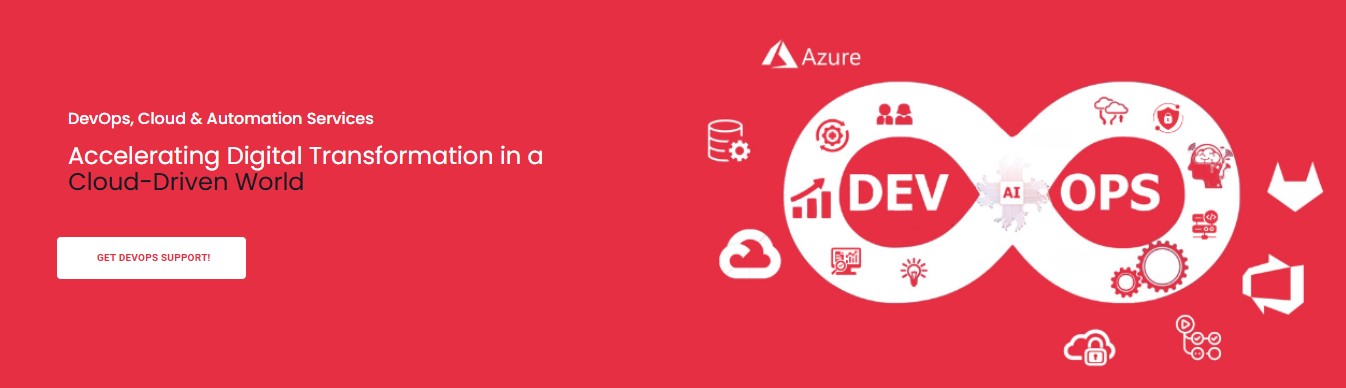
How iValuePlus Helps with DevOps Solutions
iValuePlus provides end-to-end DevOps solutions for businesses that need to move faster without introducing more risk. We start by understanding your current deployment workflow and engineering team structure — and build from there.
- CI/CD Pipeline Design and Setup — from scratch or migrating from legacy tooling
- Infrastructure as Code — Terraform, Ansible, and cloud-native provisioning
- Cloud Integration — AWS, Azure, and GCP deployment architecture
- DevSecOps Integration — security scanning embedded in your pipeline
- Observability Stack — monitoring, alerting, and logging infrastructure
- Ongoing Optimization — pipeline performance, deployment frequency, MTTR reduction
Future Trends in DevOps Worth Watching
- Trend — AI-Augmented Pipelines — tools that flag failing tests before they run and predict deployment risk
- Trend — Platform Engineering — internal developer platforms that standardize deployment experience across teams
- Trend — GitOps — treating Git as the single source of truth for both application and infrastructure state
- Trend — Continuous Compliance — automating compliance evidence collection alongside the pipeline in regulated industries
FAQ
Q: What is the main cause of slow deployment cycles?
In most organizations, the primary cause is an over-reliance on manual processes — manual testing, manual environment setup, and manual approval chains. These create bottlenecks that accumulate with every new service, team member, or product line added. The second most common cause is siloed team structures where developers and operations work separately rather than collaboratively.
Q: How long does it take to implement DevOps solutions?
A small team with a single codebase can have a working CI pipeline in place within two to four weeks. Enterprise-scale DevOps transformation — covering multiple teams, legacy systems, and cultural change — typically takes six to twelve months to reach meaningful maturity. The key is incremental progress, not a big-bang rollout.
Q: Can DevOps solutions work with legacy systems?
Yes, though it requires more planning. Legacy monolithic applications can be wrapped with modern CI/CD tooling even before they’re fully modernized. The typical path: automate testing first, then automate deployment, then gradually decompose the monolith into services that can be deployed independently.
Q: What’s the difference between DevOps and DevSecOps?
DevOps integrates development and operations workflows. DevSecOps extends this by adding security as a shared responsibility throughout the pipeline — running security scans and compliance validation at the build and test stages rather than as a final approval gate. The goal is to catch security issues early, when they’re cheapest to fix.
Q: How does DevOps reduce deployment failures?
By making deployments smaller, more frequent, and more automated. When you deploy large batches of changes infrequently, any failure involves sorting through weeks of changes. When you deploy small, tested changes continuously, failures are isolated, easier to diagnose, and faster to roll back. DORA research shows elite DevOps teams have a change failure rate of 0–15%, compared to 46–60% for low-performing teams.

Conclusion
A slow deployment cycle isn’t a sign that your team isn’t working hard enough. It’s usually a sign that the processes around them weren’t designed for the speed modern software delivery demands.
DevOps solutions — when implemented thoughtfully, with genuine team alignment and a clear starting point — don’t just accelerate releases. They reduce the cost of failures, improve developer experience, and give your engineering investment more leverage.
The companies that move faster in 2026 won’t be the ones with the biggest engineering budgets. They’ll be the ones that took the time to fix the underlying process before scaling it.
If you’re unsure where your deployment cycle is losing time, that’s exactly where to start.
Ready to Speed Up Your Deployment?
Get in touch with us. We’ll audit your current workflow, identify the bottlenecks, and build a clear path forward.
Recent Post
Build or Buy AI: A Decision That Keeps Business Goals Ahead of Technology
Build or Buy AI: A Decision That Keeps Business Goals...
Why AI Automation Projects Get Stuck at the Pilot Stage – And What Businesses Should Do Next
Why AI Automation Projects Get Stuck at the Pilot Stage...

iValuePlus Services
iValuePlus is a one-stop solution to address all your needs to access, build and grow your business in the Indian market which is cost-effective & has a huge talent pool. Established in 2019 as a ‘Business Solution provider', our team has delivered successful growth projects in the international market.
Our services include setting up ODC (offshore development center), Staff Augmentation, Talent Acquisition, Digital Marketing, in the IT/ITES domain.