
Why AI Automation Projects Get Stuck at the Pilot Stage...
Categories
Tags
- digital workspace infrastructure solutions
- infrastructure and operations trends
- managed office infrastructure
- office infrastructure management
- office infrastructure services
- professionally operated infrastructure
- workplace and infrastructure
- workplace infrastructure management
- workspace infrastructure management

When the Office Is Running but No One Is Truly Managing It
A US technology company with an 80-person engineering team in Bengaluru’s Outer Ring Road corridor experienced three network outages in six months. Each one ran between 90 minutes and four hours. Each time, the Operations Lead in London spent half a day on calls with the local office manager, the ISP, and the building’s IT team, attempting to diagnose a problem from 8,000 kilometres away. There was no documented escalation path. There was no secondary ISP. There was no SLA against which to hold the vendor accountable.
The infrastructure worked well enough when it worked. The problem was that no one was actually managing it.
This is the operational reality that office infrastructure management addresses, not the initial setup, not the IT support contract for break-fix requests, but the sustained, systematic management of everything that keeps an office running day after day, at a level that does not require reactive crisis management from the people who should be focused on the business.
This guide covers the full scope of office infrastructure management, what it includes and what it is not, how to manage it at scale, what professionally operated infrastructure actually looks like, when managed services outperform self-management, and how the management model needs to evolve as an India office grows from 20 to 200 people.
What Office Infrastructure Management Covers and What It Is Not
Office infrastructure management is the ongoing operational function that maintains, monitors, and governs all physical and digital systems in an office, including IT infrastructure, power and connectivity, physical facilities, vendor relationships, and statutory compliance. It is distinct from initial office setup, reactive IT support, and facilities management in isolation.
Before covering how to manage office infrastructure well, it is worth being precise about what the function actually covers.
Office infrastructure management is not:
- Initial office setup (fit-out, procurement, cabling, installation)
- A reactive IT helpdesk contract that fixes problems when employees report them
- Facilities management in isolation (cleaning, security, pantry)
- A one-time infrastructure audit
Office infrastructure management is the continuous operational function that sits after setup and before any specific incident. It covers five distinct areas:
Physical infrastructure: Power systems (UPS, generator, power conditioning), HVAC, physical security, access control, fire safety, and the maintenance schedules that keep each of these functional rather than just installed.
IT infrastructure: Network performance, endpoint device management, patch and update schedules, cloud and VPN connectivity, and the monitoring systems that surface problems before users experience them.
Vendor management: The ongoing management of every third-party supplier providing infrastructure services, including ISPs, hardware vendors, facilities contractors, and security firms, against documented SLAs.
Compliance and documentation: The calendar of statutory renewals, inspections, and certifications that an office must maintain, from Shops and Establishments registration to fire safety inspections and electrical safety certifications.
Workspace and facilities: The operational quality management of housekeeping, visitor management, meeting room readiness, and fit-out maintenance that determines the day-to-day experience of the people using the office.
For companies evaluating how their current infrastructure setup compares to what ongoing management requires, the distinction between these two functions is the starting point.
How to Manage Office Infrastructure at Scale in 6 Steps
Managing office infrastructure at scale requires six sequential disciplines: documenting the full infrastructure inventory with named ownership, establishing preventive maintenance schedules for every critical system, implementing performance monitoring with defined SLA thresholds, building a vendor management framework with formal review cadences, maintaining a statutory compliance calendar with advance preparation windows, and reviewing infrastructure performance data monthly against baseline benchmarks.
Step 1: Complete inventory and ownership mapping.
Every infrastructure component must be documented: hardware assets (servers, switches, UPS units, access points), software systems, vendor contracts, and physical systems (HVAC, generators, fire suppression). Each component must have a named owner accountable for its performance and maintenance.
Step 2: Build preventive maintenance schedules.
Reactive maintenance is expensive and disruptive. Preventive maintenance is scheduled and controlled. Define quarterly maintenance visits for UPS systems and generators, monthly checks for network hardware, semi-annual reviews for HVAC, and annual reviews for fire safety systems and access control. Document each visit and its outcomes.
Step 3: Implement performance monitoring.
Network uptime, internet bandwidth utilisation, UPS charge status, and helpdesk ticket resolution times should be tracked continuously, not reviewed after an incident. Monitoring tools surface degradation before failure. Define alert thresholds and the escalation path when a threshold is breached.
Step 4: Establish a vendor management framework.
Every infrastructure vendor should have a documented SLA and a quarterly performance review. Dual-vendor strategies for critical services (primary and backup ISP, primary and backup UPS maintenance contractor) should be in place for any service where downtime has direct business impact.
Step 5: Maintain a statutory compliance calendar.
India office compliance requires advance preparation: Shops and Establishments registration renewals, fire safety inspection scheduling, electrical safety certification renewal, building management committee submissions, and DPDPA 2023 data governance reviews for IT systems. These are calendar-driven obligations, not reactive tasks.
Step 6: Review and report monthly.
Monthly review of infrastructure performance data against baseline benchmarks is what separates infrastructure management from infrastructure maintenance. Define the metrics (uptime percentage, mean time to resolution for incidents, number of preventive maintenance tasks completed on schedule) and review them consistently.
The Key Components of Office Infrastructure Management
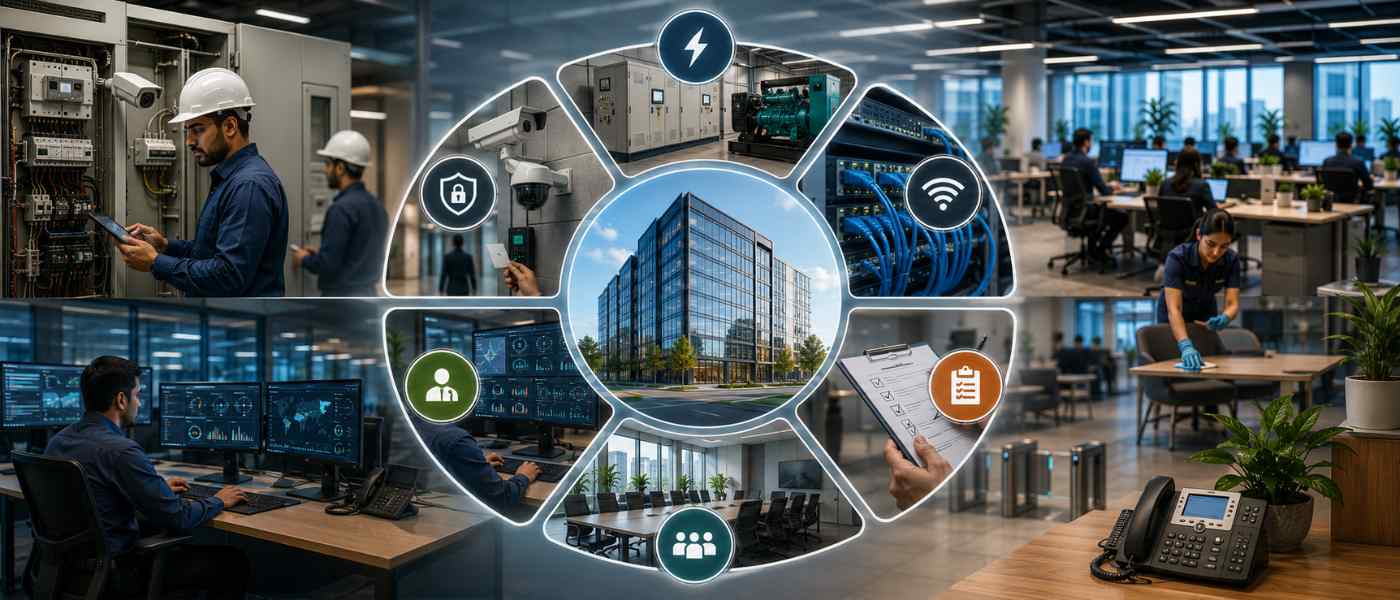
The five key components of office infrastructure management are physical infrastructure (power, HVAC, security), IT infrastructure (network, devices, cloud connectivity), vendor management (SLA governance and performance review), compliance and documentation (statutory renewals and inspections), and workspace management (facilities quality and employee experience operations).
Physical Infrastructure Management
Power reliability is the most India-specific physical infrastructure management challenge. In India’s major office cities, including Bengaluru, Hyderabad, and Gurugram, commercial power supply quality varies significantly by building quality, time of year, and location within the city. Grade-A buildings in Electronic City, Hitec City, and Gurugram’s Cyber City corridor typically offer better supply reliability than secondary locations, but even Grade-A buildings experience brief interruptions that require UPS and generator backup to cover.
UPS system maintenance requires quarterly battery health checks, load testing, and discharge cycle verification. Generator maintenance requires monthly test runs under load, fuel level management, and annual service visits. These are not optional maintenance tasks. An untested generator that fails during a real power cut is operationally equivalent to having no generator.
HVAC management in Indian offices is a constant operational task. Server room cooling is a critical dependency: network equipment operating above thermal thresholds experiences degraded performance and reduced hardware life. HVAC systems serving server rooms should have independent monitoring and a defined response protocol separate from the general office HVAC schedule.
Physical security and access control systems require firmware updates, battery replacements in wireless sensors, and periodic testing of door-locking mechanisms. These systems are often set up and then forgotten until they fail. A preventive maintenance schedule that tests every access point quarterly prevents the failure mode where a critical door is unlocked because the control panel battery died.
IT Infrastructure Management
Network performance management is where most India office IT infrastructure failures originate. TRAI telecom market data consistently shows that enterprise broadband in India’s major cities is available at competitive bandwidth rates, but the last-mile reliability between the ISP’s point of presence and the building varies significantly. A dual-ISP configuration with automatic failover is not a luxury for an office above 30 people. It is the baseline.
Endpoint device management requires documented asset registers, patch management schedules aligned with the OS and application update cycles, and a hardware refresh cycle (typically three years for laptops in an intensive use environment). Companies managing devices without a formal asset register consistently encounter the same problems: devices with outdated operating systems, unlicensed software discovered during audits, and no record of which equipment was assigned to a departed employee.
Cloud connectivity management for India offices supporting global teams requires VPN configuration management, split tunnelling policies, and bandwidth allocation between latency-sensitive applications (video calls) and background traffic (file synchronisation, cloud backups). Getting these configurations right reduces the most common complaint in India offices supporting global teams: poor video call quality during the Bengaluru or Gurugram business day.
In 2026, zero-trust network architecture is rapidly becoming the standard IT infrastructure configuration for India GCC and ODC offices, driven by cybersecurity mandates from US and UK parent companies. Zero-trust means no device or user is trusted by default, even within the office network perimeter. Every access request is verified against identity, device health, and context before being granted. For India offices managing this transition, the IT infrastructure management function must now include zero-trust policy management, conditional access configuration, and regular access review cycles alongside the traditional network and device management scope.
Vendor Management
Most India offices engage four to eight infrastructure vendors simultaneously: building management, ISP, hardware maintenance, UPS maintenance, HVAC maintenance, security systems, housekeeping, and canteen or pantry services. Managing these relationships informally produces inconsistent service quality and no performance baseline.
A vendor management framework requires four elements: documented SLAs for each vendor covering response time, resolution time, and service quality metrics; a quarterly performance review meeting where SLA achievement is reviewed and deviations are formally noted; contract renewal tracking with a 90-day advance review window; and a named vendor manager on the client side accountable for each relationship.
The dual-vendor strategy for critical infrastructure services is particularly important for ISP management in India. ISPs operate on different last-mile infrastructure in most Indian cities: one provider on FTTH fibre, one on leased line or a different fibre provider. A dual-ISP configuration where failover is tested monthly is the standard for any office where connectivity downtime has direct delivery impact.
For companies establishing their infrastructure management approach for the first time, the guide on choosing the right infrastructure setup partner for an offshore team covers the vendor selection criteria that apply both at setup and in ongoing management.
Compliance and Documentation
India office compliance management involves a recurring calendar of statutory obligations that differ from what international companies manage in their home markets. The Shops and Establishments Act registration must be renewed annually in most states, with different renewal processes in Karnataka, Telangana, Haryana, and Maharashtra. Fire safety inspections are required annually by the local fire department. Electrical safety certifications from a licensed electrical contractor are required by most commercial building management committees.
Under DPDPA 2023, enforcement is now active rather than prospective. As of 2026, the Digital Personal Data Protection Act’s penalty provisions are live, and data fiduciaries managing employee and visitor personal data through office IT systems face real penalty exposure for non-compliance. Offices handling employee data through HRMS platforms, access control systems, and visitor management software must have completed their data governance review: what personal data is captured, how it is stored, who has access, how long it is retained, and whether processing is covered by appropriate consent or legitimate purpose grounds. This is no longer a future preparation task. It is a current compliance obligation.
Workspace and Facilities Management
The operational quality of housekeeping, pantry services, visitor management, and meeting room management directly affects the employee experience on hybrid working days. CBRE India’s hybrid workplace research consistently shows that the primary factor determining employee satisfaction with office attendance is the quality of the experience when they arrive, not the desk booking system or the commute alone.
Meeting room AV reliability is a specific management failure point in hybrid environments. A meeting room where the display cable is missing, the video conferencing unit requires a restart, or the calendar booking system is out of sync with physical availability creates frustration disproportionate to the technical simplicity of the fix. Meeting room infrastructure requires a daily pre-check, not just break-fix support.
What Professionally Operated Infrastructure Includes
Professionally operated infrastructure means every component has a named owner, a documented SLA, a preventive maintenance schedule, and a performance dashboard. It means problems are surfaced by monitoring before users experience them, not reported by users after the fact. It is the operational standard that distinguishes a managed infrastructure from an adequately functioning one.
Most self-managed India offices operate on a model that might be described as “functioning until it is not.” The network is running. The power backup switches on when needed. The air conditioning cools the space. But there is no documentation of who is accountable for each system, no baseline performance data to compare against, no preventive maintenance schedule, and no escalation path that does not run through a single person.
When that single person is on leave, sick, or resigns, the entire informal infrastructure management system pauses with them.
Professionally operated infrastructure has six defining characteristics:
Named accountability for every component. Every infrastructure system has a named owner, whether internal or from a managed service provider, who is specifically accountable for its performance and maintenance. Not a team, not a general IT department, a named person with a documented responsibility.
Documented SLAs with performance review. Every vendor and every internal function operating infrastructure has a defined SLA covering response time, resolution time, and minimum performance standards. SLA performance is reviewed formally on a monthly or quarterly cadence, not only when something goes wrong.
Preventive maintenance schedules, followed and documented. Maintenance tasks are scheduled in advance, completed on time, and documented in a maintenance log that is available for audit. The documentation serves two purposes: it ensures the task was done and it creates a performance baseline that makes degradation visible before failure.
Performance monitoring with alert thresholds. Critical systems (network uptime, UPS charge status, ISP failover status, server room temperature) are monitored continuously with defined alert thresholds that trigger a response before a user-impacting incident occurs.
Documented escalation paths. Every category of infrastructure failure has a documented response path: who is called first, who is the escalation point if the first contact does not respond, what the resolution target is, and what interim measures are in place while resolution is in progress.
Audit-ready compliance documentation. All statutory certificates, inspection records, vendor contracts, and maintenance logs are filed in a structured system that can be produced for a building management committee, a fire department inspection, or a parent company audit on demand.
The difference between a professionally operated office and one that is merely adequately functional is not dramatic on a good day. It becomes apparent when something fails, when a compliance inspection occurs, or when the person who knew where everything was stored leaves the organisation.
Customizability of IT Infrastructure in Managed Office Environments
IT infrastructure customisation in a managed environment covers VLAN configurations for different team types, device provisioning standards by role, VPN and cloud access configurations for global connectivity, and software licence management per user profile. Managed providers handle customisation through change management processes that avoid disrupting standardised management frameworks.
A common concern when evaluating managed office infrastructure services is whether the standardised management model restricts the ability to configure IT infrastructure for specific team requirements. This concern is legitimate and worth addressing directly.
Network segmentation and VLAN configuration: In a managed environment, the managed service provider maintains the network architecture. Customisation requests, such as isolating a development environment on a separate VLAN, creating a guest network with bandwidth limits and content filtering, or segmenting access for different functional teams, are executed through a formal change request process rather than ad hoc. This process adds a short lead time (typically 24 to 48 hours for a non-urgent change) but ensures the change is documented, tested before implementation, and integrated into the overall network management framework.
Device provisioning by role: Managed infrastructure services typically maintain device provisioning templates by role category. Engineers receive laptops configured with development tools, elevated RAM, and specific security exceptions. Administrative staff receive standard provisioning. Client-facing staff may receive additional device security configurations. New hire provisioning against a pre-defined template is faster and more consistent than custom provisioning per individual. Deviations from standard templates are accommodated through the change management process.
Zero-trust access customisation: In 2026, managed office IT environments increasingly include zero-trust conditional access policies as part of the standard configuration. Customisation within a zero-trust framework means defining access policies by user role, device compliance status, and location context, rather than by network perimeter alone. Managed providers handle this through policy templates that are configured per client requirement and reviewed quarterly as team structures and access patterns change.
Cloud and VPN configuration: For India offices supporting global teams, VPN split tunnelling configurations, cloud application access policies, and bandwidth prioritisation for video conferencing applications are managed centrally by the provider. Customisation requests from the client team are accommodated through documented change requests rather than informal adjustments that may not be reflected in the broader network management configuration.
Software licence management: Managed providers track software licence allocation per user profile, licence expiry dates, and usage data to support licence optimisation. Customisation of the software environment per individual or team is accommodated within the licence management framework, with the provider managing compliance tracking and renewal.
The practical trade-off is between the speed of ad hoc changes (faster but undocumented) and the managed change process (slightly slower but documented and integrated). For offices above 50 people, the managed change process consistently produces fewer incidents than informal IT configuration changes made by individuals without a change log.
Infrastructure Solutions for More Efficient Office Workflow
The infrastructure improvements with the highest workflow impact are network redundancy (dual ISP with automatic failover), meeting room AV reliability (daily pre-checks and standardised equipment), device provisioning speed for new hires (pre-configured provisioning templates), cloud storage consistency (dedicated bandwidth allocation), and visitor network isolation (preventing guest traffic from affecting primary connectivity).
Not all infrastructure improvements have equal workflow impact. Prioritising by the friction point that most affects productivity, rather than by technical complexity or cost, produces faster returns on infrastructure investment.
Network redundancy: A primary ISP connection with automatic failover to a secondary provider prevents the entire-office productivity halt that follows a single-ISP outage. For a 60-person India engineering team, four hours of network downtime represents 240 person-hours of lost productivity. The cost of a secondary ISP line at approximately INR 8,000 to 15,000 per month (2026 estimate) is recovered from a single prevented outage within the first quarter.
Meeting room AV reliability: The gap between a meeting room with reliable AV and one that requires technical assistance before every call is measurable in meeting preparation time across the organisation. Standardise equipment across all meeting rooms, implement daily pre-checks that confirm each room is camera-ready and cable-complete, and assign explicit responsibility for AV maintenance to a named person with a weekly verification task.
New hire device provisioning speed: Every day between a new hire joining and receiving a fully configured, access-enabled device is a day of below-productivity onboarding. Managed provisioning templates that can be deployed in two to four hours rather than two to four days reduce this friction significantly, particularly for engineering teams where tooling access is prerequisite to productive work.
Cloud storage access consistency: In hybrid environments where employees access shared files and project repositories from both office and home networks, inconsistent cloud storage performance in the office (caused by insufficient bandwidth allocation for cloud traffic) creates a perverse situation where cloud access is better from home than from the office. Dedicated bandwidth allocation for cloud traffic and QoS configuration for cloud storage applications resolves this.
Visitor network isolation: Guest Wi-Fi that shares bandwidth with the primary corporate network creates two problems: visitor usage degrades corporate network performance during peak hours, and the guest network becomes a potential security surface if not properly isolated. A physically separate SSID on a dedicated bandwidth allocation with internet-only access and content filtering resolves both.
For companies reviewing their current infrastructure against the office infrastructure setup trends for 2025, the workflow efficiency improvements above consistently rank as the highest-priority operational upgrades in hybrid office environments.
Managed vs Self-Managed Office Infrastructure: Choosing the Right Model
The managed office infrastructure model provides defined SLAs, named accountability, preventive maintenance, and India-specific operational expertise in exchange for a monthly service fee. Self-managed is appropriate for offices below 30 people with an on-ground IT person. Above 50 people, or for foreign companies managing India offices remotely, managed services consistently outperform self-management on reliability and compliance coverage.
Managed vs Self-Managed Office Infrastructure Comparison
Factor | Self-Managed | Managed Service |
Setup requirements | In-house IT/facilities hire or informal responsibility allocation | Service agreement with defined scope and SLAs |
Cost structure | Fixed staff cost plus variable vendor costs | Monthly fee per seat or per service, predictable |
Accountability | Diffuse, often dependent on one person | Contractual, with named ownership and documented SLAs |
Scalability | Headcount-dependent: each growth phase requires new hiring decisions | Scales with office headcount within the service agreement |
Compliance risk | High if no dedicated compliance calendar owner | Provider-managed with advance preparation windows |
Key-person dependency | High: one resignation removes institutional knowledge | Eliminated: provider maintains documentation and continuity |
Performance visibility | Typically absent or reactive (issues reported after they occur) | Dashboard-based, proactive monitoring with monthly reporting |
India-specific knowledge | Dependent on individual hire’s experience | Embedded in provider’s delivery model for India operations |
When self-management is the right choice:
For offices below 30 people with an on-ground IT manager who has India office experience, self-management can be adequate if the infrastructure footprint is simple (single ISP, no server room, standard end-user devices) and the compliance calendar is explicitly owned. Self-management works when it is intentional and resourced, not when it is the default because no one has thought about the alternative.
When managed services are the right choice:
For offices above 50 people, multi-location operations, or foreign companies managing India offices from overseas without on-ground IT leadership, the managed service model consistently delivers better infrastructure reliability, lower compliance risk, and better performance visibility than self-management at comparable or lower total cost.
At 80 people in 2026, the fully-loaded cost of an in-house IT and facilities function (one IT manager plus one facilities coordinator, with vendor costs) typically runs INR 32 to 48 lakh per year. A comparable managed service contract runs INR 20 to 30 lakh per year with broader coverage, documented SLAs, and no key-person departure risk.
The honest limitation of managed services:
Managed service models introduce a dependency on the provider’s responsiveness and service quality. If the provider’s account management is poor or the on-ground delivery team is under-resourced, the managed model can perform worse than a motivated in-house hire. Provider selection quality is as important as the model selection decision.
Not sure whether your current India office infrastructure management model is working as well as it should? iValuePlus offers an infrastructure management assessment for foreign-owned India offices, reviewing your current coverage against the managed vs self-managed framework above.
How Office Infrastructure Management Scales as the India Team Grows
Office infrastructure management requirements change materially at three headcount thresholds: 20 to 50 people (self-management viable with named ownership), 50 to 100 people (dedicated management function required, typically outsourced), and 100 to 200 people (GCC-grade governance with performance dashboards, compliance reporting, and multi-vendor SLA management).
20 to 50 People: Named Ownership Is the Priority
At this stage, self-management is viable if it is intentional. The primary failure mode is not complexity but diffusion: everyone assumes someone else is managing the infrastructure until something fails.
Define named ownership for each of the five infrastructure component areas. This does not require five different people. A single capable office manager can own all five if they have a documented management framework, a vendor contact list with SLA expectations, and a statutory compliance calendar. What they cannot do without support is manage proactive monitoring or preventive maintenance across technical systems. For the IT infrastructure component specifically, supplementing the office manager with a part-time managed IT service adds the technical layer without requiring a full IT hire.
City selection at this stage affects infrastructure management directly. NASSCOM data shows that India now hosts more than 1,800 GCCs nationally as of 2026, with Bengaluru, Hyderabad, and Gurugram continuing to account for the majority of new foreign company office setups. Infrastructure management complexity varies by city: Gurugram offices in well-managed towers like DLF Cyber City experience fewer utility reliability issues than secondary market locations. For the city-specific infrastructure management implications, the best city to set up an office in India analysis covers these trade-offs in depth.
50 to 100 People: The Complexity Inflection Point
At 50 people, informal infrastructure management consistently breaks down. The indicators are predictable: incident frequency increases, vendor relationships become personality-dependent, compliance tasks get missed on the calendar, and the Operations Director or COO starts receiving infrastructure escalations directly because no one owns the escalation path.
This is the headcount range where dedicated infrastructure management ownership, whether in-house or via a managed service provider, produces the clearest return on investment. The functions that require dedicated ownership at this scale include: network and IT infrastructure monitoring (requiring either dedicated tooling or a managed IT provider with remote monitoring capability), vendor SLA management (requiring a formal quarterly review process rather than ad hoc calls), and the statutory compliance calendar (requiring advance preparation 60 to 90 days before each renewal deadline).
From operational experience working with India offices at this growth stage, the most common governance failure at the 50-person threshold is the absence of a documented escalation path. When the network goes down, who is called first? When that person does not respond within 15 minutes, who is called next? When the issue is still unresolved after two hours, who has the authority to engage an external contractor outside the normal procurement process? Documenting this escalation path, and testing it before an incident, is the single most operationally impactful step available to an Operations Director managing a growing India office.
100 to 200 People: GCC-Grade Infrastructure Governance
At 100 people and above, the infrastructure management function requires the governance structure of a Global Capability Centre operation, whether or not the office is formally designated as a GCC. The scale of the team, the complexity of the infrastructure footprint (multiple floors, potentially multiple buildings, a full server room or network equipment room, 150-plus managed devices), and the parent company’s compliance and audit requirements all point toward a formal managed infrastructure service model.
At this scale in 2026, the cost-per-person economics of managed infrastructure services are particularly clear. A managed service covering IT infrastructure, facilities management coordination, vendor SLA management, and compliance documentation for a 150-person India office typically runs INR 650 to 950 per person per month (2026 estimate), or approximately INR 12 to 17 lakh per month in total. The equivalent in-house function runs INR 20 to 28 lakh per month. The managed model delivers broader coverage, documented SLAs, performance dashboards, and no key-person risk at a lower total cost.

Digital Workspace Infrastructure Solutions for Modern India Offices
Digital workspace infrastructure solutions for India offices include cloud-based room booking systems, visitor management software, IT asset management platforms, network performance monitoring dashboards, and HRMS-integrated attendance and access systems. The highest-priority implementations reduce manual management overhead for office managers and provide remote visibility into office operations for overseas-based COOs and Operations Directors.
The shift from managing office infrastructure manually (spreadsheet asset registers, calendar-based compliance reminders, email-based vendor coordination) to managing it through integrated digital platforms reduces both management overhead and error rate. The specific platforms that deliver the highest return for India offices in the 20 to 200 person range include:
IT Asset Management platforms (such as Freshservice, ManageEngine Asset Manager, or ServiceNow for larger offices): maintain real-time device registers, track maintenance schedules, manage software licence compliance, and generate audit-ready reports. These platforms replace the spreadsheet asset register that most self-managed offices rely on and that inevitably becomes outdated within six months of an initial setup.
Network performance monitoring dashboards (such as Datadog, PRTG, or SolarWinds NPM): provide continuous visibility into network uptime, bandwidth utilisation, and device health. For overseas-based Operations Leads managing India offices remotely, a network monitoring dashboard that sends alerts on threshold breaches is the operational equivalent of having an on-ground IT manager for network visibility purposes.
Room booking and visitor management systems (such as Condeco, Robin, or comparable India-market solutions): integrate with calendar systems to prevent the double-booking and AV-preparation failures that are the most common source of employee frustration in hybrid offices.
DPDPA 2023 compliance in digital systems: With DPDPA enforcement now active as of 2026, visitor management systems and access control systems that capture and process personal data must comply with data processing obligations. Digital systems that automate consent capture, enforce data retention periods, and generate compliance audit trails are now preferable to paper-based visitor logs not simply for efficiency reasons but for legal compliance reasons. Offices still using manual visitor registers should treat migration to a compliant digital system as a priority action, not a future consideration.
What Professionally Operated Infrastructure Means for India-Specific Challenges
From operational experience managing India offices in Gurugram and Bengaluru, the infrastructure management challenges that distinguish Indian office environments from their Western equivalents are concentrated in three areas: power backup management, ISP relationship management, and building management committee compliance.
Power backup: A UPS system that has never been load-tested under actual power failure conditions is not managed infrastructure. It is installed infrastructure. Monthly test runs of the generator under load, quarterly battery health checks for the UPS, and documented response procedures for extended outages are the operational standards for professionally managed power backup in an Indian office environment.
ISP management: In Indian cities, ISP service quality is more variable than the line speed contract suggests. Escalation contacts above the standard customer support line, relationships with the ISP’s enterprise account team, and documented incident logs that support SLA compensation claims are the practical tools of effective ISP management. A managed infrastructure provider with existing relationships with enterprise ISP teams in Bengaluru and Gurugram can resolve connectivity incidents faster than a client making first contact through a standard support number.
Building management committee compliance: India commercial buildings require tenants to maintain current fire safety certificates, electrical safety certifications, and Shops and Establishments registrations. BM committee submission deadlines vary by building and are not always proactively communicated. A compliance calendar that tracks each renewal deadline with a 90-day advance preparation window, and a designated point of contact in the building management team, prevents the compliance lapse that results in BM committee notices or access restrictions.
How iValuePlus Manages Office Infrastructure for International Companies in India
iValuePlus provides on-ground office infrastructure management for international companies in India from offices in Gurugram, covering IT infrastructure monitoring, power backup coordination, ISP management, vendor SLA governance, and statutory compliance renewals for foreign-owned offices managing India operations remotely.
For US, UK, and Australian companies whose India office is managed day-to-day from overseas, the fundamental challenge is reliable on-ground presence that can respond to infrastructure incidents, manage vendor relationships, and handle compliance renewals without requiring the COO or Operations Director to manage these tasks remotely.
iValuePlus’s infrastructure management service model for international clients covers the full scope of the five component areas described in this article: physical infrastructure maintenance coordination, IT infrastructure monitoring and vendor management, DPDPA 2023 compliance calendar management, workspace and facilities vendor quality management, and monthly performance reporting that gives overseas leadership teams visibility into infrastructure status without requiring them to chase individual vendors for updates.
The on-ground presence in Gurugram provides direct operational capability in two of India’s primary GCC and ODC office markets, with established relationships with local ISPs, building management teams, and statutory compliance specialists that reduce response times and resolution complexity compared to a remote management model.
Infrastructure and Operations Trends for 2026
The seven infrastructure and operations trends with the most direct impact on India office management in 2026 are AI-powered and agentic infrastructure monitoring, zero-trust network architecture becoming standard, hybrid work driving activity-based space utilisation measurement, active DPDPA 2023 enforcement creating live compliance obligations, integrated managed infrastructure platforms replacing fragmented vendor relationships, sustainability metrics becoming standard in Grade-A office reporting, and agentic AI automating routine facilities management tasks.
Trend 1: AI-powered and agentic infrastructure monitoring.
Predictive maintenance systems using AI to analyse performance data and flag degradation before failure are now standard in mid-market India office environments, not just large enterprise IT operations. In 2026, the next step is agentic AI: AI systems that do not merely alert on threshold breaches but autonomously raise vendor tickets, schedule maintenance callbacks, and escalate SLA breaches through defined workflows without requiring human initiation. For India offices where on-ground IT expertise may be limited, agentic monitoring tools provide the early warning and first-response capability that previously required a senior on-site IT manager.
Trend 2: Zero-trust network architecture as the new standard.
US and UK parent companies are increasingly mandating zero-trust network architecture for their India GCC and ODC offices as part of enterprise cybersecurity frameworks. Zero-trust means no device or user is trusted by default, even within the office network. Every access request is verified against identity, device health, and location context. For India office IT infrastructure management in 2026, this means conditional access policy management, device compliance enforcement, and regular access review cycles are now part of the standard IT management scope, not optional security enhancements.
Trend 3: Activity-based space utilisation measurement.
CBRE India’s hybrid workplace data shows that most India offices designed for 100 percent occupancy operate at 55 to 70 percent average occupancy in a hybrid model. JLL India research similarly confirms that space utilisation measurement is now a standard operational metric for GCC real estate teams. Infrastructure management must now include occupancy data collection and analysis to support real estate optimisation decisions.
Trend 4: Active DPDPA 2023 enforcement.
DPDPA 2023 enforcement is live in 2026. The penalty provisions under the Digital Personal Data Protection Act are no longer prospective obligations but active compliance requirements. Offices that have not completed their data governance review for office IT systems (HRMS, access control, visitor management) face real financial exposure. Infrastructure management must include DPDPA compliance as a standing operational obligation, not a one-time setup task.
Trend 5: Integrated managed infrastructure platforms.
The shift from managing five to eight separate vendor relationships to a single managed infrastructure platform covering IT, facilities, compliance, and workspace management is accelerating. NASSCOM operational data from India’s GCC ecosystem shows that multi-vendor fragmentation is consistently cited as a management overhead driver in India offices of 50 to 200 people. Integrated platforms reduce this overhead and create a single accountability point for infrastructure performance.
Trend 6: Sustainability and energy efficiency reporting.
Grade-A commercial buildings in Bengaluru, Hyderabad, and Gurugram are requiring tenants to report on energy consumption, waste management, and carbon footprint as part of building management committee requirements and parent company ESG reporting obligations. Infrastructure management must now include energy monitoring and waste management compliance tracking alongside the traditional operational scope.
Trend 7: Agentic AI in facilities management.
Beyond monitoring, AI agents are beginning to handle routine facilities management tasks autonomously in 2026: automatically reordering pantry supplies when inventory falls below threshold, raising housekeeping quality alerts when sensor or check-in data signals a gap, and coordinating meeting room maintenance bookings based on utilisation patterns. For India offices with lean facilities teams, agentic AI tools reduce the manual coordination burden without requiring additional headcount.
Common Mistakes in Office Infrastructure Management
The most common office infrastructure management mistakes are managing reactively rather than preventively, allowing key-person dependency to develop for critical systems knowledge, running without a statutory compliance calendar, not testing backup systems before they are needed, and treating vendor management as a relationship rather than an SLA governance exercise.
Mistake 1: Reactive-only management. The most expensive infrastructure management approach is break-fix: waiting for a failure to occur before addressing the underlying cause. Preventive maintenance schedules exist precisely to prevent the UPS battery that was never tested from failing during the first significant power outage.
Mistake 2: Single-point knowledge dependency. When one person knows the ISP account number, the generator maintenance contractor’s contact, the building’s fire safety inspection contact, and the server room access code, and that person is on leave or resigns, the organisation discovers the infrastructure knowledge gap at the worst possible moment.
Mistake 3: Untested backup systems. A generator that starts under test conditions but has never been tested under full load may not sustain load during a real outage. A failover ISP connection configured but never activated may have expired credentials or routing errors. Test every backup system under realistic conditions, document the results, and schedule the next test before closing the current one.
Mistake 4: Informal vendor management. Managing ISP, UPS maintenance, HVAC, and housekeeping contractors through personal relationships and informal calls creates a service experience that is entirely dependent on individual goodwill rather than contractual accountability. Define SLAs, hold quarterly reviews, and document performance formally.
Mistake 5: Compliance calendar gaps. Shops and Establishments registration lapses, missed fire safety inspection deadlines, and overdue electrical safety certifications are not discovered until they cause a problem. A compliance calendar with advance preparation windows of 60 to 90 days before each deadline prevents these gaps.
Mistake 6: Ignoring DPDPA obligations for office systems. In 2026, assuming DPDPA compliance is an IT department responsibility that does not touch facilities or office management is a significant oversight. Visitor management systems, access control logs, and CCTV footage all constitute personal data processing under the Act. Office managers must understand what their systems capture and confirm that processing is compliant
Office Infrastructure Management Checklist by Function
Physical Infrastructure
- UPS battery health check completed and documented within the last quarter
- Generator load test completed under full office load within the last month
- Generator fuel level checked and topped up within the last week
- HVAC service completed and documented within the last six months
- Server room temperature monitoring alert thresholds defined and active
- Access control system test completed across all entry points within the last quarter
- Fire suppression system inspection completed within the last six months
- Emergency lighting test completed and documented within the last quarter
IT Infrastructure
- Network uptime monitored with alert thresholds defined for downtime events
- Secondary ISP failover tested within the last month and result documented
- All endpoints enrolled in device management platform with current OS patch status
- Software licence register current with renewal dates tracked and advance alerts set
- VPN performance reviewed for latency and throughput on the primary global connectivity path
- Bandwidth utilisation reviewed and QoS policies confirmed for video conferencing priority
- Cloud storage access speed benchmarked from office network within the last month
- Guest Wi-Fi isolated from corporate network and bandwidth-limited
- IT asset register updated with all devices, serial numbers, assigned users, and purchase dates
- Helpdesk ticket resolution time tracked and reviewed against SLA monthly
- Zero-trust conditional access policies reviewed for all user roles and device compliance requirements
- Access review cycle completed within the last quarter for all privileged system access
Vendor Management
- All infrastructure vendor SLAs documented and current
- Quarterly performance review completed with primary ISP
- Quarterly performance review completed with UPS maintenance contractor
- Contract renewal dates tracked for all vendors with 90-day advance review window
- Dual-vendor strategy confirmed for ISP, UPS maintenance, and HVAC
- Vendor escalation contacts documented above standard support tier for every critical vendor
Compliance and Documentation
- Shops and Establishments registration renewal date tracked with 90-day advance window
- Fire safety inspection scheduled and certificate current
- Electrical safety certification current and renewal date tracked
- Building management committee submissions calendar maintained
- DPDPA 2023 data processing review completed for all office IT systems handling personal data
- Data retention periods defined and technically enforced for visitor management and access control systems
- DPDPA consent or legitimate purpose basis documented for each personal data processing activity in office systems
Workspace and Facilities Management
- Meeting room AV pre-check completed daily and any defects logged and resolved within 24 hours
- Housekeeping quality review completed monthly with documented feedback to vendor
- Visitor management system operational and visitor data DPDPA compliance confirmed
- Furniture and fit-out maintenance tracker current with outstanding items assigned
- Pantry and facilities vendor performance reviewed quarterly against service standards
- Space utilisation data collected and reviewed monthly against headcount and occupancy benchmarks
Conclusion
Office infrastructure management is not the most visible function in an organisation, but it is one of the most consequential for the people who depend on it daily. The engineering team in Bengaluru whose network connectivity is monitored proactively, maintained preventively, and governed against documented SLAs operates differently from one that waits for the next outage and then manages the escalation chain reactively.
In 2026, the bar for what office infrastructure management must cover has risen. Zero-trust network architecture, active DPDPA compliance obligations, agentic AI in monitoring and facilities coordination, and parent company ESG reporting requirements have all added to the operational scope. The companies managing India offices well in this environment are not necessarily spending more. They are managing more systematically, with defined ownership, documented SLAs, and the right mix of on-ground expertise and digital tooling.
The choice between self-managed and professionally managed office infrastructure remains a question of scale, complexity, and operational capability. Below 30 people with a capable on-ground IT person, self-management with named ownership is adequate. Above 50 people, particularly for international companies managing India offices across time zones, the managed service model delivers better reliability, lower compliance risk, and more complete performance visibility at comparable or lower total cost.
The checklist, comparison framework, and scaling guidance in this article provide the operational foundation for making that decision with clarity.
FAQ
What does office infrastructure management include?
Office infrastructure management covers five areas: physical infrastructure (power backup, HVAC, security), IT infrastructure (network, devices, cloud connectivity), vendor management (SLA governance and performance reviews), compliance documentation (statutory renewals and inspections), and workspace management (facilities quality and employee experience operations). It is the ongoing management function, not the initial setup.
What does professionally operated infrastructure mean in practice?
Professionally operated infrastructure means every component has a named owner, a documented SLA, a preventive maintenance schedule, and performance monitoring with defined alert thresholds. Problems are surfaced before users experience them. Compliance documentation is audit-ready. The management model does not depend on any single person’s knowledge or availability.
How do you manage office infrastructure at scale?
Manage office infrastructure at scale through six disciplines: complete inventory and ownership mapping, preventive maintenance schedules for every critical system, performance monitoring with alert thresholds, a vendor SLA framework with quarterly reviews, a statutory compliance calendar with 90-day advance windows, and monthly performance reporting against baseline benchmarks.
What does customizability of IT infrastructure in managed office environments look like?
In a managed environment, IT customisation including VLAN configurations, device provisioning by role, zero-trust access policies, VPN and cloud access configurations, and software licence management per user profile is handled through a formal change management process. This ensures every configuration change is documented, tested, and integrated into the broader network management framework.
How do managed and self-managed office infrastructure compare?
Managed infrastructure provides defined SLAs, named accountability, preventive maintenance, performance dashboards, and India-specific compliance expertise at a predictable monthly cost. Self-managed is adequate for offices below 30 people with an on-ground IT person and a simple infrastructure footprint. Above 50 people or for remote management across time zones, managed services consistently outperform self-management on reliability and compliance coverage.
What are digital workspace infrastructure solutions and how do they reduce management overhead?
Digital workspace infrastructure solutions include IT asset management platforms, network performance monitoring dashboards, room booking and visitor management systems, and HRMS-integrated access and attendance platforms. In 2026, DPDPA-compliant digital visitor management systems are a compliance requirement, not just an efficiency tool. These platforms replace manual processes with automated systems that generate alerts, reports, and audit-ready records.
How does office infrastructure management work for foreign companies in India specifically?
Foreign companies managing India offices face India-specific challenges: power backup dependency (requiring tested UPS and generator systems), ISP reliability variability (requiring dual-provider configurations), building management committee compliance obligations (requiring a statutory calendar for India-specific renewals), zero-trust architecture mandates from overseas parent companies, and active DPDPA 2023 enforcement for office IT systems handling personal data. On-ground managed providers with India experience handle these within a documented service model.
What are the infrastructure and operations trends for 2026?
The seven key trends in 2026 are: agentic AI for infrastructure monitoring and facilities management, zero-trust network architecture becoming standard for India GCC offices, activity-based space utilisation measurement for hybrid workplaces, active DPDPA 2023 enforcement creating live compliance obligations, integrated managed infrastructure platforms replacing fragmented vendor relationships, sustainability and energy efficiency metrics in Grade-A building reporting, and AI-driven predictive maintenance replacing manual alert systems.
How do you choose an office infrastructure management service provider?
Evaluate providers on six criteria: India-specific operational experience with on-ground presence in your office city, documented SLAs covering response and resolution times for each infrastructure component, DPDPA 2023 compliance capability for office IT systems, reference clients of comparable size and international origin, a compliance coverage matrix for India-specific statutory obligations, and a performance reporting model that gives overseas leadership teams remote visibility into infrastructure status.
Recent Post
Staff Augmentation vs Full-Time Hiring: A Strategic Comparison for 2026
Compare staff augmentation vs full-time hiring across cost, speed, flexibility,...
Step-by-Step Guide to Setting Up Accounting Services in India in 2026
Learn how to start accounting services in India in 2026:...

iValuePlus Services
iValuePlus is a one-stop solution to address all your needs to access, build and grow your business in the Indian market which is cost-effective & has a huge talent pool. Established in 2019 as a ‘Business Solution provider', our team has delivered successful growth projects in the international market.
Our services include setting up ODC (offshore development center), Staff Augmentation, Talent Acquisition, Digital Marketing, in the IT/ITES domain.