
IT setup guide to plan networks, hardware, cybersecurity, cloud systems,...

BOT Outsourcing Model for IT Services: How It Works, What It Costs, and How to Choose a Provider in India
A US-based SaaS company with forty engineers had been running a staff augmentation arrangement in India for three years. The headcount grew. The billings grew. But when the CTO asked a straightforward question, the answer exposed the model’s core limitation: none of the code, none of the processes, and none of the institutional knowledge belonged to the company. The engineers were skilled. The output was adequate. But the IP lived in a vendor’s delivery framework, the documentation was minimal, and replacing any of it would mean starting over.
That conversation is increasingly common among technology leaders who have outgrown the short-term logic of staff augmentation and are now looking for a structure that builds something they actually own. The BOT outsourcing model for IT services was designed precisely for this transition: a phased approach that moves an offshore IT team from a provider’s management into the client’s direct ownership, with IP, infrastructure, and institutional knowledge transferring in full at the end of the engagement.
This guide covers how the BOT model works for IT-specific engagements, what it costs per seat by city and phase in India, what the Transfer phase actually involves at the operational level, and how to evaluate and choose the right provider. It is written for CTOs, COOs, IT procurement leads, and operations directors who are at the evaluation or shortlisting stage, not the awareness stage.
What the BOT Outsourcing Model Is and What It Is Not
The BOT outsourcing model is a structured engagement in which a provider builds an offshore IT team on behalf of a client, operates that team under agreed governance for a defined period, and then transfers full ownership of the team, its IP, its infrastructure, and its documentation to the client at the end of the engagement. The client ends the engagement with a functioning captive team, not a vendor dependency.
This is categorically different from traditional IT outsourcing, where delivery control and output ownership reside with the vendor throughout. It is different from staff augmentation, which adds individual engineers to an existing workflow without building an organisational unit. And it is different from managed services, which optimises a defined function under ongoing vendor control. The BOT model’s defining characteristic is that it is designed to end, and everything maintained during the engagement is maintained with that ending in mind.
The BOT model also differs from a direct captive center or GCC setup, where the client builds and operates the India entity independently from day one. The BOT route lowers the entry barrier by placing the build and early operational risk with a provider who has existing hiring infrastructure, compliance frameworks, and city-level market knowledge. For a full comparison of the BOT model against related structures including BOTT and BOOT variants, the BOT vs BOTT vs BOOT key differences guide covers the structural distinctions in detail.
How the BOT Outsourcing Model Works for IT Services in 5 Steps
- Scope and city selection: The client and provider define the team’s technical charter, target headcount, tech stack, and city of operation. Bengaluru or Hyderabad are the primary options for IT engagements, each with distinct talent pool characteristics and cost profiles.
- Build phase execution: The provider establishes the legal entity or employer-of-record structure, sources and hires engineers against the agreed role specifications, provisions development environments and tooling, and aligns systems with the client’s parent company infrastructure.
- Operate phase governance: The provider manages day-to-day operations including HR, payroll, statutory compliance, performance reviews, and sprint governance, while the client’s CTO or VP Engineering directs technical output. Documentation hygiene and process standards are maintained specifically to support a clean Transfer.
- Transfer preparation: At the agreed trigger point, typically tied to team maturity, headcount threshold, or engagement milestone, the provider initiates a structured handover program covering employment contracts, IP assignment, code repositories, access credentials, vendor accounts, and physical assets.
- Transfer completion and sign-off: The client accepts the team under formal acceptance criteria, signs off on IP assignment agreements, and assumes direct employer status. The BOT provider’s operational role ends. The client operates the team independently from this point forward.
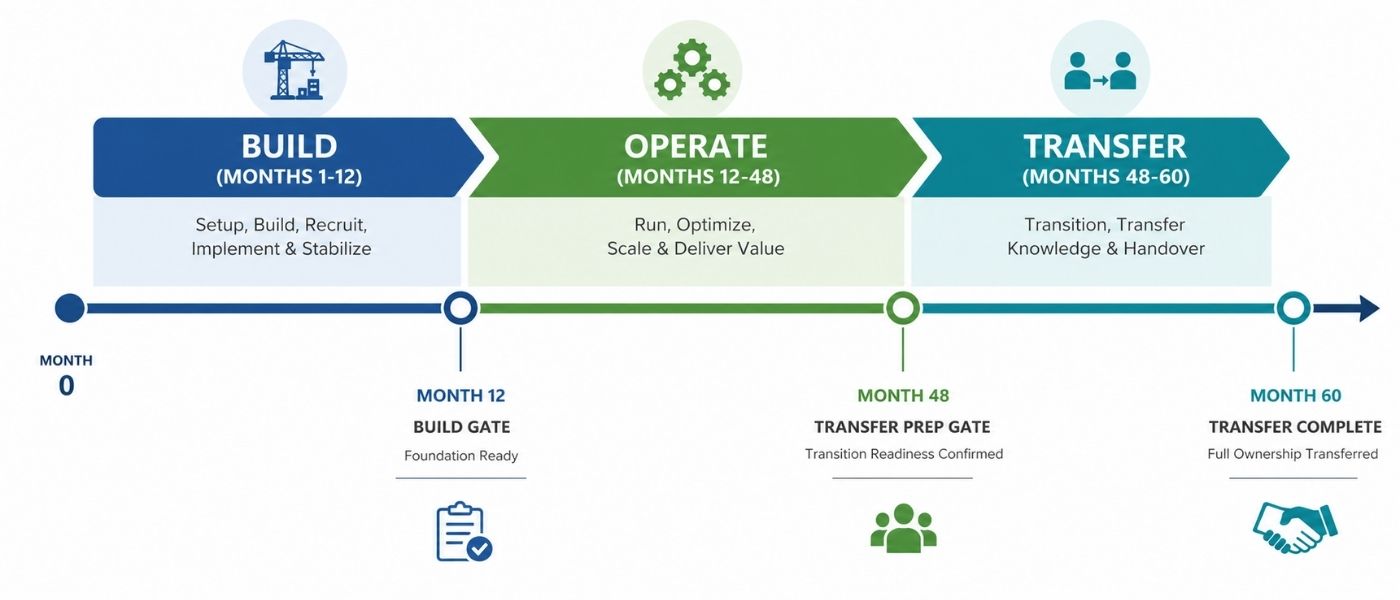
The Three Phases of a BOT IT Engagement: Build, Operate, Transfer
Build Phase: Infrastructure, Talent, and Technical Alignment (Months 1 to 12)
The Build phase is where the operating infrastructure for the future captive team is established. For IT-specific engagements, this goes well beyond office setup. It includes provisioning the development environment in alignment with the parent company’s existing tech stack, configuring version control and CI/CD pipeline access, setting up communication and project management tooling on the client’s preferred platforms, and establishing the security and access control framework that will eventually transfer to the client.
Talent sourcing during the Build phase is the most operationally significant activity. BOT providers source engineers differently from staff augmentation agencies. Rather than matching individual contractors to open specifications, a BOT provider is building a team with a defined organisational structure: typically a technical lead or engineering manager, senior engineers across the relevant stack, mid-level engineers to fill delivery capacity, QA engineers, and at least one DevOps or infrastructure engineer for teams of ten or more.
Bengaluru remains the primary location for product engineering, full-stack development, data engineering, and cloud infrastructure roles. The talent density for these specialisms is higher here than anywhere else in India, and the ecosystem of engineers who have worked with US and UK product companies means culture alignment during the Build phase tends to be faster. Hyderabad has closed the gap significantly over the past five years, particularly for enterprise software, SAP, and BFSI-adjacent technology roles, and offers a marginally lower cost profile for equivalent seniority levels.
Hiring timelines at the Build phase are a function of seniority and specialism. A senior backend engineer with eight or more years of experience in a specific stack, such as Golang or Rust, typically takes six to ten weeks to source, interview, and onboard in Bengaluru. Mid-level engineers across mainstream stacks such as Java, Python, or React take four to six weeks. Engineering managers with direct India market experience take eight to twelve weeks. Any Build phase plan that assumes full team readiness in under three months for a team of fifteen or more engineers is not realistic.
Statutory compliance setup runs in parallel: PF and ESI registration under EPFO, professional tax enrollment, and the establishment of employment contracts that include IP assignment clauses aligned to the parent company’s eventual ownership requirements. Getting this right during the Build phase is what makes the Transfer phase legally clean.
Operate Phase: Governance, Quality, and Transfer-Ready Operations (Months 12 to 48)
The Operate phase is where the BOT model’s differentiation from traditional outsourcing becomes operationally visible. In a traditional IT outsourcing arrangement, the vendor optimises for delivery efficiency within its own frameworks. In a BOT engagement, the Operate phase is governed by a different logic: everything maintained during Operate must be capable of surviving the handover.
This means documentation is not optional. Sprint retrospectives are documented. Architectural decisions are recorded with context, not just outcome. Runbooks are written for every deployment process. Onboarding materials are kept current. Access credentials are managed in a centralised vault that the client can assume control of at Transfer. These are not quality aspirations; they are contractual obligations in a well-structured BOT agreement.
The governance model during the Operate phase typically combines provider-managed HR, payroll, compliance, and facilities with client-directed engineering output. The client’s CTO or VP Engineering runs sprint planning, code review cadence, and technical roadmap. The BOT provider manages performance reviews, statutory filings, leave management, and team welfare. The boundary between these responsibilities must be defined clearly in the BOT contract and reviewed at least quarterly. For guidance on structuring this correctly, the BOT agreement and contract model resource covers the specific clause types that govern Operate phase accountability.
Team culture alignment is the dimension most commonly underinvested during the Operate phase. Engineers who spend eighteen to thirty-six months operating in near-isolation from the parent company’s culture, values, and product context tend to transfer as a technically capable but culturally disconnected team. BOT providers who understand this build in regular parent company exposure: quarterly visits by senior engineering leadership, participation in all-hands meetings, product context briefings, and joint sprint reviews. This is not a nice-to-have; it is the difference between a team that transfers well and one that loses its best engineers within six months of Transfer.
Transfer Phase: What IT Handover Actually Looks Like
The Transfer phase of a BOT IT engagement is not a handshake and a signed agreement. It is a structured program that typically runs for six to twelve months and involves the sequential or simultaneous transfer of six distinct asset categories.
People. Employment contracts for every team member are reviewed, novated, or reissued under the client’s India legal entity or employer-of-record arrangement. For team members on the BOT provider’s payroll, this involves a statutory transfer process that must comply with Indian labour law. Gratuity obligations that have accrued during the Operate phase must be settled correctly. Team members approaching the five-year gratuity threshold need particular attention in Transfer planning.
Intellectual property. Every deliverable produced during the Build and Operate phases must be covered by an IP assignment agreement that names the client as the legal owner. This should have been established during the Build phase, but Transfer is when it is formally documented, audited, and signed off. For teams that produced significant proprietary code, this involves a deliverables inventory that cross-references code repositories against assignment agreements.
Code repositories and version history. This is the most technically complex element of IT Transfer. Migrating repositories is not technically difficult. Migrating them with full version history, branch structures, commit attribution, and integration with the client’s existing CI/CD pipeline requires planning. Repositories should be migrated in a staging environment first, tested against build pipelines, and validated before production migration. The BOT provider’s DevOps lead and the client’s infrastructure team should co-own this process.
Access credentials and system permissions. Every system account, API key, cloud console access, SaaS tool license, and developer environment credential used by the team must be inventoried, transferred to client-owned identity management, and deprovisioned from the provider’s systems. This is where many Transfers run into delays. Providers who have not maintained a centralised access register during the Operate phase may spend weeks reconstructing it during Transfer.
Vendor and tooling accounts. Third-party tool subscriptions, cloud accounts, infrastructure vendor contracts, and SaaS licenses that were procured by the BOT provider for the team’s use must be reviewed, transferred to the client’s billing entities, or renegotiated. This includes development tooling such as JetBrains or GitHub Enterprise licenses, monitoring tools, and any data or API subscriptions used in production.
Physical assets and documentation. Office equipment, server hardware where applicable, and all operational documentation including runbooks, architecture diagrams, process playbooks, onboarding materials, and HR policy documents must be transferred formally. Documentation transfer is typically completed last and is often the area that reveals the most gaps if the Operate phase governance was weak.
Transfer timeline in practice. For a team of twenty engineers, a well-prepared Transfer takes approximately six months from trigger to completion. For a team of fifty engineers, the realistic timeline is eight to twelve months. Teams where the Operate phase governance was strong, documentation was maintained proactively, and access credentials were managed centrally consistently Transfer faster than teams where these disciplines were treated as administrative overhead.
Acceptance criteria and sign-off. Transfer completion should not be measured by the passage of time. It should be measured against a defined acceptance framework: all employment contracts novated, IP assignment agreements executed for every deliverable, code repositories migrated and validated, access credentials transferred and provider access deprovisioned, vendor contracts assigned, and documentation inventory reviewed and signed off by the client’s engineering lead. Only when all criteria are met should the Transfer be declared complete.
From direct engagement experience, the providers who execute the cleanest Transfers are those who start planning the Transfer checklist during the Operate phase, not when the Transfer trigger is reached. The providers who struggle are those who treated documentation and access management as administrative obligations rather than as Transfer preparation activities.
IT Staffing via Build Operate Transfer: Team Composition and Hiring
IT staffing via the build operate transfer model differs from conventional IT recruitment in one significant respect: the BOT provider is not filling seats. It is building an organisational unit designed to function independently once it transfers.
A typical IT team assembled during a BOT Build phase for a product engineering engagement of fifteen to twenty-five people includes an engineering manager or technical lead, two to four senior engineers across the primary stack, six to ten mid-level engineers, two to three QA engineers, and one to two DevOps or platform engineers. For data-intensive products, a data engineer or ML engineer may be added. For customer-facing products, a UX engineer or front-end specialist is typically included.
BOT providers source this team differently from staff augmentation agencies in one critical respect: every hire is assessed not only for technical competence but for career trajectory alignment with the team’s long-term direction. Engineers who are likely to seek contract work or change employers within eighteen months are not suitable BOT hires, regardless of technical capability. The best BOT providers use a combination of direct sourcing, referral networks, and campus relationships to access engineers who are looking for long-term professional development, not short-term billing rates.
City-level hiring specifics matter. For Bengaluru, the strongest talent pools are in product engineering across Java, Python, Node.js, React, Go, and cloud-native stacks on AWS and GCP. The city’s concentration of global product companies creates a lateral hiring market where experienced engineers are accustomed to working in distributed product teams, which shortens the parent company alignment curve. For Hyderabad, enterprise software, SAP, Oracle, and Microsoft stack talent is deeper, and the overall compensation expectations are three to eight percent lower than equivalent Bengaluru profiles for mid-level roles.
BOT Outsourcing Model vs Traditional IT Outsourcing vs Staff Augmentation
The three models serve different purposes and should not be evaluated on cost alone. The editorial framing is accurate: staff augmentation provides temporary capacity without IP accumulation. Traditional outsourcing transfers delivery control to a vendor and creates ongoing dependency. The BOT model creates a bridge from dependency to autonomous ownership through a structured, time-bounded transfer of people, knowledge, and assets.
| Dimension | BOT Outsourcing Model | Traditional IT Outsourcing | Staff Augmentation |
|---|---|---|---|
| IP Ownership | Client owns all IP from day one by contract | IP terms vary; often vendor-retained | IP terms vary; typically contractor-dependent |
| Team Ownership at End | Full team transfers to client | No transfer; engagement ends | No transfer; contractors leave |
| Cost Model | Per-seat plus management fee; phases have distinct cost profiles | Project-based or FTE equivalent | Daily or monthly rate per contractor |
| Engagement Timeline | 3 to 5 years total | Project duration; ongoing renewal | As needed; typically 3 to 24 months |
| Scalability | Planned scale during Build; stable during Operate | Negotiated per contract | Flexible up or down with notice period |
| Control Over Quality and Tech Stack | Client directs technical output; provider manages operations | Vendor governs delivery framework | Client directs individual; no team governance |
| Knowledge Retention | High; documentation and processes transfer with team | Low; knowledge stays with vendor | Low; knowledge leaves with contractor |
| Exit Flexibility | Defined at contract; Transfer is the exit | Termination clause dependent | Notice period; typically 30 to 90 days |
| Best Suited For | Companies building a long-term captive India team | Defined project delivery with clear scope | Filling specific skills gaps short-term |
For companies considering the relationship between the BOT model and GCC setup, the build operate transfer in India and GCC setup guide covers the structural comparison in detail, including which stage of India market maturity each model is appropriate for.

Build Operate Transfer Companies in India: How to Choose the Right Provider
This is an active vendor evaluation question, not a research question. The right provider evaluation framework covers seven criteria.
1. On-ground hiring infrastructure. A BOT provider without a physical recruitment operation in Bengaluru or Hyderabad will rely on third-party agencies to hire the team, which increases time-to-hire, reduces candidate quality control, and creates a chain of accountability that weakens during the Operate phase. Ask providers for their direct headcount in the city where your team will be built.
2. Compliance depth. The BOT provider will be the employer of record during the Build and Operate phases. Their compliance infrastructure, including PF, ESI, professional tax, gratuity management, and labour law compliance, directly affects the legal cleanliness of the Transfer. Ask for a sample employment contract and a description of their statutory compliance process.
3. Transfer execution track record. Most BOT providers can demonstrate a Build phase. Far fewer have executed multiple clean Transfers. Ask specifically for reference clients where the Transfer phase was completed, not just initiated. Ask what the Transfer timeline was, what the acceptance criteria were, and whether any team members left during Transfer.
4. IP assignment architecture. The IP assignment clause in the BOT contract should assign ownership of every deliverable to the client at the point of creation, not at Transfer. A provider who offers IP assignment only at Transfer completion is creating a window of exposure that no client should accept. Review this clause carefully, and see the BOT agreement and contract model for the specific clause language that governs this correctly.
5. Documentation standards during Operate. Ask providers to describe their documentation obligations during the Operate phase. If the answer focuses on delivery reporting rather than runbooks, architectural decision records, and process playbooks, the provider is not operating with Transfer in mind.
6. Team exclusivity. Engineers on a BOT engagement should be dedicated exclusively to the client. A provider who cannot guarantee exclusivity is running a shared delivery model, which creates knowledge fragmentation and makes the Transfer phase significantly more complex.
7. City-level physical presence. A BOT provider with physical offices in the city of engagement has fundamentally better access to talent, compliance infrastructure, and operational oversight than a remote coordination model. iValuePlus operates from physical offices in Gurugram and Bengaluru, which provides on-ground delivery accountability that remote providers cannot replicate.
Red flags to watch for: A provider who cannot name the specific individuals who will manage your Build phase. A provider whose Transfer clause is shorter than their Build phase clause. A provider who describes the Transfer as a straightforward legal process without acknowledging the technical complexity of code repository migration, access credential transfer, and vendor contract assignment. A provider who has no reference clients who have completed a Transfer.
Questions to ask before signing: Who manages our team day-to-day during the Operate phase, and what happens if that person leaves the provider? What are the Transfer trigger conditions, and who decides when Transfer begins? What is the documentation standard for runbooks and architectural records during Operate? How are access credentials managed, and how are they transferred?
For a structured guide to the India BOT setup process, setting up BOT in India covers the regulatory, contractual, and operational steps in sequence.
Cost of the BOT Outsourcing Model for IT Services in India
Per-seat cost data for BOT IT engagements in India varies meaningfully by city, phase, and team seniority. Bengaluru and Hyderabad are the primary delivery cities for product engineering and enterprise technology BOT engagements. Gurugram is the right choice for financial technology, analytics, and enterprise operations functions — and carries a different cost profile that reflects both the talent it attracts and the real estate market it operates within.
How to Think About BOT Costs Before Looking at Numbers
BOT pricing has three layers that need to be understood separately before a total cost comparison makes sense.
The first layer is the engineer’s direct employment cost: salary, statutory contributions (PF, ESI, Professional Tax, gratuity), and benefits. This varies by city, seniority, and specialisation.
The second layer is the provider’s management fee, which covers HR administration, compliance management, facilities, operational governance, and the provider’s margin. This compresses across phases as the team stabilises.
The third layer is one-time program costs for Build phase infrastructure setup and Transfer phase legal and technical execution. These are not monthly costs and should be budgeted separately from the per-seat figures.
Per-Seat Monthly Cost Ranges by City and Phase
| Phase | Bengaluru | Hyderabad | Gurugram | What Is Included |
|---|---|---|---|---|
| Build | $3,800 to $5,200 | $3,400 to $4,700 | $4,000 to $5,400 | Hiring, compliance setup, tooling provisioning, infrastructure, onboarding |
| Operate | $3,200 to $4,600 | $2,900 to $4,200 | $3,400 to $4,800 | Payroll, HR management, statutory compliance, facilities, performance governance |
| Management fee (Build) | 18% to 25% of team cost | 18% to 25% of team cost | 18% to 25% of team cost | Provider operational margin on top of per-seat cost |
| Management fee (Operate) | 12% to 18% of team cost | 12% to 18% of team cost | 12% to 18% of team cost | Reduces as team stabilises |
| Transfer | One-time program cost | One-time program cost | One-time program cost | Legal documentation, contract novation, IP assignment, repository migration |
iValuePlus Case Study: US-Based Technology Services Firm
The situation. A US-based technology services firm decided to establish a delivery presence in India for the first time. The company had no prior experience with Indian regulatory frameworks, labour law, or the practicalities of talent acquisition in the Indian IT market. Internal capacity for an independent India entity setup was limited, and the leadership team was not willing to commit the capital and management bandwidth required to build and operate a captive center from scratch.
The engagement. iValuePlus implemented a full BOT engagement covering every dimension of the India operation. During the Build phase, iValuePlus handled office setup and infrastructure provisioning, statutory compliance registration, and the sourcing and hiring of a skilled engineering team tailored to the client’s technical requirements. The employment structure was designed from the outset with a clean Transfer in mind: IP assignment clauses were embedded in every employment contract, tooling was provisioned on client-owned accounts where possible, and documentation standards were established as a contractual obligation from month one.
During the Operate phase, iValuePlus managed all HR, finance, and administration functions while the client’s technical leadership directed engineering output. Governance cadence included monthly operational reviews with iValuePlus and weekly technical syncs with the parent company engineering team. The Bengaluru office provided on-ground delivery accountability that a remote coordination model could not have replicated.
The outcomes. Indian operations were established and fully functional within six months of engagement commencement. The client achieved a 25 percent reduction in overall operating costs compared to their prior US-only delivery model. Fifteen skilled professionals were hired and onboarded within the first year of operation. The Indian office was generating direct revenue contribution within twelve months of establishment. Stakeholder satisfaction across the client’s internal engineering, HR, and operations teams reached 90 percent positive feedback at the twelve-month review.
iValuePlus’s physical presence in Gurugram and Bengaluru was a material factor in the speed of Build phase execution. On-ground hiring relationships, established compliance infrastructure, and direct facilities management capabilities reduced the time between engagement commencement and team readiness that remote BOT providers consistently cannot match.

Common Mistakes IT Companies Make with the BOT Model
Treating Transfer as a closing formality rather than an ongoing discipline. The single most common failure in BOT engagements is treating the Transfer phase as a discrete event that happens at the end of the engagement. Companies that end up with messy Transfers, delayed handovers, and team attrition during the transfer period are almost always companies where the Operate phase was not managed with Transfer readiness as a governance criterion.
Under-specifying IP assignment in the Build phase contract. Discovering at Transfer that IP assignment language does not clearly cover all deliverables, or that assignment was conditional on Transfer completion rather than point-of-creation, creates legal exposure and can delay the Transfer by months.
Selecting a city on cost rather than talent stack alignment. Choosing Hyderabad because the per-seat cost is marginally lower than Bengaluru is a defensible decision for some tech stacks. Choosing it for a team of senior cloud-native engineers where Bengaluru has demonstrably deeper talent density is a decision that extends Build phase timelines and compromises team quality.
Not investing in parent company culture integration during the Operate phase. Engineers who spend thirty-six months in relative isolation from the parent company’s product context, values, and engineering culture transfer as technically capable but organisationally misaligned. The best BOT engagements run the offshore team as a genuine extension of the parent company from the first month of operations.
Accepting a BOT contract without defined Transfer trigger conditions. If the Transfer trigger is vague, such as “when the parties agree the team is ready,” it creates a situation where the provider has no contractual obligation to execute the Transfer on a defined timeline. Transfer triggers should be specific, measurable, and tied to objective criteria: team headcount, documentation completion percentage, or engagement duration.
BOT Outsourcing Model Checklist for IT Companies
Before signing the BOT contract:
- IP assignment clause covers all deliverables at point of creation, not at Transfer
- Transfer trigger conditions are specific and measurable
- Documentation obligations during Operate are contractually defined
- Team exclusivity is guaranteed in writing
- Management fee structure for all three phases is confirmed in writing
- Transfer program scope and fee are specified separately from Operate phase fees
- Statutory compliance responsibilities are clearly allocated to the BOT provider
- Reference clients with completed Transfers have been contacted and verified
During the Build phase:
- City selection confirmed based on tech stack alignment, not cost alone
- Employment contracts include IP assignment and confidentiality obligations
- Development environment provisioned on client-owned accounts where possible
- Access credential management system established from day one
- Documentation standards defined and included in team onboarding
During the Operate phase:
- Runbooks, architectural decision records, and process playbooks maintained continuously
- Centralised access credential register kept current
- Quarterly Transfer readiness reviews included in governance cadence
- Parent company culture integration activities running from month one
- Any team member departures during Operate trigger an immediate documentation review
During the Transfer phase:
- Employment contract novation completed for every team member
- IP assignment agreements executed and audited against deliverables inventory
- Code repositories migrated in staging environment and validated before production
- Access credentials transferred and provider access deprovisioned and confirmed
- Vendor contracts and tool subscriptions reviewed and assigned to client billing entities
- Documentation inventory reviewed and signed off by client engineering lead
- Formal acceptance criteria documented and signed by both parties
Ready to evaluate the BOT model for your India delivery expansion?
iValuePlus has delivered BOT engagements for technology companies across the US, UK, Australia, and Canada, with on-ground operations in Bengaluru and Gurugram. If you are at the vendor shortlisting stage or planning an RFP, a direct conversation with the iValuePlus team will give you specific cost modelling, city selection analysis, and Transfer timeline planning for your team size and tech stack.
FAQ
How does the BOT outsourcing model work for IT services?
The BOT outsourcing model for IT services works in three phases: a provider builds an offshore IT team on the client’s behalf, operates that team under agreed governance for a defined period, and then transfers full ownership of the team, IP, code repositories, infrastructure, and documentation to the client. The client ends the engagement with a functioning captive team it owns outright.
The Build phase typically runs six to twelve months and covers talent sourcing, infrastructure provisioning, statutory compliance setup, and tech stack alignment. The Operate phase runs eighteen to thirty-six months and covers day-to-day HR, payroll, compliance, and operational governance while the client directs engineering output. The Transfer phase runs six to twelve months and involves the sequential transfer of people, IP, code, access credentials, vendor contracts, and documentation under a formal acceptance framework.
What does IT staffing via build operate transfer involve?
IT staffing via the build operate transfer model involves the BOT provider sourcing, hiring, and onboarding an engineering team specifically composed for the client’s technical requirements, including engineering leads, senior and mid-level developers, QA engineers, and DevOps engineers. Unlike staff augmentation, the provider is building an organisational unit designed for eventual ownership transfer, not filling individual contractor slots. Every hire is assessed for long-term career trajectory alignment, not just current technical competency.
Which tech consultancies are best at handing off BOT teams to clients?
The BOT providers best equipped to execute a clean Transfer are those with a verifiable track record of completed Transfers, not just initiated ones, and those who operate with Transfer readiness as an explicit Operate phase governance discipline. Providers to prioritise are those who can demonstrate: reference clients where Transfer was completed, a defined Transfer acceptance framework used in prior engagements, documentation standards maintained contractually during Operate, and centralised access credential management throughout the engagement. iValuePlus structures all BOT engagements with Transfer readiness as a standing governance criterion from the first month of the Operate phase, which is the single clearest indicator that a Transfer will complete cleanly.
How long does a BOT IT engagement take in India?
A full BOT IT engagement in India typically runs three to five years in total. The Build phase takes six to twelve months, the Operate phase eighteen to thirty-six months, and the Transfer phase six to twelve months. The Transfer timeline depends primarily on team size, documentation quality during Operate, and access credential management discipline. A team of twenty engineers with well-maintained documentation typically completes Transfer in six months. A team of fifty with gaps in Operate phase governance typically takes ten to twelve months.
What does a BOT outsourcing model cost for IT services in India?
Per-seat monthly costs for a BOT IT engagement in India range from $3,800 to $5,200 in Bengaluru and $3,400 to $4,700 in Hyderabad during the Build phase, plus a management fee of 18 to 25 percent of total team cost. During the Operate phase, per-seat costs fall to $3,200 to $4,600 in Bengaluru and $2,900 to $4,200 in Hyderabad, with a management fee of 12 to 18 percent. The Transfer phase involves a one-time program cost of $1,200 to $2,000 per seat rather than a monthly fee. These figures are exclusive of engineer gross salaries, infrastructure deposits, tooling licenses, and Transfer legal fees.
What does the Transfer phase of a BOT engagement actually involve for an IT team?
The Transfer phase involves the formal handover of six asset categories: employment contracts novated to the client, IP assignment agreements executed for all deliverables, code repositories migrated with full version history, access credentials and system permissions transferred and provider access deprovisioned, vendor and tooling accounts assigned to client billing entities, and all operational documentation including runbooks and architectural records reviewed and signed off. Transfer is complete only when all acceptance criteria have been satisfied, not when the Transfer period ends by calendar.
How does the BOT model differ from staff augmentation and traditional IT outsourcing?
Staff augmentation adds individual contractors to an existing workflow without building an organisational unit or accumulating IP in the client’s name. Traditional IT outsourcing transfers delivery control to a vendor for a defined scope, with knowledge and processes retained by the vendor at engagement end. The BOT model builds a complete offshore team with all IP assigned to the client from the point of creation, operates that team under client-directed technical governance, and transfers full ownership of people, IP, infrastructure, and knowledge to the client at the end of the engagement. Only the BOT model ends with the client owning something.
How do I choose the right build operate transfer company in India for IT services?
Evaluate BOT providers in India against seven criteria: on-ground hiring infrastructure in the city of engagement, statutory compliance depth and track record, verified Transfer execution history with reference clients, IP assignment architecture that covers all deliverables at point of creation, documented Operate phase standards for runbooks and architectural records, team exclusivity guarantees, and physical office presence in the delivery city. Eliminate any provider who cannot name reference clients where Transfer was completed, who does not guarantee team exclusivity, or whose Transfer clause is less specific than their Build phase clause.
What should a BOT contract for IT services include?
A BOT contract for IT services must include IP assignment at point of creation for all deliverables, defined Transfer trigger conditions tied to objective criteria, contractual documentation obligations during the Operate phase, team exclusivity guarantees, a separately specified Transfer program scope and fee, statutory compliance responsibilities allocated to the provider, and a formal Transfer acceptance framework with defined sign-off criteria. The BOT agreement and contract model resource covers the specific clause types and negotiation points in detail.
Recent Post
How to Reduce Time-to-Hire Without Lowering Hiring Quality
Companies now compete for the same small pool of skilled...
Scaling Global Capability Centres in India Without Operational Fragmentation
Global capability centres in India have moved far beyond their...

iValuePlus Services
iValuePlus is a one-stop solution to address all your needs to access, build and grow your business in the Indian market which is cost-effective & has a huge talent pool. Established in 2019 as a ‘Business Solution provider', our team has delivered successful growth projects in the international market.
Our services include setting up ODC (offshore development center), Staff Augmentation, Talent Acquisition, Digital Marketing, in the IT/ITES domain.