
Explore Offshore vs in-house teams and compare cost, control, talent...

How Global Companies Use BOT to Build GCCs in India
The Rise of GCCs in India
India is the world’s GCC capital. More than 1,700 Global Capability Centres now operate across Bangalore, Hyderabad, Pune, Chennai, and NCR, employing nearly two million professionals in roles that span software engineering, finance operations, data science, legal services, and R&D. The India GCC market is projected to reach significant scale by 2030, driven by a structural combination that no other market replicates: deep engineering talent, English proficiency, a maturing regulatory environment, and a cost base that allows capability centres to operate at a fraction of equivalent Western costs.
For global companies, the question is no longer whether to establish a GCC in India. It is how — and how quickly — to do so without exposing the business to the considerable operational complexity of Indian market entry.
The Build-Operate-Transfer model has emerged as the dominant answer for companies that want the long-term strategic value of a fully owned India operation, without the risk of navigating the build phase alone.
What Is the BOT Model?
The Build-Operate-Transfer (BOT) model is a structured approach to setting up an offshore capability centre in India. A specialist partner builds the operation (legal entity, infrastructure, initial team), operates it under defined governance and client oversight for an agreed period — typically 18 to 30 months — and then transfers full ownership to the client as a running, staffed, and documented entity.
The term ‘BOT’ describes the structure of the engagement, not just a service offering. At each phase, the division of accountability between client and partner is clearly defined:
• During Build — the partner owns execution. The client owns strategic requirements and approves key decisions.
• During Operate — the partner retains operational accountability. The client increases oversight and embeds leadership progressively.
• At Transfer — the client assumes full legal and operational ownership of a functioning entity, with no ongoing vendor dependency.
This matters because BOT is frequently confused with pure outsourcing — where a vendor runs an operation permanently on your behalf. BOT is explicitly time-bounded. The vendor’s role is to make themselves unnecessary.
What Is a Global Capability Centre (GCC)?
A Global Capability Centre is an offshore unit established by a multinational company to deliver business functions that were previously handled in the home market. The defining characteristic of a GCC — as distinct from a service provider relationship or outsourced vendor — is ownership: the GCC is a fully owned subsidiary of the parent company, staffed by employees on the parent company’s payroll (or a wholly owned entity’s payroll), operating under the parent company’s governance.
GCCs in India span a wide range of functions:
- Software engineering, product development, and platform operations
- Data science, machine learning, and AI research
- Finance, accounting, and shared services
- Legal, compliance, and risk operations
- Customer experience and support operations
- R&D, innovation labs, and design centres
The shift in recent years has been from GCCs as cost-reduction centres to GCCs as capability centres — organisations that contribute genuine innovation, own product decisions, and operate at a strategic level rather than as execution arms. This shift changes what a successful GCC setup looks like: it’s not just headcount and infrastructure, it’s culture, leadership, and process maturity.
Why India for GCCs?
The talent depth is structural, not coincidental
India produces approximately 1.5 million engineering graduates annually. The developer and analyst community is concentrated in cities with mature tech ecosystems — Bangalore alone has a developer population that rivals entire European countries. The depth in AI/ML, cloud architecture, data engineering, and DevOps has grown substantially in the past five years, driven by both domestic demand and the increasing sophistication of work performed by existing GCCs.
The regulatory environment has matured
India’s company registration, employer-of-record frameworks, and SEBI/RBI regulations have become considerably more navigable for foreign companies over the past decade. The introduction of the Digital Personal Data Protection Act (2023, operational 2025) has added compliance requirements for data processing — but has also created a clearer framework than previously existed. Foreign companies with clear compliance structuring face a substantially lower bureaucratic burden than they did a decade ago.
The GCC ecosystem is self-reinforcing
The concentration of GCCs in India has created a self-reinforcing talent market: professionals who have worked in well-run GCCs become the hiring pool for the next generation of GCCs. This means that experienced GCC talent — people who understand how to work across time zones, in a distributed leadership model, and at the intersection of Indian operations and Western strategic direction — is increasingly available. The ecosystem maturity reduces the time required to build a functional operation.
Why Global Companies Use the BOT Model to Build GCCs in India
The case for BOT over self-setup is primarily a case about time and risk, not cost. The following challenges are consistently cited by companies that have attempted GCC self-setup without a BOT framework:
1. Faster Market Entry
Establishing a legal entity in India — whether a wholly owned subsidiary, a liaison office, or a project office — involves regulatory filings, tax registration, labour compliance setup, and real estate procurement. Companies that navigate this independently typically require 12 to 18 months before their first GCC employee starts work. A BOT partner with an existing employer-of-record infrastructure can begin hiring within weeks of engagement start, compressing the timeline by several months.
For companies with competitive pressure to accelerate India operations — responding to a competitor’s GCC setup, meeting a board mandate for cost structure improvement, or scaling a capability that is currently a bottleneck — this timeline difference is strategic, not administrative.
2. Reduced Operational and Compliance Risk
Indian employment law, tax regulation, and data protection requirements are navigable — but they penalise companies that make common first-time mistakes. Misclassifying workers as contractors, failing to register under the Provident Fund and ESI schemes, or handling data subject to the DPDP Act without compliant processing agreements creates legal and financial exposure that is difficult to unwind.
A BOT partner with a track record of India entity setup has encountered and solved these problems previously. The risk is not eliminated — but it is transferred to a party better positioned to manage it.
3. Access to Local Hiring Infrastructure
Building a hiring capability in India from scratch — identifying the right job boards, building employer brand in the relevant talent markets, developing a technical interview process calibrated to the local talent pool, and establishing payroll and benefits structures competitive with local GCCs — takes time and produces suboptimal results for companies doing it for the first time.
BOT partners maintain active hiring pipelines, employer brand in key cities, and benchmarking data on compensation and benefits. The difference in time-to-hire and quality-of-hire between a first-time India employer and an experienced BOT partner is significant.
4. Phased Investment Rather Than Concentrated Upfront Spend
Self-setup requires concentrating significant investment in the pre-operational phase: legal and regulatory costs, real estate, equipment, and the management time of senior leaders who may spend six to twelve months navigating setup challenges before the first productive hire joins. BOT structures spread investment across the engagement lifecycle, with the client taking on more of the operational cost as the team stabilises and demonstrates value.
5. Scalability Without Proportional Management Overhead
Growing a GCC from an initial team to a full operation requires a hiring machine, a management layer, and process infrastructure that scales. BOT partners provide this infrastructure; clients benefit from it without having to build it. Companies that have established GCCs through BOT consistently report that the operate phase delivers team scale that would have taken significantly longer under self-management.
6. Seamless Transition to Full Ownership
The transfer phase is what differentiates a well-structured BOT from an outsourcing relationship that never ends. A proper BOT engagement defines the transfer conditions contractually from day one: the team size, operational maturity, documentation standards, and legal entity status that must be achieved before transfer triggers. The client receives a functioning, owned operation — not a handover package that requires significant investment to make operational.
How the BOT Model Works for GCC Setup
The three phases of a BOT engagement are not sequential in a hard-stop sense — the operate phase begins before the build phase is entirely complete, and transfer preparation should begin in the middle of the operate phase, not at its end. The following breakdown describes the core activities and ownership structure at each stage.
Phase 1: Build
What happens: Legal entity registration or employer-of-record setup, India-specific compliance structuring, office/infrastructure procurement, hiring of first cohort, process documentation, tooling integration, governance framework design.
Ownership: iValuePlus (or BOT partner) leads; client defines requirements and approves key hires.
Deliverable: Operational team of agreed headcount, documented processes, defined KPIs, legal structure in place.
Phase 2: Operate
What happens: Day-to-day operations run by BOT partner under client oversight. Team scaling, performance management, process optimisation, quality assurance, reporting. Client embedding begins — leadership from client side joins or oversees.
Ownership: BOT partner retains operational accountability; client increases involvement progressively.
Deliverable: Stable, scaling team; documented SOPs; performance data; leadership pipeline established.
Phase 3: Transfer
What happens: Legal entity transfer to client ownership (or fresh entity setup), employee TUPE/transfer agreements, IP and systems handover, vendor contract termination, full operational handover with documentation.
Ownership: Client assumes full legal and operational ownership.
Deliverable: Fully client-owned GCC with experienced team, proven processes, and zero operational dependency on vendor.

Benefits of Using the BOT Model for GCCs in India
1. Faster Setup
The compression of the build phase timeline — from 12–18 months of independent setup to weeks of BOT-partner-led onboarding — is the most immediate and measurable benefit. For competitive strategy reasons, this timing advantage often outweighs the cost premium of the BOT structure.
2. Lower Risk During Market Entry
The build phase is where most self-setup GCC attempts accumulate avoidable costs: regulatory mistakes, mis-hires at senior levels, real estate decisions made without local market knowledge, and compliance gaps that require retrospective correction. BOT transfers this risk to a partner whose business model depends on getting it right.
3. Cost Efficiency Through Phased Investment
The total cost of a BOT engagement versus self-setup is not straightforwardly lower — the BOT partner charges for their services. But the comparison is not BOT fees versus no fees: it is BOT fees versus the cost of the delays, errors, and management time that self-setup typically incurs. On this basis, BOT is reliably more cost-effective for first-time India market entrants.
4. Access to Skilled Talent at Speed
BOT partners with active India hiring operations can source and place qualified candidates significantly faster than a first-time India employer building a hiring function from scratch. The partner’s employer brand, existing candidate relationships, and compensation benchmarking data represent a real hiring advantage.
5. Operational Excellence From Day One
A well-structured BOT engagement does not just transfer headcount — it transfers documented processes, governance frameworks, performance management systems, and institutional knowledge. The GCC that the client receives at transfer is operationally mature, not a team that needs to be rebuilt once the vendor exits.
BOT vs. Traditional GCC Self-Setup
Factor | BOT Model | Traditional Self-Setup |
Time to first operational team | Weeks to months | 6–18 months typical |
Upfront legal/compliance burden | Managed by partner | Borne entirely by client |
Local hiring expertise | Built-in (partner network) | Must be built from scratch |
Risk during ramp-up | Shared with partner | 100% client-side |
Control during operate phase | Partial (increases over time) | Full from day one |
Total cost at equivalent scale | Lower (phased investment) | Higher (concentrated upfront) |
IP/ownership at end state | Fully client-owned | Fully client-owned |
Best for | Companies new to India operations or with tight timelines | Companies with India presence or long planning horizons |
Industries Leveraging the BOT Model for GCCs in India
GCC adoption through BOT spans every major industry vertical. The following table shows the primary functions being delivered, and why BOT is particularly suited to each sector’s setup requirements.
Sector | GCC Functions | Why BOT Works Well Here |
IT & Software | Engineering, platform ops, DevOps, QA, data science | Deep talent pool, mature GCC ecosystem, fast hiring pipelines in Bangalore/Hyderabad |
BFSI | Risk analytics, compliance ops, fraud detection, finance shared services | Regulatory complexity in India setup makes BOT partner expertise especially valuable |
Healthcare & Pharma | Clinical data management, R&D support, regulatory affairs, tech development | DPDP Act compliance and specialised hiring make expert-led setup important |
E-commerce & Retail | Customer ops, supply chain analytics, product engineering, data platforms | Rapid scaling requirements suit BOT’s ability to grow teams quickly |
Manufacturing | Engineering design, procurement analytics, IoT/Industry 4.0 dev | Newer GCC vertical; BOT partners with cross-sector experience reduce learning curve |
Legal & Professional Services | Contract review, legal research, paralegal ops, compliance monitoring | Emerging GCC function; BOT reduces risk of establishing novel operation type |
Common Challenges in the BOT Model — And How to Manage Them
Challenge 1: Vendor Selection Is Where Most BOT Engagements Succeed or Fail
The BOT partner you select shapes everything: the quality of your initial hires, the compliance of your legal structure, the governance framework you inherit at transfer, and the culture of the team you own. The selection process should be treated with the same rigour as a major strategic hire — case studies, reference calls with current clients, a detailed review of proposed governance frameworks, and an honest assessment of whether their previous BOT transfers produced the operational maturity they claim.
Specifically ask: How many BOT-to-GCC transfers have you completed? What was the headcount and operational state at transfer? Can we speak with the client’s India operations lead, not just their procurement contact?
Challenge 2: Governance During the Operate Phase
The operate phase is not a period of passive observation. Clients that treat it as ‘the vendor runs it, we wait for transfer’ consistently receive a GCC at transfer that requires significant management investment to stabilise. Effective governance during operate means: a named client-side India operations sponsor who attends regular reviews; monthly KPI reporting covering quality, velocity, attrition, and escalations; periodic on-site visits by client leadership; and progressive embedding of client culture, values, and strategic direction into the GCC team.
Challenge 3: Transfer Planning Starts at Contract Signing
The most common structural mistake in BOT engagements is treating transfer as a phase that begins at the end of operate. By the time transfer is initiated, knowledge transfer, leadership succession, and legal entity preparation should be substantially complete. Define transfer conditions contractually before the engagement starts: what headcount, operational metrics, documentation standards, and legal status must the entity achieve before transfer is triggered? Build a transfer readiness tracker that is reviewed quarterly throughout the operate phase.
Challenge 4: Attrition Management in the Indian Market
India’s competitive talent market means GCC attrition at the team level is a persistent management challenge, particularly in technology roles. BOT partners should have explicit attrition management protocols: competitive compensation benchmarking against local GCC peers, structured career path frameworks, and employer brand investment. If a vendor’s SLAs don’t address attrition management and replacement timelines, negotiate to include them before signing.
Best Practices for Successful BOT Implementation
- Define the end state before starting the build — What does a successful GCC transfer look like — in terms of headcount, functions, operational metrics, team maturity, and leadership structure? Define this in writing before the engagement begins, and build the operate phase governance around closing the gap to that end state.
- Choose the right India location for your function mix — Bangalore and Hyderabad are deepest for technology talent. Chennai is strong for engineering and manufacturing support. Pune has depth in IT and financial services. NCR serves government-adjacent and large-enterprise functions well. Tier-2 cities (Jaipur, Coimbatore, Indore) offer strong talent at lower cost and attrition for specific function types. Location choice affects hiring speed, attrition, and cost — it deserves more strategic attention than it typically receives.
- Establish strong governance from day one, not after problems emerge — Governance means more than a monthly call. Define reporting cadence, escalation paths, KPIs, and who on the client side is accountable for the GCC’s performance. Assign a senior client-side India sponsor with real authority to make decisions — not a committee that meets quarterly.
- Monitor leading indicators, not just outputs — Attrition rate, offer acceptance rate, time-to-fill, onboarding velocity, and sprint velocity are leading indicators of GCC health. Output metrics (features shipped, tickets closed, SLA adherence) tell you what happened. Leading indicators tell you what is about to happen.
- Plan for transfer from day one — contractually — Include transfer conditions, timelines, and obligations in the original contract. Define what happens if transfer conditions are not met by the agreed date. Ensure the partner’s financial incentives are aligned with transfer success, not engagement extension.
How iValuePlus Helps Global Companies Build GCCs Using the BOT Model
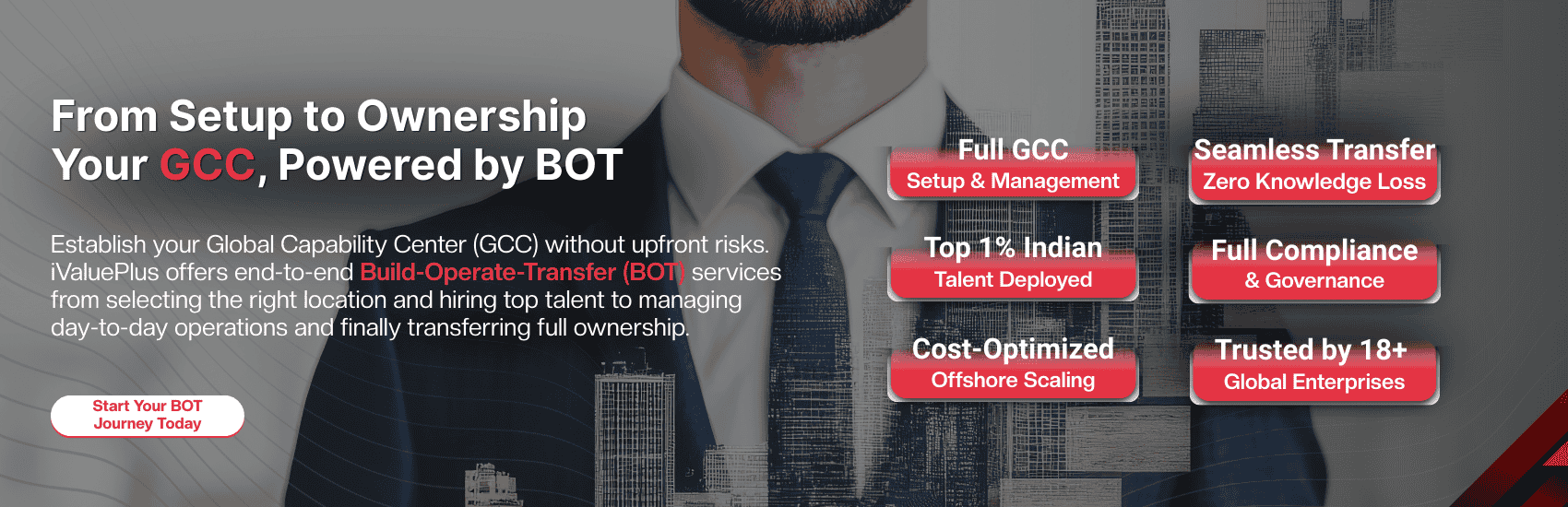
iValuePlus provides end-to-end BOT services for global companies establishing GCCs in India. Our model is built around one objective: delivering a GCC that performs at the end of the transfer phase, not just at the end of the build phase.
What this looks like in practice:
- We handle India legal entity setup, employer-of-record structuring, and regulatory compliance — so clients don’t have to navigate Indian company law, tax registration, and labour compliance independently
- Our hiring network in Bangalore, Hyderabad, Pune, and Chennai provides sourcing speed and quality benchmarking that a first-time India employer cannot replicate
- We design the governance framework during the build phase — not as a retrofit once operate has started — so clients have meaningful oversight from day one
- We embed client culture, values, and strategic direction into the GCC team throughout the operate phase, so the entity transferred is not just staffed but culturally aligned
- Transfer conditions are contractually defined from engagement start, with a quarterly transfer readiness review built into the operate phase governance
Future Trends in the BOT Model and GCCs in India
- AI-driven GCC operations are redefining what ‘capability centre’ means — GCCs that were established to handle rules-based, repeatable processes are increasingly deploying AI tools that automate the work those processes contained. The strategic implication: GCCs are becoming smaller, higher-value, and more engineering-intensive. Companies setting up GCCs in 2026 should design for an AI-augmented workforce from the outset — not retrofit AI into a headcount model designed for manual process.
- Hybrid workforce models are becoming the GCC standard — The pure offshore GCC model — where the entire capability is in India — is giving way to hybrid structures: a small strategic leadership layer in the home market, a larger execution team in India, and specialist expertise accessed through targeted contracts. BOT is well-suited to building the India execution layer in this hybrid model, with client leadership embedded from the operate phase.
- GCCs are expanding beyond IT into professional services — Legal services, financial research, procurement analytics, and HR operations are the fast-growing GCC categories in India. Companies in professional services, legal, and financial sectors that have observed IT companies’ GCC success are now establishing their own. BOT is particularly well-suited to these new entrants, who lack the institutional knowledge of India operations that technology companies have accumulated over decades.
- Data sovereignty and regulatory compliance are increasing setup complexity — India’s DPDP Act, combined with sector-specific regulations in BFSI and healthcare, is adding compliance layers to GCC setup that did not exist five years ago. BOT partners with current compliance expertise are increasingly valuable — not just for speed, but for regulatory correctness in an environment where the rules are actively changing.
FAQ
Q: What is the difference between a BOT model and traditional outsourcing?
The fundamental difference is ownership trajectory. In traditional outsourcing, a vendor delivers a service on your behalf indefinitely — you pay for output, the vendor retains operational control, and the relationship is open-ended. In a BOT engagement, the vendor’s role is explicitly temporary: they build and operate an entity that will be transferred to you as a fully owned operation. BOT ends with the client owning an asset. Outsourcing ends when the contract ends. For GCC establishment, this distinction is critical — BOT is a market entry mechanism, not a permanent service relationship.
Q: How long does a BOT GCC engagement typically take?
The full BOT lifecycle — from engagement start to legal transfer — typically runs 24 to 36 months for a GCC of moderate scale. The build phase (initial team operational) typically completes in three to six months. The operate phase runs for 12 to 24 months, depending on the agreed transfer conditions. Simpler operations with a clear function scope and a client with some India familiarity can complete faster. Heavily regulated industries, large target headcounts, or complex multi-location setups will take longer. Define timeline milestones and transfer conditions in the contract, not as aspirational targets.
Q: Who owns the team and IP during the BOT operate phase?
During the operate phase, the BOT partner typically serves as the employer of record for GCC employees — the team is employed by the partner’s entity, not the client’s. All work product created during the operate phase should be assigned to the client through an explicit IP assignment clause in the engagement contract. At transfer, employment contracts are typically novated to the client’s India entity. The IP assignment clause is non-negotiable — ensure your legal team reviews it before signing, not after.
Q: What should be in a BOT engagement contract?
At minimum: build phase deliverables and timeline (team size, entity status, infrastructure); operate phase KPIs (performance metrics, reporting cadence, attrition SLAs, escalation paths); transfer conditions (the metrics and operational maturity the entity must achieve before transfer is triggered); IP assignment (all work product owned by client from creation); employment transfer provisions (how employees will be transferred to client entity or successor employer); exit and termination provisions (what happens if either party terminates before transfer); and governing law and jurisdiction. Have legal counsel experienced in India cross-border transactions review the contract.
Q: Is the BOT model more expensive than setting up a GCC independently?
Not reliably — and the comparison is more complex than it appears. BOT involves a partner fee that self-setup does not. But self-setup involves costs that are easy to underestimate: legal and regulatory advisory fees, the management time of senior leaders navigating unfamiliar market requirements, extended timelines before the team is productive, and the cost of mistakes in hiring, compliance, or real estate that experienced BOT partners routinely avoid. For most first-time India market entrants, the total cost of a well-structured BOT engagement is comparable to — and often lower than — a self-setup that proceeds at the pace typical of a first-time India employer.
Conclusion
The Build-Operate-Transfer model has become the standard approach to GCC establishment in India for a straightforward reason: it solves the right problem. The challenge for global companies entering the India market is not access to talent — it’s the complexity and risk of building the operational infrastructure to access that talent efficiently and sustainably.
BOT partners provide the local knowledge, hiring infrastructure, regulatory expertise, and operational frameworks that compress the build timeline and reduce the risk of market entry mistakes. The client retains strategic control throughout, and receives full ownership of a functioning, mature operation at transfer.
The GCC that emerges from a well-structured BOT engagement is not a vendor-dependent unit that requires rebuilding once the partner exits. It is a staffed, documented, culturally aligned entity that the client can operate, scale, and direct as a genuine extension of their global capability.
The strategic question for 2026 is not whether to establish a GCC in India. For most global companies operating at scale, that question has been answered. The question is how to do it well — and fast enough to matter.
Start Building Your India GCC
iValuePlus designs and delivers BOT engagements for global companies ready to establish a GCC in India. Tell us your function mix, timeline, and target scale — we’ll outline what a BOT engagement looks like for your specific situation. Get in touch today.
Recent Post
A Smart Guide to Scale Your Business Faster: BOT Model in India
Learn how the BOT Model in India helps businesses scale...
Hire Remote Offshore Developers in India: Cost, Process, and Best Practices
Hire remote offshore developers in India the smart way. Get...

iValuePlus Services
iValuePlus is a one-stop solution to address all your needs to access, build and grow your business in the Indian market which is cost-effective & has a huge talent pool. Established in 2019 as a ‘Business Solution provider', our team has delivered successful growth projects in the international market.
Our services include setting up ODC (offshore development center), Staff Augmentation, Talent Acquisition, Digital Marketing, in the IT/ITES domain.